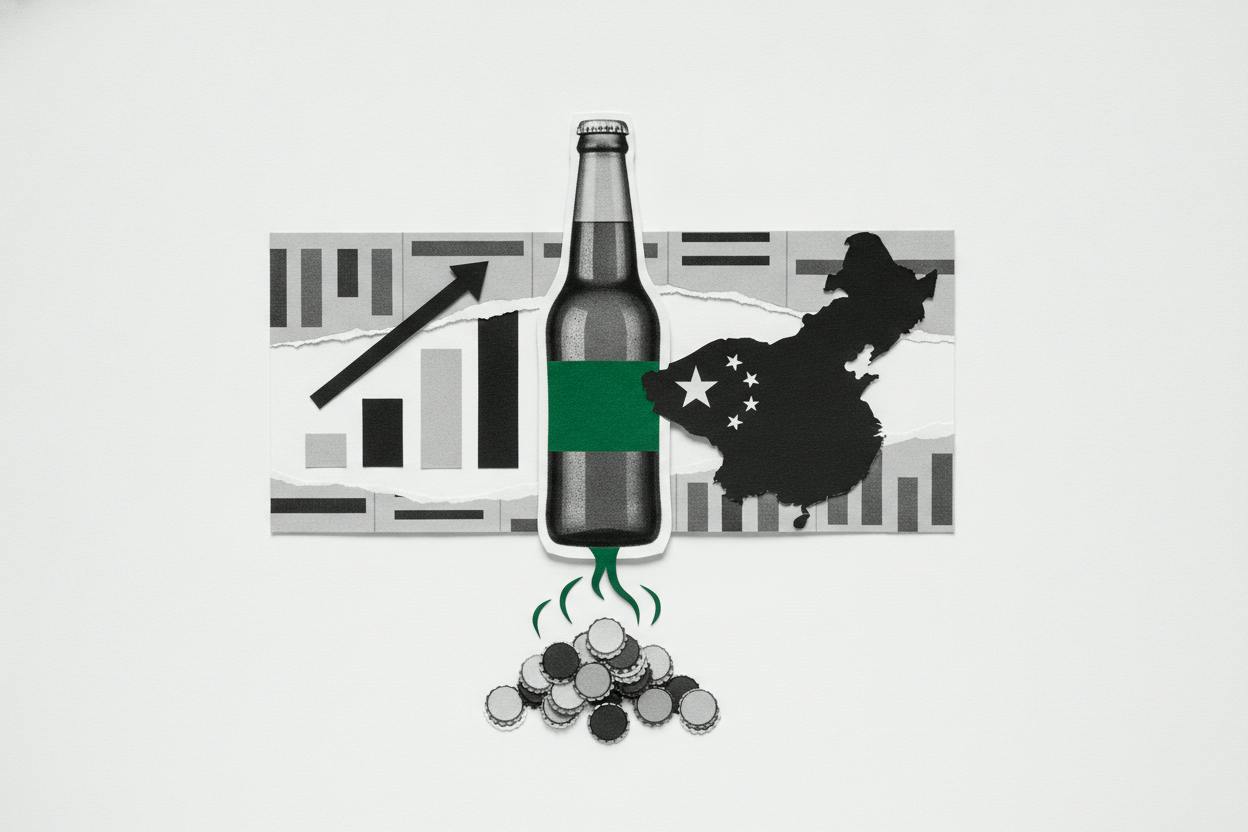
AB InBev, the world's largest brewer, delivered a steady third quarter overall, but a sharp slump in China continued to weigh on results, according to a note from investment bank Berenberg. The bank flagged a 16.8% year-on-year drop in China volumes and a 30.5% decline in EBITDA (earnings before interest, taxes, depreciation, and amortization), a common measure of profitability. Even as emerging-market volumes held up, the China weakness kept the company from building much momentum.
Two-speed business
Berenberg describes AB InBev as a two-speed business: demand is holding up in several emerging markets, while China remains the main drag. Management said China's beer industry declined in the "low teens" percentage range, meaning AB InBev underperformed the market. The underperformance is partly due to where the company sells—its regional mix—and how it sells, including its channel mix.
Another factor is "destocking," a process where the company and its distributors run down inventories after building them up. This can temporarily depress shipments even if consumer demand is steadier. In other words, the reported volume drop may overstate the actual weakness in consumer demand, as some of the decline reflects a one-time inventory correction.
Positives and challenges
AB InBev noted some positives, such as better at-home share and double-digit growth in online-to-offline sales (where customers order online and pick up in store). However, these channels tend to be lower-margin than bars and restaurants, so they don't fully offset the profitability hit from the China slowdown.
Management expects a better fourth quarter and believes the inventory reset will be largely complete by 2027. That outlook is why Berenberg left its 2026 forecasts roughly unchanged but raised earnings per share estimates by 3.5% for 2027 and 5.9% for 2028.
What it means for investors
Berenberg kept its €89 price target even after the earnings upgrade. When a broker raises earnings forecasts but doesn't raise its price target, it's implicitly saying it's willing to pay a lower valuation for each euro of future profit. Put simply: higher projected earnings, same €89 target, means the stock's expected price-to-earnings multiple is lower in Berenberg's model.
That framing can cap near-term "re-rating" hopes, where investors decide to value the company more richly. Instead, performance may hinge more on execution: whether AB InBev turns a post-destocking recovery, especially in China, into the higher 2027-28 earnings path Berenberg now expects.
For everyday investors, this highlights the importance of looking beyond headline numbers. A company can report steady overall results while facing significant regional challenges. The China drag is a reminder that global companies are exposed to local economic cycles, and that inventory adjustments can distort short-term figures.
Investors will likely watch for signs that China volumes are stabilizing, as well as any updates on the pace of the inventory reset. The company's ability to grow in emerging markets outside China will also be a key factor in whether it can meet the higher earnings expectations for 2027 and 2028.
As always, past performance is not a guarantee of future results, and individual investors should consider their own financial situation and risk tolerance before making any decisions.