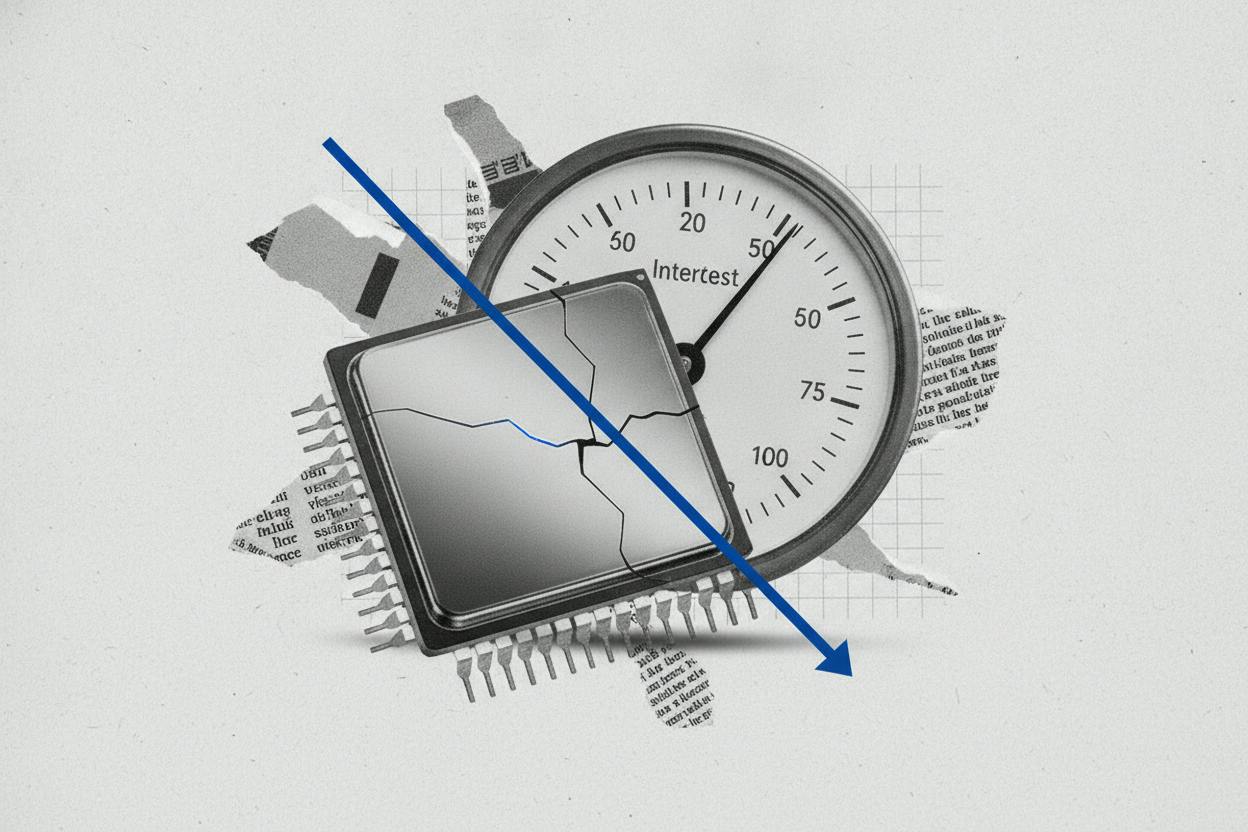
The market's AI-led rally hit a speed bump at midday Tuesday, with tech giants sliding while investors shifted into defensive stocks. The Nasdaq Composite fell 1.4%, while the Dow Jones Industrial Average climbed, a split that often signals traders are dialing back risk.
AI-linked names took the biggest hit. Nvidia dropped 6.8%, Anthropic fell 8.6%, and the VanEck Semiconductor ETF sank 7%. The moves come after a long stretch where AI optimism had powered much of the market's gains.
Why rates are driving the sell-off
The main culprit was interest rates. New York Fed President John Williams said policymakers may still need to act to get inflation back to 2%. That comment, along with other signals, led traders to boost bets on another rate hike.
According to the CME FedWatch tool, markets now see a 97% chance of a quarter-point hike in December. The two-year Treasury yield, which is sensitive to Fed policy expectations, hovered around 4.68%.
Higher expected rates raise the "risk-free" return investors can get in cash-like assets like Treasury bills. That makes far-off profits less valuable today, because future earnings are discounted at a higher rate. This hits growth stocks hardest, since their valuations rely heavily on earnings expected years down the road.
Tariff worries add to the pressure
Adding to the uncertainty, The Wall Street Journal reported that the US is preparing tariff increases on China and other countries. Even the possibility of higher trade costs can create uncertainty for supply chains, which can weigh most on the parts of the market that investors already see as pricey.
Tariffs could raise costs for companies that rely on global manufacturing, and they might also slow global trade. For tech firms with complex supply chains, that's an extra layer of risk on top of rate concerns.
What it means for investors
When traders price in more Fed tightening, the biggest shift isn't just higher borrowing costs. It's the discount rate used to value future earnings. Many AI and semiconductor leaders are valued on profits expected years from now. Raise the discount rate, and those distant cash flows get marked down more than the near-term earnings investors look for in defensive sectors.
The result: more pressure on valuations, and bigger day-to-day swings, in rate-sensitive pockets like Nvidia and funds such as the $66.44 billion VanEck Semiconductor ETF. Defensive sectors—like utilities, consumer staples, and healthcare—tend to hold up better because their earnings are more predictable and closer in time.
For everyday investors, this rotation is a reminder that the AI trade isn't a one-way bet. Even the most exciting technologies can see sharp pullbacks when the macro backdrop shifts. It's also a sign that diversification matters: having some exposure to defensive sectors can cushion the blow when growth stocks stumble.
As always, it's important to keep a long-term perspective. Rate moves and tariff headlines can cause short-term volatility, but they don't change the underlying fundamentals of most companies. Investors should focus on their own goals and risk tolerance rather than trying to time the market.
Related coverage: Nvidia's recent drop and tariff worries have been a theme this week. Also see how tech stocks slipped as Anthropic fell below its IPO price and how the dollar slipped as the AI rally faded.