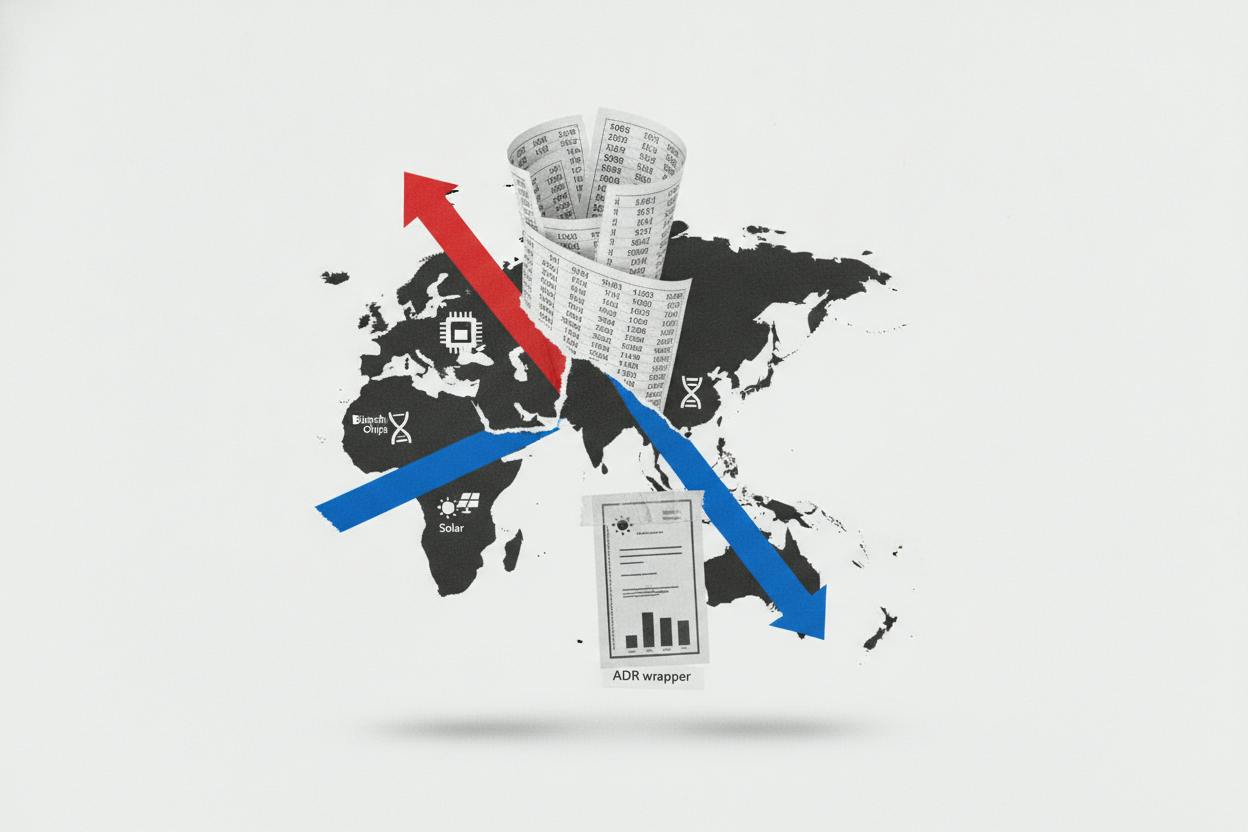
US-listed shares of Asian companies kicked off the week on a positive note, with the S&P Asia 50 ADR Index rising 1.58% to 2,893.83 in Monday morning trading. The advance was led by biotech and semiconductor names, while clean-energy stocks pulled in the opposite direction.
American depositary receipts, or ADRs, are US-traded certificates that represent shares of foreign companies. They allow US investors to buy and sell overseas stocks during regular US market hours, making them a convenient way to gain exposure to Asian markets without navigating foreign exchanges or currency conversions.
Because ADRs trade in the US, they often act as an early barometer for how Asian stocks might perform when their home markets open later in the day. Monday's move suggests a risk-on mood among global investors, with money flowing into faster-growing sectors like biotech and semiconductors.
Who led and who lagged
Zai Lab, a biopharmaceutical company focused on innovative medicines, jumped 7.1% in early US trading. ASE Technology, a major semiconductor packaging and testing firm, rose 8.4%. Both are among the larger Asian ADRs and are often seen as proxies for their respective sectors.
On the other side of the ledger, solar energy names fell sharply. JinkoSolar, a leading solar panel manufacturer, dropped 5.6%, while Daqo New Energy, a polysilicon supplier, slid 6.6%. The divergence highlights a clear rotation: investors favored growth-oriented tech and biotech plays while shunning clean-energy stocks.
The pattern is not unusual. When global risk appetite strengthens, money tends to move into sectors with higher growth potential, while more cyclical or policy-sensitive areas like solar can lag. The solar industry has also faced headwinds from oversupply and pricing pressure in recent quarters, though Monday's move may simply reflect a broader sector rotation.
Why ADR moves matter
Many Asian companies are cross-listed, meaning they trade both on their home exchanges and as ADRs in the US. When the ADR price moves away from the underlying share price, arbitrageurs—traders who exploit price differences—can step in. They might buy the cheaper version and sell the more expensive one, which helps push the two prices back into alignment.
This mechanism means that a big ADR move can spill over into the local session. If an ADR closes significantly above or below the implied home-market price, the gap often narrows when the underlying shares begin trading in Asia. So Monday's 1.58% jump in the ADR index could translate into similar gains for the underlying stocks when markets in Tokyo, Seoul, Shanghai, and Taipei open.
For US-based investors with exposure to Asian equities, the ADR screen is more than just a daily scoreboard. It offers a real-time read on how global investors are pricing Asian risk, and which sectors are attracting capital.
What it means for investors
The Monday move suggests that global investors are willing to take on more risk, at least in the short term. Biotech and semiconductor stocks are often seen as higher-beta plays—they tend to rise more than the broader market in good times and fall more in bad times. Their leadership on Monday points to a constructive risk appetite.
However, the sharp drop in solar names is a reminder that sector rotation can be swift. Investors who hold ADRs should pay attention to the divergence, as it may signal changing sentiment toward clean energy or a simple rebalancing of portfolios.
It's also worth noting that ADR moves can be amplified by currency fluctuations and US market conditions. A strong US dollar can make foreign shares more expensive in dollar terms, while a weak dollar can boost ADR prices. Monday's gains came without any major macroeconomic news, suggesting the move was driven more by technical factors and sector flows than by fresh fundamentals.
For those watching Asia from the US, the key takeaway is that ADRs provide a useful window into global risk appetite. The fact that growth sectors led while solar lagged could be a sign that investors are rotating back into technology and innovation plays, a theme that has been prominent in recent months. As always, it's important to consider the broader context—such as interest rates, earnings, and geopolitical developments—before drawing conclusions from a single day's trading.
Related coverage: AI stocks stumble as crowded trades bite and South Korean stocks fall on Nvidia probe worries.