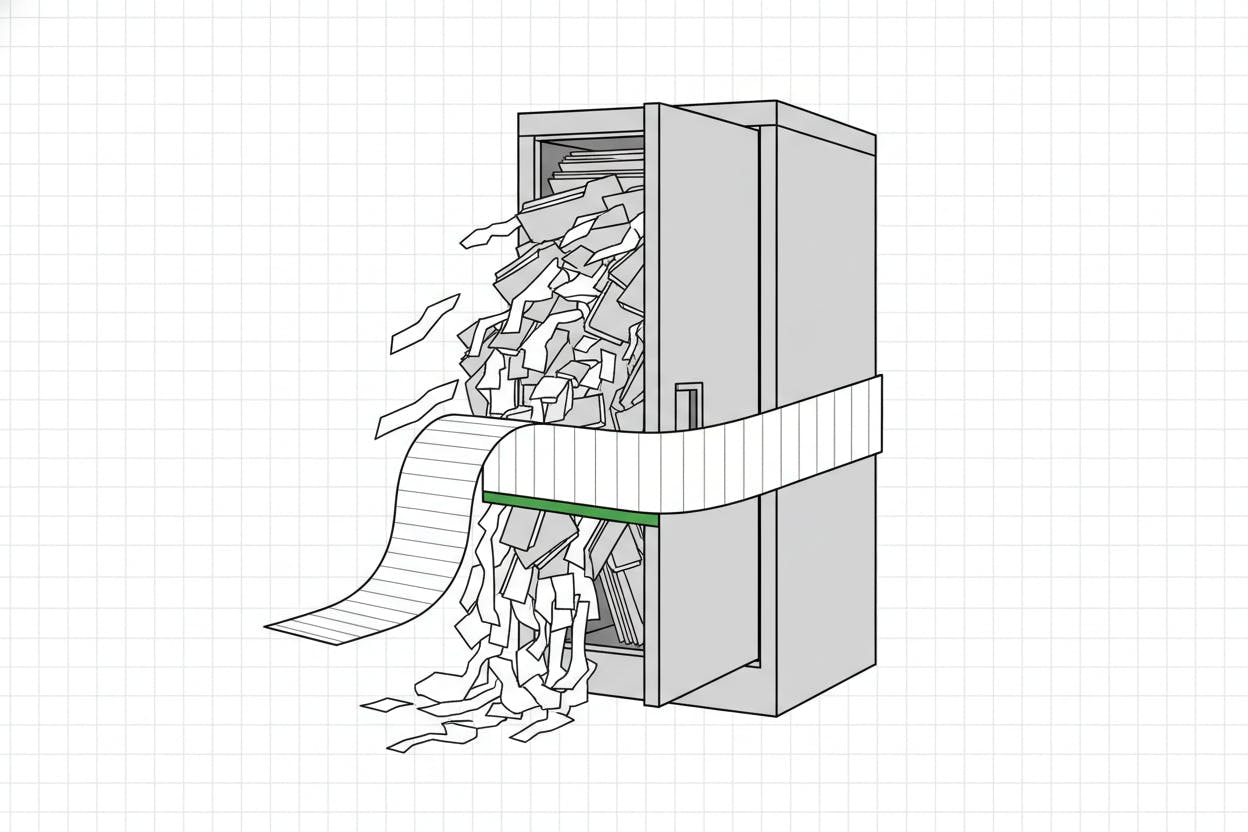
Some of the biggest corporate buyers of artificial intelligence are drawing a line in the sand: if OpenAI and Anthropic want to keep their business, they need to promise not to hold onto the data those companies feed into their models. Palantir, Nvidia, and Booz Allen are pushing for tougher "zero-retention" guarantees, according to a report from The Information.
The dispute is about what happens to the prompts, files, and logs that companies send into frontier AI models. For firms handling intellectual property, cybersecurity details, or other sensitive information, the question of who can see that data—and for how long—has become a deal-breaker.
What is zero data retention?
Zero data retention means an AI provider does not store the inputs (prompts) or outputs (responses) after the interaction is complete. In theory, this protects a company's confidential information from being accessed later, whether by the AI lab's employees, other customers, or even used to train future models.
But the practice is not always absolute. According to The Information, Anthropic recently faced pushback after a policy change that allowed it to keep certain usage logs for 30 days to help investigate sophisticated attacks. OpenAI, meanwhile, has faced scrutiny over whether user data was used in training for a specific test case. Both companies have denied wrongdoing, but the incidents have heightened concerns among enterprise clients.
For companies like Palantir, Nvidia, and Booz Allen—which work in defense, intelligence, and critical infrastructure—the stakes are especially high. A single leak of proprietary code or a client's sensitive data could have serious consequences.
Microsoft's pitch: isolated cloud setups
Microsoft is trying to capitalize on these concerns by pitching isolated cloud environments. In such setups, a customer's AI workloads run in a dedicated, segregated portion of the cloud, with strict controls on data access and retention. This approach is designed to give cautious clients more assurance that their data won't be mixed with others or retained longer than necessary.
Microsoft's move is part of a broader competition among cloud providers and AI labs to win over enterprise customers, who are increasingly wary of sending sensitive data to third-party AI systems. The company is betting that its Azure cloud, combined with its partnership with OpenAI, can offer a middle ground: the power of frontier models without the data worries.
What it means for investors
For everyday investors, this dispute is a reminder that AI's commercial success depends not just on model capability, but on trust. If enterprises cannot be confident that their data is safe, they will be slower to adopt AI in critical areas—which could slow revenue growth for AI labs and their cloud partners.
Nvidia's involvement is notable. The chipmaker has been weighing a $10 billion anchor stake in Anthropic's potential IPO, according to reports. That would give Nvidia a direct financial interest in Anthropic's ability to win enterprise clients. If data retention concerns hurt Anthropic's growth, it could affect Nvidia's investment thesis.
For Palantir, which sells data analytics software to government and defense agencies, the push for stricter guarantees aligns with its own business model. Palantir's customers are often the most security-conscious organizations in the world, and the company has built its reputation on handling sensitive data. By demanding zero retention from AI labs, Palantir is signaling that its own products must meet the same standard.
Booz Allen, a major government contractor, similarly works with classified and sensitive information. Its clients are unlikely to use AI models that retain data, so the company has a strong incentive to ensure its AI partners comply.
The bigger picture
The tension between AI labs and their enterprise customers is likely to grow as AI becomes more embedded in business operations. While consumer users may not care whether their chat history is stored, corporate clients have different expectations. This could lead to more customized contracts, with different retention policies for different types of customers.
It could also push AI labs to develop new technologies, such as on-device processing or federated learning, that reduce the need to send data to the cloud in the first place. But for now, the immediate battle is over contract terms.
For investors, the key takeaway is to watch how AI companies handle these negotiations. A company that can offer strong data protections may gain a competitive edge in the enterprise market, while one that stumbles could lose valuable contracts. The outcome of this dispute will shape the AI industry's growth trajectory—and the fortunes of the companies involved.