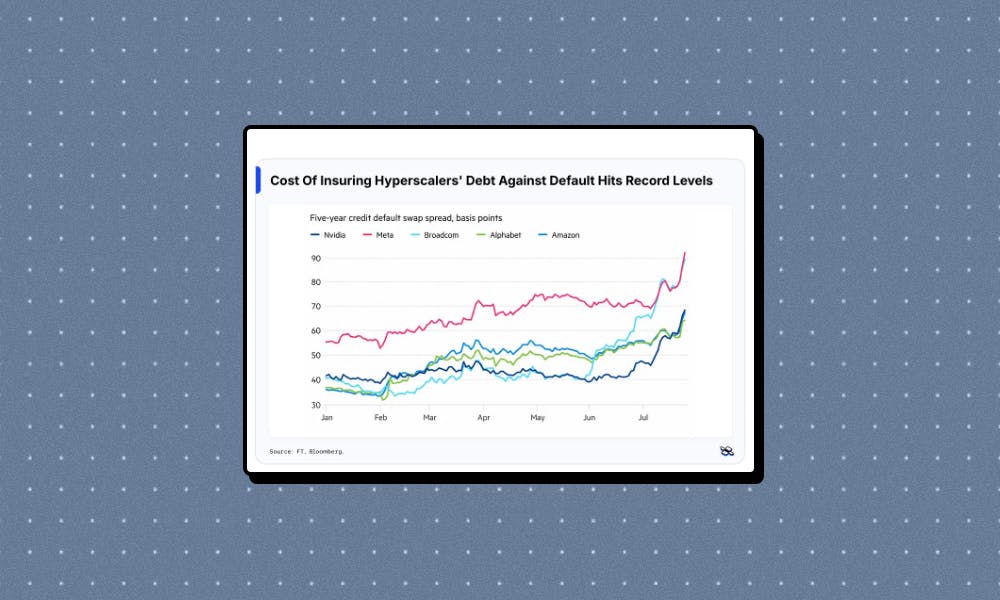
Big Tech companies are spending hundreds of billions of dollars on artificial intelligence infrastructure, but the bond market is growing increasingly uneasy about when those investments will pay off. Credit investors are demanding more protection against the risk of default, pushing the cost of credit default swaps (CDS) to record highs for several major tech firms.
A credit default swap is essentially insurance against a company failing to pay its debts. When the cost of these swaps rises, it signals that investors see a higher chance of default. For Big Tech, which has long been considered a safe bet, this shift marks a notable change in sentiment.
Who is spending what
Companies including Oracle, Nvidia, Alphabet, Amazon and Meta are leading the charge, collectively pouring hundreds of billions into data centers, chips and other AI infrastructure. The spending is driven by the belief that AI will transform industries and generate enormous returns. But the timeline for those returns remains unclear, and bond investors are starting to ask hard questions.
Oracle is the clearest example of the trend. After announcing plans to spend $70 billion on data centers over the next year, the company's credit rating was cut to just one notch above junk status. At the same time, the cost of insuring Oracle's debt has surged, reflecting growing concern about its ability to service that debt if AI revenues take longer to materialize.
This is not just an Oracle problem. Across the tech sector, the cost of credit default swaps has risen as investors reassess the risks tied to massive capital expenditure programs. Even companies with strong balance sheets are feeling the pressure.
Why bond investors are worried
Bond investors tend to be more cautious than equity investors. They care less about upside potential and more about getting their money back with interest. When a company borrows heavily to fund speculative projects, bondholders worry that the debt could become harder to repay if the projects don't generate cash quickly.
In the case of AI, the returns are uncertain. While companies like Nvidia are already seeing huge revenue from AI chips, the broader payoff for cloud providers and software firms may take years. That gap between spending and revenue is what makes credit markets nervous.
Earlier this year, Fitch warned that the AI boom could become a credit risk for markets and the broader economy. The rating agency noted that the scale of investment, combined with uncertain returns, could lead to downgrades and higher borrowing costs for tech companies. That warning now appears prescient.
What it means for investors
For everyday investors, the bond market's unease is a signal worth watching. If credit conditions tighten for Big Tech, it could affect stock prices, especially for companies that are borrowing heavily to fund AI expansion. Higher debt costs eat into profits, and rating downgrades can trigger forced selling by institutional investors who are required to hold only investment-grade bonds.
It also means that the era of cheap debt for tech giants may be ending. As bond investors demand higher yields to compensate for risk, the cost of funding AI projects will rise. That could slow the pace of investment or force companies to prioritize projects with clearer near-term returns.
Investors should also keep an eye on the broader market. The tech sector has been a major driver of stock market gains in recent years, and any sign of strain in the credit markets could spill over into equities. The recent decline in Asian chip stocks amid AI funding fears shows how quickly sentiment can shift.
What to watch next
The key question is whether AI spending will translate into revenue growth fast enough to reassure bond investors. Earnings reports from the major tech companies will be closely watched for signs that AI investments are paying off. Any disappointment could accelerate the sell-off in credit markets.
Also worth watching is the response from rating agencies. If more companies face downgrades, the cost of borrowing could rise further, creating a feedback loop that pressures both bonds and stocks.
For now, the bond market is sending a clear message: even the biggest spenders need to show results. Investors who ignore that signal do so at their own risk.