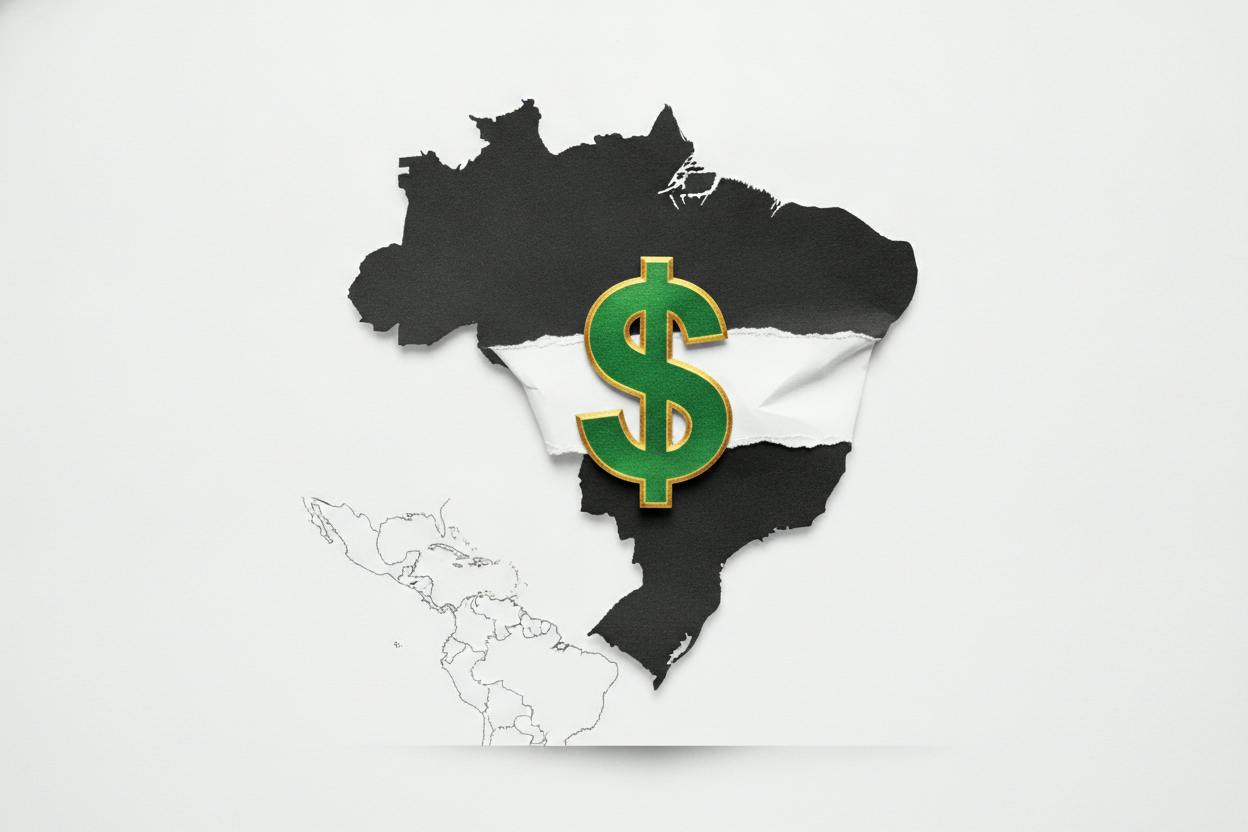
A closely watched gauge of Brazilian economic activity slipped in September, triggering a sharp selloff in Latin American markets as the US dollar continued its climb. Brazil's central bank reported that its IBC-Br activity index — a monthly proxy for gross domestic product — fell 0.2% on a seasonally adjusted basis compared with August. On a quarterly basis, activity was down 0.9% from the prior three-month period, according to Reuters.
The reaction was swift. Brazil's currency, the real, dropped 1.94% to 5.7769 per dollar, its weakest level in nearly 19 months. The Bovespa stock index fell 2.11% to a one-week low. The pain spread across the region: MSCI's Latin American equities index lost 2.84%, while its regional currencies gauge declined 1.38%.
Why a small miss moved markets
The IBC-Br is not an official GDP report, but it is published monthly and is widely treated as a timely temperature check on Brazil's economy. A reading below expectations signals that growth momentum may be fading — and that matters enormously for how investors price Brazilian assets.
When growth looks softer, markets typically begin to anticipate that the central bank will lower its benchmark interest rate sooner or more aggressively than previously thought. Brazil has long offered some of the world's highest real interest rates, which is a key reason international investors hold reais: the so-called carry trade, where investors borrow in a low-yielding currency and invest in a higher-yielding one to pocket the difference.
If Brazil's rate advantage over the US looks set to narrow, those carry positions become less attractive and can unwind quickly. That dynamic was amplified by the dollar hitting its strongest level since April 2025. A rising dollar tends to pull capital away from emerging markets, and it also makes dollar-denominated debt more expensive for companies and governments in those countries to service.
Fiscal concerns add to the mix
The weak activity data landed against a backdrop of persistent investor anxiety about Brazil's fiscal outlook under President Luiz Inácio Lula da Silva's government. Markets have been sensitive to signs that government spending could rise faster than revenue, which would complicate the central bank's job of bringing inflation down.
That combination — slowing growth, fiscal uncertainty and a strong dollar — creates a difficult environment for Brazilian assets. It also explains why the selloff spread beyond Brazil's borders. Latin American markets often trade as a bloc when global risk appetite shifts, and a weaker real can drag on sentiment toward neighboring currencies and equities even when their own economic data looks steadier.
For context, this is not the first time Brazil's growth gauge has disappointed. The country's economy has been navigating a tricky path: inflation has eased from its peaks, allowing the central bank to begin cutting rates, but the pace of those cuts depends heavily on whether growth holds up and whether fiscal policy stays credible. Each soft data point feeds into that calculus.
What it means for investors
For everyday investors, this story is a reminder of how interconnected global markets have become — and how quickly currency moves can ripple through portfolios.
- Emerging-market exposure: If you hold emerging-market funds or ETFs, Brazil is often one of the largest components. A weaker real and falling Bovespa can weigh on returns, especially for US-dollar-based investors who also lose on the currency conversion.
- Currency risk is real: The real's slide shows how fast a currency can move on a single data release. For investors, that is a reminder that international investments carry two sources of return — the asset itself and the currency it is denominated in.
- Rate expectations drive flows: Brazil's high rates have attracted yield-seeking capital for years. If the market starts pricing steeper rate cuts, some of that money may head elsewhere, putting further pressure on the real.
- Dollar strength matters: A broadly stronger dollar is a headwind for most emerging markets. Investors with significant international exposure may want to understand how much of their portfolio is sensitive to dollar moves.
Looking ahead, investors will watch several things: whether upcoming Brazilian data confirms the slowdown or shows September was a blip; how the central bank signals its next rate move; and whether the government takes steps to reassure markets on the fiscal front. Any of these could shift the trajectory of the real and Latin American assets more broadly.
For now, the message from markets is clear: in an environment of dollar strength and fiscal uncertainty, even a modest miss on economic activity can have outsized consequences.



