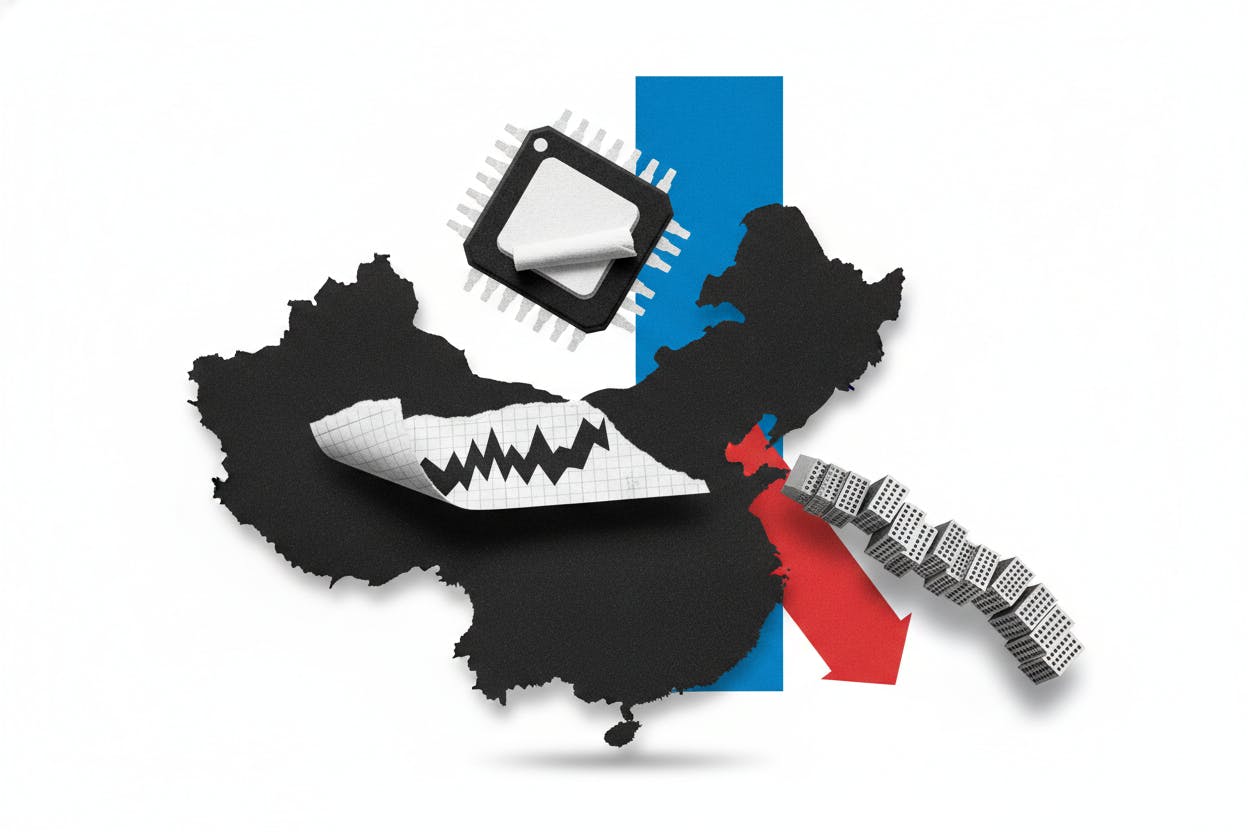
Chinese stocks took diverging paths on Wednesday, with mainland A-shares climbing on a wave of artificial intelligence and semiconductor enthusiasm, while Hong Kong shares slipped as tech heavyweight Tencent tumbled nearly 6%.
The CSI 300, which tracks the largest stocks on China's Shanghai and Shenzhen exchanges, rose 0.7%. The STAR 50 index, home to many of China's tech and chip companies, gained 1.5%. Semiconductor shares were the standout, jumping 3.4% as investors piled into the AI hardware trade.
In Hong Kong, the Hang Seng Index fell 0.8%, and the tech-heavy Hang Seng Tech Index dropped 2.1%. Tencent, one of the city's most valuable listed companies, led the decline with a near-6% slide.
What's Driving the Split?
The divergence reflects a broader shift in investor focus. On the mainland, the rally was concentrated in AI-related stocks, particularly semiconductor firms that supply chips for AI computing. This mirrors a global trend where investors are betting on companies that provide the hardware and infrastructure for artificial intelligence.
Hong Kong's decline, meanwhile, was tied to weakness in Tencent, which has a heavy weighting in the Hang Seng. The company's drop dragged down the broader index, even as other sectors held relatively steady.
One factor supporting mainland stocks is a potential easing in the deleveraging cycle. UBS, a global investment bank, noted that the rapid decline in margin financing—borrowed money used to buy stocks—suggests the A-share deleveraging process may be mostly over. When margin balances shrink, it means fewer investors are sitting on fragile, leveraged positions that could trigger forced selling. That can reduce downside risk and make the market more stable.
What It Means for Investors
For everyday investors, the split between mainland and Hong Kong markets highlights how different factors can drive returns in China's two major stock markets. Mainland A-shares are more influenced by domestic retail investors and policy moves, while Hong Kong is more exposed to global capital flows and big tech names.
The AI and semiconductor rally in Shanghai and Shenzhen shows that thematic investing is alive and well in China. Investors are betting that companies like chipmakers will benefit from the country's push to develop its own AI capabilities, especially as US export controls limit access to advanced semiconductors. This has fueled interest in stocks on the STAR Market, which was launched in 2019 to host innovative tech firms. For example, China's CXMT raised $8 billion in a mega IPO on the STAR Market, underscoring the demand for chip-related listings.
However, the Tencent slide in Hong Kong is a reminder that even the biggest names can face sudden pressure. Tencent is a bellwether for China's internet sector, and its moves can sway the entire market. Investors should watch for any company-specific news or regulatory developments that might explain the drop.
The broader context is that China tech firms have raised $27.5 billion in Hong Kong this year, led by AI and chip companies, showing strong demand for tech listings. But the market remains sensitive to sentiment shifts.
Looking Ahead
Investors will be watching to see if the AI trade can sustain momentum in mainland markets, or if profit-taking sets in after the recent gains. The semiconductor sector, in particular, is known for volatility, and a pullback could weigh on the broader CSI 300.
In Hong Kong, the focus will be on whether Tencent can recover and whether other tech stocks can offset its weakness. The Hang Seng's performance often hinges on a handful of large-cap names, so diversification across sectors is important for investors with exposure to the region.
For now, the message from Wednesday's trading is clear: China's markets are not moving in lockstep. Mainland A-shares are riding an AI wave, while Hong Kong is grappling with headwinds from its tech giants. Investors should pay attention to the specific drivers in each market rather than treating China as a single story.



