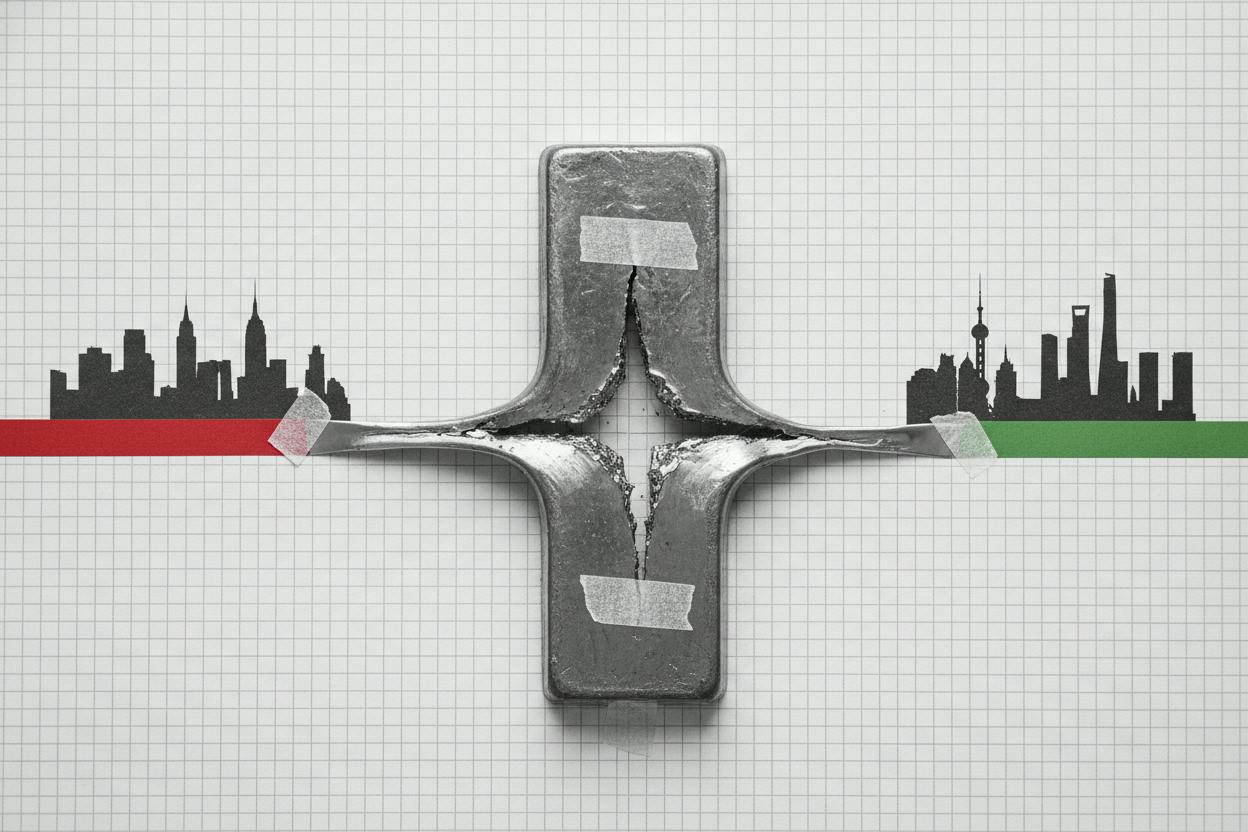
Copper, long considered a single global commodity with one international price, is increasingly trading like two separate markets. Tariff risk in the United States has pushed New York's COMEX copper prices above London's LME benchmark, while Shanghai's ShFE contract is being treated as the on-the-ground price for China, the world's biggest copper consumer. The result: copper now has a "US duty-paid" price and a "China price," with London's LME looking less like the single reference point it once was.
Why the split is happening
The divergence is being driven by policy and supply-demand conditions that are moving in different directions on either side of the Pacific. In the US, the threat of tariffs on imported copper has made domestic metal more valuable, pushing COMEX prices above the LME. That premium has encouraged traders and producers to ship metal into the US, where they can lock in higher prices.
According to industry sources cited by Reuters, more than 700,000 tons of copper are now sitting in COMEX-registered warehouses, a sign of how much metal has been redirected toward the US market. This build-up is a direct response to the price gap, as companies rush to take advantage of the arbitrage opportunity.
Meanwhile, in China, the ShFE contract is increasingly seen as the more accurate reflection of local supply and demand. China's property sector has been weak, and its manufacturing recovery has been uneven, so the on-the-ground price there tells a different story than the tariff-inflated US price.
What this means for the copper market
At LME Week, the industry's annual gathering in London, Jin Hennig, CME Group's global head of metals, told Reuters that copper pricing is getting more regional as policy and supply-demand conditions diverge. That's a notable shift for a market that has historically been unified around a single global benchmark.
For everyday investors, this split matters because it changes how copper prices are quoted and traded. If you're tracking copper as an economic indicator, you now have to ask which price you're looking at. The US price may be distorted by tariff expectations, while the China price may be more reflective of actual industrial demand.
The regionalization also affects companies that produce or use copper. Miners with operations in the Americas may benefit from higher US prices, while those focused on Asia may see weaker margins. Manufacturers that rely on copper as an input could face different cost pressures depending on where they source their metal.
What it means for investors
For investors, the key takeaway is that copper is no longer a simple global commodity. The price you see on any given day depends on which exchange you're looking at, and that divergence is likely to persist as long as tariff policy and regional demand conditions remain out of sync.
This also highlights the growing importance of China's financial markets. The ShFE's role as a price setter is expanding, and that's part of a broader trend of China's markets gaining influence. For example, China has recently approved Citi's wholly owned securities unit in Shanghai, a sign of the country's efforts to open up its financial sector. And while Chinese stocks have been volatile, state-backed buying has helped steady the market, as seen in recent ETF purchases.
For those invested in copper producers or users, it's worth watching how the US-China price gap evolves. If tariffs are imposed, the US premium could widen further, drawing even more metal into the country. If trade tensions ease, the gap could narrow, and copper might return to a more unified global market.
But for now, the message is clear: copper is trading in two lanes, and investors need to know which one they're looking at.



