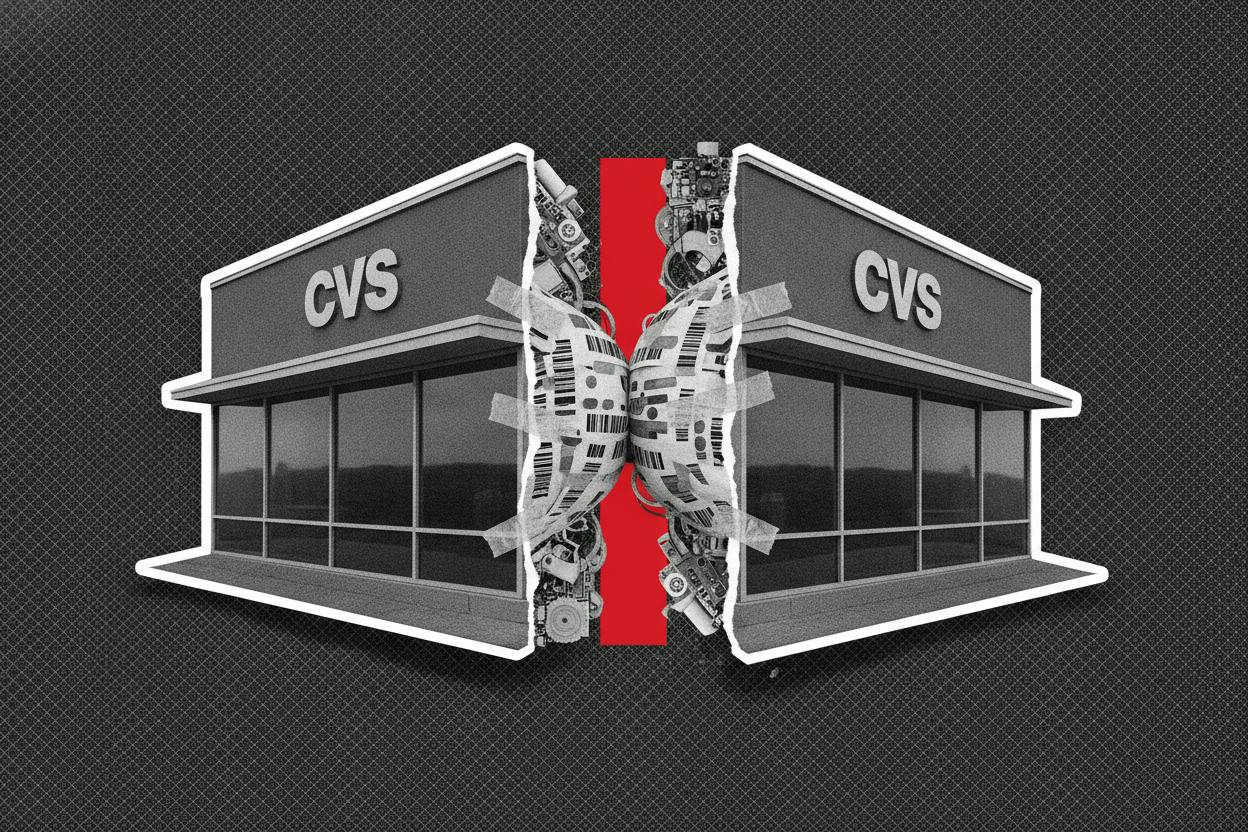
CVS Health said it will split into two separate public companies by the first half of 2028, separating its roughly 9,000-store CVS Pharmacy retail chain from its Aetna health insurance arm and Caremark pharmacy-benefit manager business. Shareholders would end up owning stock in both companies.
The announcement marks a striking reversal for a company that spent years assembling one of the largest integrated healthcare businesses in the United States. Investors reacted sharply: the stock fell 12.5% to $79.96, wiping out nearly $15 billion in market value in a single session — even though the company beat profit expectations for the latest quarter, reporting $2.09 a share against analysts' forecasts of $1.65.
How CVS got here
CVS built its current shape through a series of large acquisitions. The most consequential was the $78 billion purchase of Aetna in 2018, which pushed the company well beyond its roots as a drugstore chain and into the business of insuring patients. Add Caremark, its pharmacy-benefit manager — the middleman that negotiates drug prices between insurers, employers and pharmacies — and CVS controlled much of the chain from the pharmacy counter to the insurance card.
That structure is known as vertical integration: one company owning multiple layers of the same industry. Proponents argue it can lower costs and coordinate care. Critics — including regulators and politicians from both parties — argue it can concentrate too much power in one firm, potentially steering patients toward its own pharmacies and shaping which drugs get covered.
CVS now says a simpler setup will run better in that environment. Splitting the retail business from the insurance and drug-benefit operations would reduce the appearance — and the regulatory scrutiny — of one company controlling so many pieces of the healthcare system at once.
Why the stock fell anyway
A breakup that is years away forces the market to price in uncertainty, and CVS left plenty of it. Management has not yet published pro forma financials — the hypothetical statements showing what each future company's revenue, costs and profits would look like on their own. It also hasn't detailed separation costs or specified which efficiencies between the businesses would survive once they are apart.
Barclays analyst Andrew Mok highlighted that gap, and investors appear to have marked the stock down first rather than wait for clarity. When a company announces a separation without stand-alone financial detail, the market often cuts the valuation multiple because it cannot confidently estimate future earnings power or the synergies that will be lost.
The near-term backdrop adds to the caution. CFO Brian Newman warned of headwinds next year at Caremark tied to a government drug-discount program, a weaker selling season, and slipping health-plan membership. Uncertainty plus softer near-term trends typically means investors demand a higher risk premium — a lower share price for the same earnings.
What it means for investors
For everyday investors, the key takeaway is that this is a story about execution risk, not just strategy. Breakups of this size take years, require regulatory approvals, and often cost more than initially expected. Until CVS publishes clearer financials and the mechanics of the split, its valuation can stay capped — even with management pointing to a 2027 adjusted earnings-per-share floor of at least $8.65.
Investors holding CVS, or considering it, will want to watch several things:
- Pro forma financials for each future company, which will show how much profit each business generates on its own.
- Separation costs and how they are allocated between the two entities.
- Lost synergies — the savings CVS currently gets from owning insurance, drug benefits and pharmacies together.
- Caremark's trajectory into next year, given the government drug-discount pressure and membership trends.
- Regulatory signals from Washington, where scrutiny of healthcare consolidation remains active.
It's also worth remembering that spin-offs and splits can create value over time by letting each business be valued on its own merits. A focused retail pharmacy chain and a focused insurance-and-benefits company may each attract different types of investors. But that outcome depends on getting the details right — and the market is not yet willing to assume it will.
For now, CVS has given investors a destination without a map. The stock's sharp drop is the market's way of saying it wants the map before it pays up for the trip.