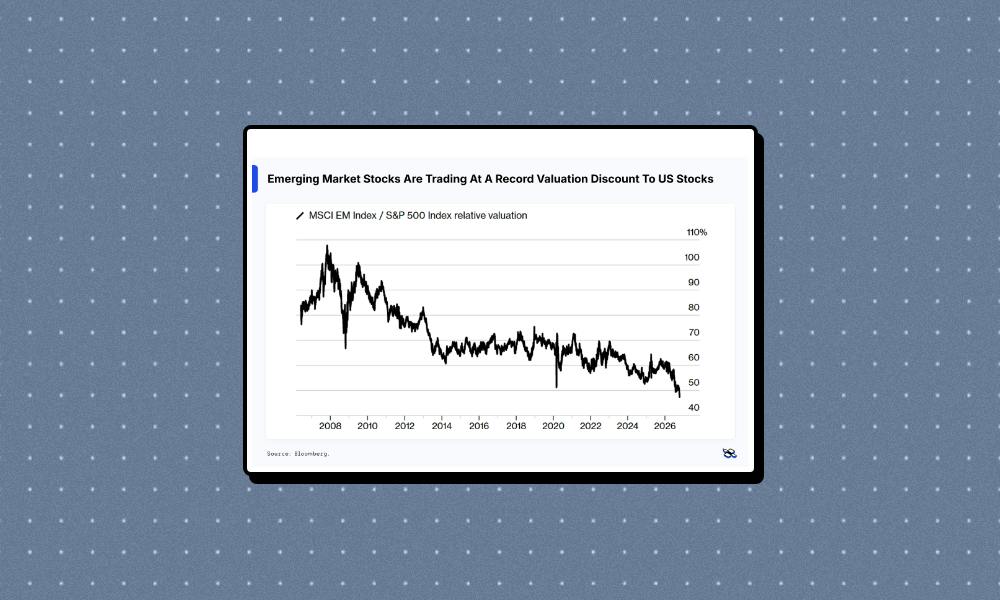
Emerging market (EM) stocks have never been this cheap relative to their US counterparts, a gap that could tempt investors looking for value in a pricey global market. The MSCI EM Index, a broad gauge of stocks in developing economies, now trades at less than 9 times expected earnings, compared with roughly 19 times for the S&P 500. That works out to a 53% discount—the widest since records began in 2006.
The striking part is that this valuation gap isn't the result of a slump in emerging markets. In fact, EM stocks have climbed 15% this year, actually outperforming US equities. The reason the discount has widened is that earnings forecasts for EM companies have risen even faster—by a staggering 70%—making their shares look relatively more attractive on a price-to-earnings basis.
Why the gap matters
For everyday investors, the price-to-earnings (P/E) ratio is a simple way to gauge how expensive a stock or index is. A lower P/E can mean you're paying less for each dollar of earnings, but it can also signal that investors expect slower growth or higher risk. In this case, the discount is notable because it's happening while EM earnings are accelerating, not decelerating.
Asia's AI suppliers are leading the charge, according to the data behind the brief. Companies that provide chips, components, and other hardware for artificial intelligence systems are seeing demand surge, which is boosting their earnings outlooks. This mirrors a broader trend where technology—especially AI-related—has become a key driver of corporate profits globally, as seen in recent Big Tech earnings that have split retail investors' favorites.
The valuation gap also reflects a longer-term shift. US stocks, particularly large-cap technology names, have enjoyed a prolonged run of outperformance, pushing their valuations to historically high levels. Meanwhile, emerging markets have faced headwinds ranging from geopolitical tensions to concerns about China's economic slowdown. But the earnings surge suggests that the profit picture in EM is improving, even if investor sentiment hasn't fully caught up.
What it means for investors
For investors, this record discount could be a signal to take a closer look at emerging markets. However, it's important to remember that cheap can get cheaper, and valuation alone isn't a reason to buy. EM stocks come with their own risks, including currency fluctuations, political instability, and less transparent corporate governance.
That said, the combination of strong earnings growth and a wide valuation gap has historically been a compelling setup. When earnings rise faster than prices, it often means the market hasn't fully recognized the improvement in fundamentals. Over time, that gap tends to narrow, either through further price gains or through earnings catching up to expectations.
Investors should also consider the broader context. The US market's high valuation is partly driven by a handful of mega-cap tech stocks, which has led some to question whether the rally is too concentrated. In contrast, EM offers a more diversified set of opportunities, from Asian manufacturers to Latin American commodity producers. For instance, Latin American markets have had their own volatility, showing that EM isn't a monolith.
Another factor to watch is the interest rate environment. The Federal Reserve's stance on rates affects global liquidity and the dollar, which in turn influences EM investments. A stronger dollar can weigh on EM currencies and make dollar-denominated debt more expensive. As noted in recent coverage of Saudi stocks, a Fed that's in no rush to cut rates can create headwinds for EM assets.
Looking ahead
For now, the earnings momentum in EM is a positive sign. If companies continue to beat expectations, the valuation gap could narrow even if prices stay flat. But investors should be prepared for volatility. EM markets are sensitive to global trade, commodity prices, and political events, all of which can shift quickly.
One area to watch is how AI-related demand evolves. If the AI boom continues, Asian suppliers could see further earnings upgrades, which would make EM valuations even more attractive. On the other hand, any slowdown in global tech spending could hit these companies hard.
Ultimately, the record discount is a data point, not a recommendation. It suggests that EM stocks are priced for pessimism, while US stocks are priced for optimism. For long-term investors, that asymmetry might be worth exploring—but only as part of a diversified portfolio that matches your risk tolerance and time horizon.