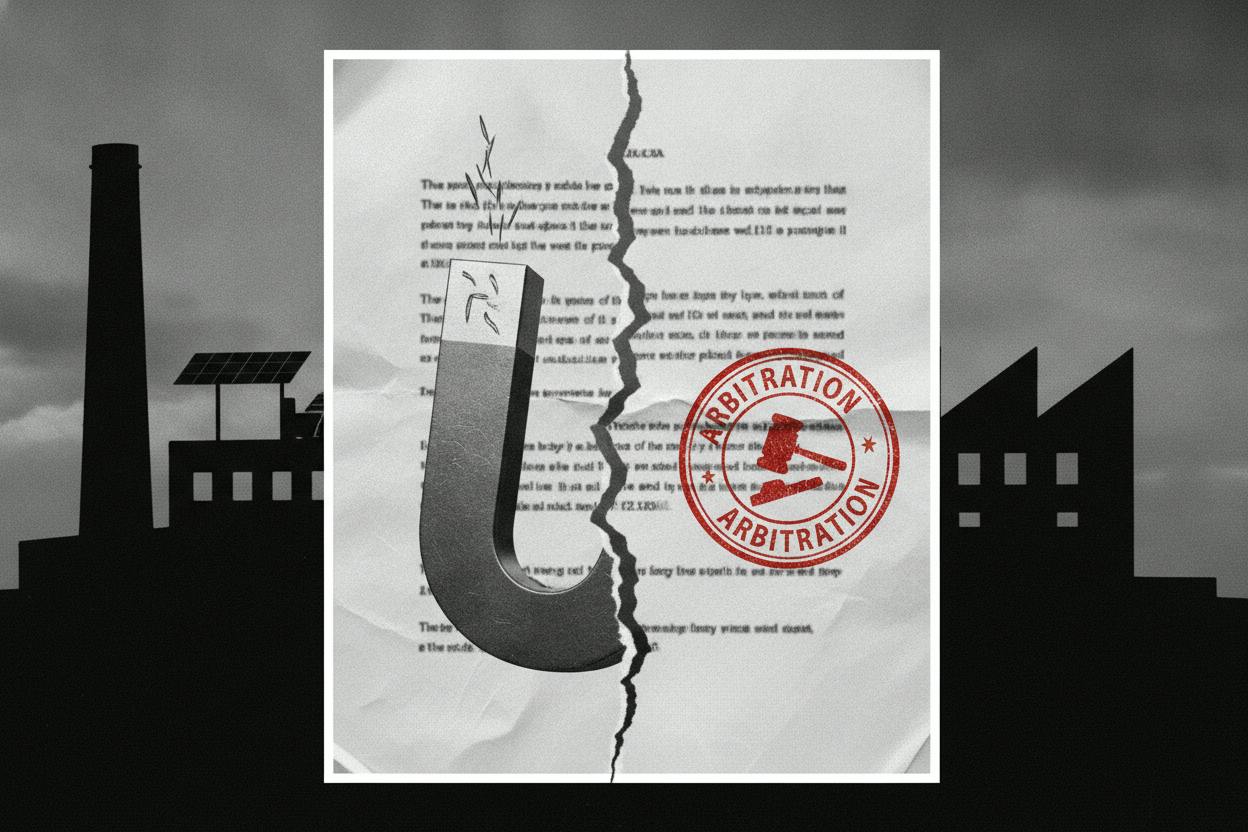
General Motors has pulled out of a long-term agreement to buy rare-earth magnets from Vacuumschmelze (VAC), the German specialty materials company that recently opened a new plant in South Carolina. The dispute is now headed to arbitration, according to recent SEC filings, and it is casting a shadow over Energy Fuels' planned $1.9 billion acquisition of VAC.
Rare-earth magnets are critical components in electric vehicle (EV) motors, and the U.S. has been trying to build a domestic supply chain to reduce reliance on China, which dominates global magnet production. VAC's new U.S. plant, which came online late last year, has an annual capacity of just under 2,000 metric tons—enough to supply a significant number of EV motors. VAC's CEO had previously said that 90% of the plant's output was earmarked for GM for at least a decade, making the automaker the anchor customer.
What happened?
According to SEC filings, the supply agreement was terminated on July 1. VAC quickly initiated arbitration, seeking damages for what it calls wrongful termination. GM, for its part, told investors that it is in arbitration related to an EV traction-motor component after ending a “strategic sourcing agreement.” The company did not provide further details.
The timing is notable because Energy Fuels, a U.S. critical-minerals company, agreed in June to acquire VAC for $1.9 billion. The deal was seen as a way for Energy Fuels to expand beyond uranium and into the rare-earth magnet supply chain, which is considered vital for both EVs and defense applications. But the loss of GM as a customer—if it holds—could significantly alter the economics of the acquisition.
Why the anchor customer matters
A new magnet factory is only as valuable as its contracted customers. Without a guaranteed buyer, volumes and pricing become harder to forecast, which makes it difficult to project the steady cash flows that a buyer like Energy Fuels is paying for. The 90% figure was a key part of VAC's growth story, and its disappearance forces investors to reassess the plant's revenue potential.
This situation also highlights a broader challenge for Western rare-earth supply chains. While there is strong political and corporate interest in building domestic capacity, demand assumptions can shift quickly when EV plans change, policy support wavers, or automakers decide to renegotiate contracts. The GM-VAC dispute is a reminder that even well-intentioned supply deals can unravel, especially when market conditions evolve.
What it means for investors
For Energy Fuels, the arbitration adds a new layer of uncertainty to an already complex deal. The company has said that the outcome of the arbitration—whether it results in damages, a settlement, or a rewritten supply contract—could lead to adjustments in the purchase price. That means the legal process could have as much impact on the deal's value as the plant's operational ramp-up.
Investors should watch for updates from both GM and VAC regarding the arbitration. Key questions include: Will GM be forced to honor the contract? Will VAC receive compensation? Or will the two sides negotiate a new agreement with different terms? Any of these outcomes could change the financial picture for Energy Fuels.
The dispute also underscores the risks inherent in building a domestic rare-earth supply chain. While the U.S. has made progress in recent years—such as Apple's titanium deal and TSMC's Arizona chip plant—the GM-VAC situation shows that contracts are not guarantees. Companies and investors alike must weigh the potential for such disruptions when evaluating critical-minerals projects.
For everyday investors, this story is a reminder that even seemingly solid supply agreements can be broken. When a company's value depends on a single customer, that concentration risk is a real factor to consider. As the arbitration unfolds, the market will be watching closely to see how it affects Energy Fuels' deal and the broader push for Western rare-earth independence.
In the meantime, the copper market's recent moves and other commodity trends continue to influence investor sentiment in the critical-minerals space. But for now, the focus is on the arbitration room, where the fate of a $1.9 billion deal—and a key piece of the U.S. EV supply chain—hangs in the balance.



