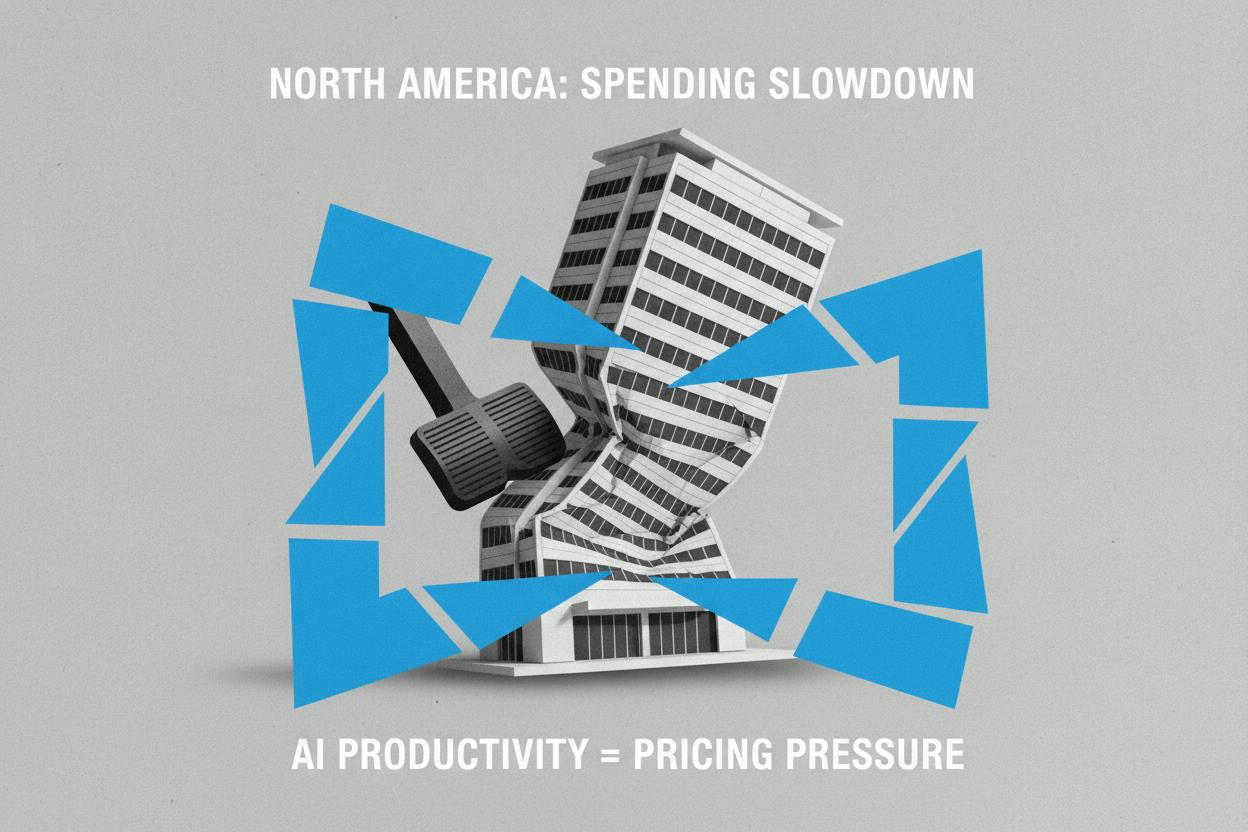
Infosys, one of India's largest IT services companies, has lowered its revenue growth forecast for the current fiscal year to 1%-2%, down from its previous guidance. The revision follows a weak quarter in North America, its biggest market, where clients are increasingly using artificial intelligence to cut costs—and demanding that vendors share those savings through lower prices.
The company's second-quarter results showed North America revenue fell 1.5% from the previous quarter, with technology and retail customers pulling back on spending. While the overall numbers were slightly better than analysts expected, the cautious outlook overshadowed the beat.
Why AI is squeezing the outsourcing model
Infosys and its rivals like Tata Consultancy Services and Wipro have long built their businesses on selling "billable hours"—charging clients for the time their engineers spend on projects. That model is now being tested by generative AI, which can automate coding, testing, and other routine tasks that once required large teams.
Clients are realizing they can get the same work done with fewer people, and they want those efficiency gains reflected in lower fees. For Infosys, that means pressure on pricing even as demand for digital transformation services remains steady.
This isn't just a one-quarter blip. The company's management said the pricing pressure is "AI-driven" and likely to persist as clients adopt more automation. The challenge is that while AI can help Infosys deliver projects faster, it also reduces the number of billable hours—the very thing that drives revenue in the traditional outsourcing model.
North America: the weak spot
North America accounts for roughly a third of Infosys's revenue, making it the company's most important market. The 1.5% sequential decline in that region is a red flag, especially as technology and retail clients—two of the biggest spenders on IT services—have become more cautious.
The slowdown echoes what other companies have reported recently. For example, Electrolux warned that North American demand is cooling, and Sodexo saw profits slide partly due to North America costs. While those are different industries, the pattern suggests a broader softening in corporate spending across the region.
Infosys's outlook also reflects a wider trend in the IT services sector. SAP's cloud outlook brightened, but AI monetization remains unproven, and investors are watching closely to see which companies can turn AI investments into actual revenue growth.
What it means for investors
For everyday investors, Infosys's guidance cut is a reminder that AI is a double-edged sword for tech companies. While it can boost productivity and margins, it can also disrupt traditional revenue models.
In the short term, the lowered forecast may weigh on Infosys's stock, as it signals slower growth ahead. But the company still expects to grow, just at a more modest pace. The key question is whether Infosys can adapt by offering AI-powered solutions that command premium pricing, rather than simply discounting its existing services.
Investors should also watch how other IT services firms respond. If Infosys is feeling pricing pressure, its competitors likely are too. That could lead to a wave of guidance cuts across the sector, which would be a headwind for the broader tech services industry.
On the other hand, some companies are finding ways to benefit from AI-driven efficiency. SLB beat estimates as North America revenue jumped 24%, though that's in energy services, not IT. And American Express raised its profit forecast as affluent spending held up, showing that not all sectors are feeling the same pinch.
The bigger picture
Infosys's situation is part of a larger shift in the global IT services industry. As AI becomes more capable, the value of routine coding and support work declines. Companies that can move up the value chain—offering strategic consulting, AI integration, and data analytics—may thrive, while those that rely on headcount-driven models could struggle.
For now, Infosys is navigating that transition. The company's management has said it is investing in AI capabilities and training its workforce, but the near-term impact on pricing is clear.
Investors should keep an eye on Infosys's next few quarters to see if the pricing pressure stabilizes or worsens. If AI-driven efficiency gains continue to erode billable hours, the company may need to find new ways to monetize its services—or accept slower growth as the new normal.
In the meantime, the guidance cut is a signal that even large, established tech firms are not immune to the disruptive forces of AI. For those holding Infosys stock, patience may be required as the company works through this transition.