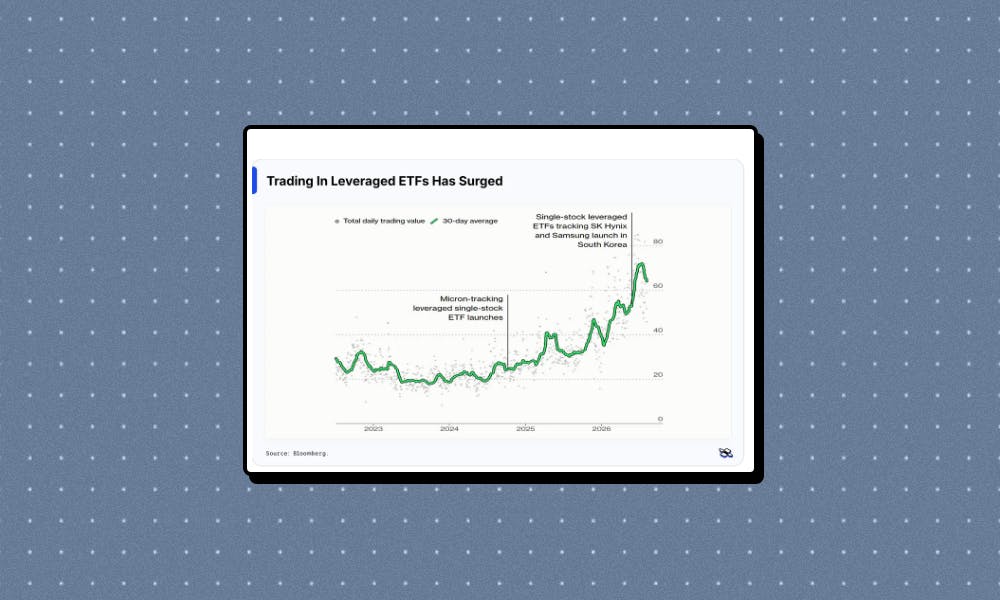
If you've noticed AI stocks swinging wildly on a daily basis, you're not imagining things. A growing force in the markets—leveraged exchange-traded funds (ETFs)—is helping to amplify those moves. These funds, which use derivatives to multiply the daily performance of an underlying stock or index, now hold roughly $250 billion in assets globally. That's a small fraction of the more than $22 trillion parked in ETFs worldwide, but their impact on trading is outsized.
Small assets, big trading footprint
Leveraged ETFs account for only about 1% of total ETF assets, yet they generate roughly 16% of daily ETF trading volume. That means these funds are far more active in the market than their size suggests. When a leveraged ETF rebalances its holdings—often at the end of each trading day—it can trigger large buy or sell orders in the underlying stocks. This activity can push prices around, especially in sectors where trading is already concentrated.
Nowhere is that more evident than in artificial intelligence. Bullish leveraged ETF exposure to AI-related stocks has roughly quadrupled since 2022, according to the source brief. That surge has coincided with a period of intense investor enthusiasm for AI, from chipmakers to software companies. As more money flows into these leveraged products, they can add fuel to both rallies and sell-offs.
How leveraged ETFs work
To understand why these funds matter, it helps to know how they operate. A standard ETF aims to track the performance of an index or a basket of stocks. A leveraged ETF, by contrast, aims to deliver a multiple of the daily return—typically two or three times. For example, a 2x leveraged ETF on a tech index will try to gain 2% on a day when the index rises 1%, and lose 2% when it falls 1%.
To achieve that, fund managers use derivatives like swaps and futures contracts. These instruments allow the fund to gain exposure to a large notional amount of stock without actually buying all the shares. But the daily rebalancing—buying or selling to reset the leverage—can create significant trading flows. This is why leveraged ETFs can be a source of volatility, especially in fast-moving markets.
Why AI stocks are particularly exposed
AI stocks have become a favorite target for leveraged ETF investors. The sector has seen explosive growth in interest, with names like Nvidia and other chipmakers leading the charge. The source brief notes that bullish leveraged ETF exposure to AI has roughly quadrupled since 2022. That's a rapid increase, and it means these funds now hold a meaningful position in a sector that is already known for sharp price swings.
When a leveraged ETF rebalances, it can amplify moves in both directions. On a day when AI stocks fall, leveraged funds may be forced to sell more shares to maintain their leverage ratio, potentially deepening the decline. Conversely, on an up day, they may buy more, pushing prices higher. This dynamic can make AI stocks even more volatile than they would be otherwise.
What it means for everyday investors
For the average investor, the rise of leveraged ETFs is a double-edged sword. On one hand, it can create opportunities for traders who are comfortable with high risk. On the other, it can make the broader market—and especially AI stocks—more unpredictable. If you hold a diversified portfolio of regular ETFs or individual stocks, you might see bigger daily swings than you'd expect, even if you're not directly invested in leveraged products.
It's also worth noting that leveraged ETFs are designed for short-term trading, not long-term holding. Because of daily rebalancing, their performance can diverge significantly from the underlying index over longer periods. That's a key reason why financial advisors generally caution against holding them for more than a day or two.
Looking ahead
As AI continues to dominate market headlines, the influence of leveraged ETFs is likely to grow. Investors should keep an eye on trading volumes and volatility in the sector. The broader market context also matters—recent moves in chip stocks and South Korean chip exports show how interconnected these trends are. And with oil and bond yields climbing, the overall risk appetite could shift.
For now, the key takeaway is that leveraged ETFs are a force to be reckoned with. They may be small in size, but their trading footprint is huge—and that's making AI stocks even more volatile. Understanding how they work can help you make sense of the daily noise in the market.