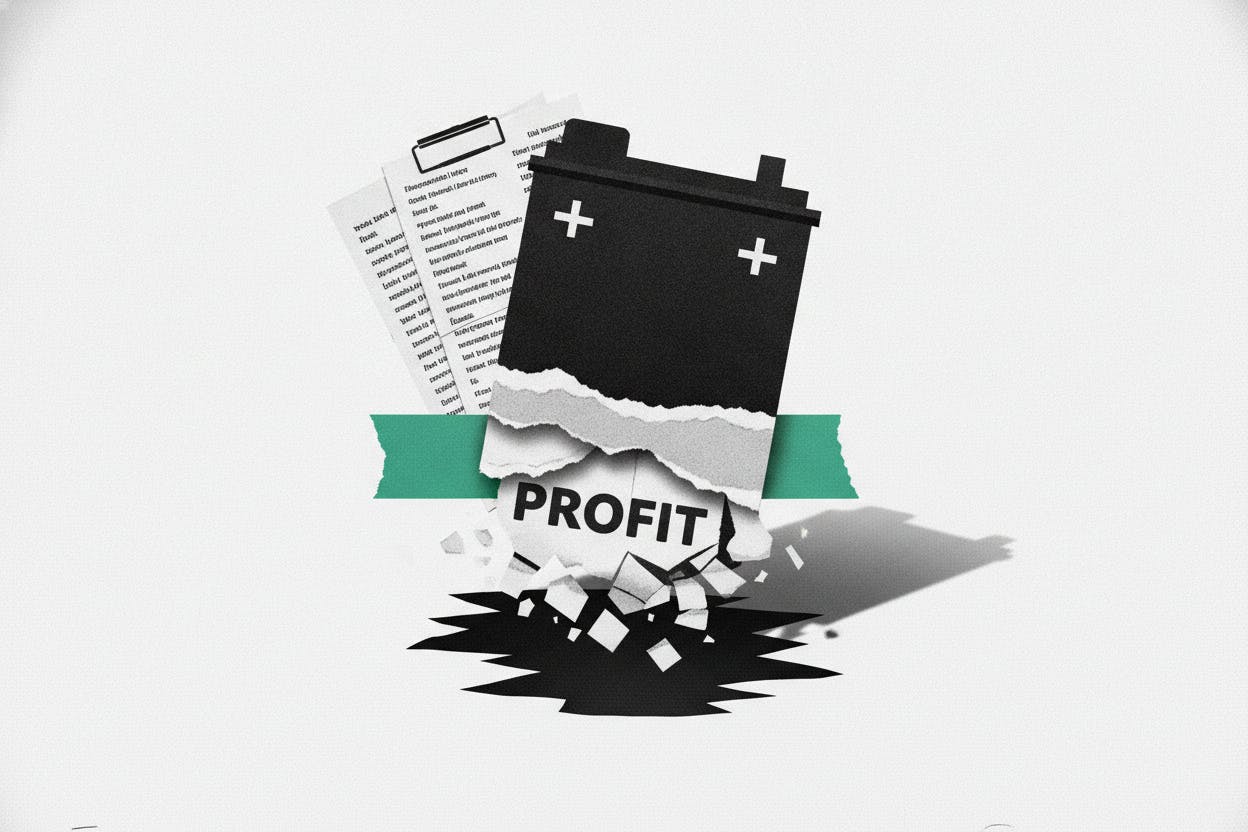
South Korean battery giant LG Energy Solution (LGES) has warned that its second-quarter operating profit likely fell 77% from a year ago, and that it would have posted a loss without the help of US government tax credits. The guidance, released Tuesday, is the latest sign that the electric-vehicle (EV) boom is losing steam, and that policy support is becoming a critical crutch for the industry.
LGES, which supplies batteries to Tesla, General Motors, and Hyundai, said it expects operating profit of about 113 billion won (roughly $82 million) for the April-to-June period. That is down sharply from 488 billion won a year earlier. More strikingly, the company noted that without production tax credits under the US Inflation Reduction Act (IRA), it would have recorded an operating loss of 128 billion won.
The IRA, signed into law in 2022, offers subsidies for domestic manufacturing of EV batteries and other clean-energy components. For LGES, those credits are now the difference between red ink and black ink.
Why the EV battery boom is cooling
The profit warning is not an isolated event. Across the EV supply chain, companies are feeling the pinch as automakers slow their electric-vehicle rollouts and compete more aggressively on price. In the US and Europe, demand for EVs has not grown as fast as many expected, partly due to high interest rates, range anxiety, and the still-high cost of many models.
Automakers like Ford and General Motors have delayed or scaled back some EV production plans, which directly affects battery suppliers like LGES. The company's customers are ordering fewer batteries and pushing for lower prices, squeezing margins.
This dynamic is playing out even as the broader market for memory chips and AI-related hardware surges — a contrast highlighted by rival Samsung's recent forecast of a 19-fold profit surge, driven by AI demand. For a deeper look at that story, see Samsung Expects 19-Fold Profit Surge as AI Demand Drives Memory Chip Prices Higher.
What the Inflation Reduction Act means for battery makers
The IRA's advanced manufacturing production credit, known as Section 45X, provides a tax credit for each battery cell and module produced in the US. For LGES, which operates a major factory in Michigan and is building others in Ohio and Arizona, these credits have become a significant revenue stream.
In its guidance, LGES said the credits are included in its operating profit forecast. Without them, the company would have been in the red. That underscores how dependent the EV battery industry has become on government incentives — and how vulnerable it would be if those policies were changed or phased out.
For investors, this raises a key question: How sustainable is LGES's profitability if it relies on tax credits to stay profitable? The company's core business — selling batteries to automakers — is under pressure from lower volumes and price competition. The IRA credits are a temporary boost, but they are not a long-term solution to weak demand.
What it means for investors
For everyday investors, the LGES update is a reminder that the EV revolution is not a straight line. While the long-term trend toward electrification remains intact, the near-term path is bumpy. Battery makers and automakers alike are navigating a period of slower growth, higher costs, and policy uncertainty.
Investors should watch for similar warnings from other battery suppliers and EV companies in the coming weeks. If demand continues to soften, more companies may need to rely on government support to maintain profitability.
It is also worth noting that the broader economic backdrop is mixed. In Europe, for example, the German DAX edged up on better-than-expected factory orders, but construction remains weak. For more on that, see German DAX Edges Up as Factory Orders Beat Forecasts, Construction Still Weak. Meanwhile, in Canada, the services sector shrank in June as high prices and uncertainty weighed on demand, as reported in Canada's Services Sector Shrinks in June as High Prices and Uncertainty Weigh on Demand.
For now, LGES's profit warning is a clear signal that the EV battery boom has cooled — and that government tax credits are doing more than just sweetening the deal. They are keeping some companies in the black.