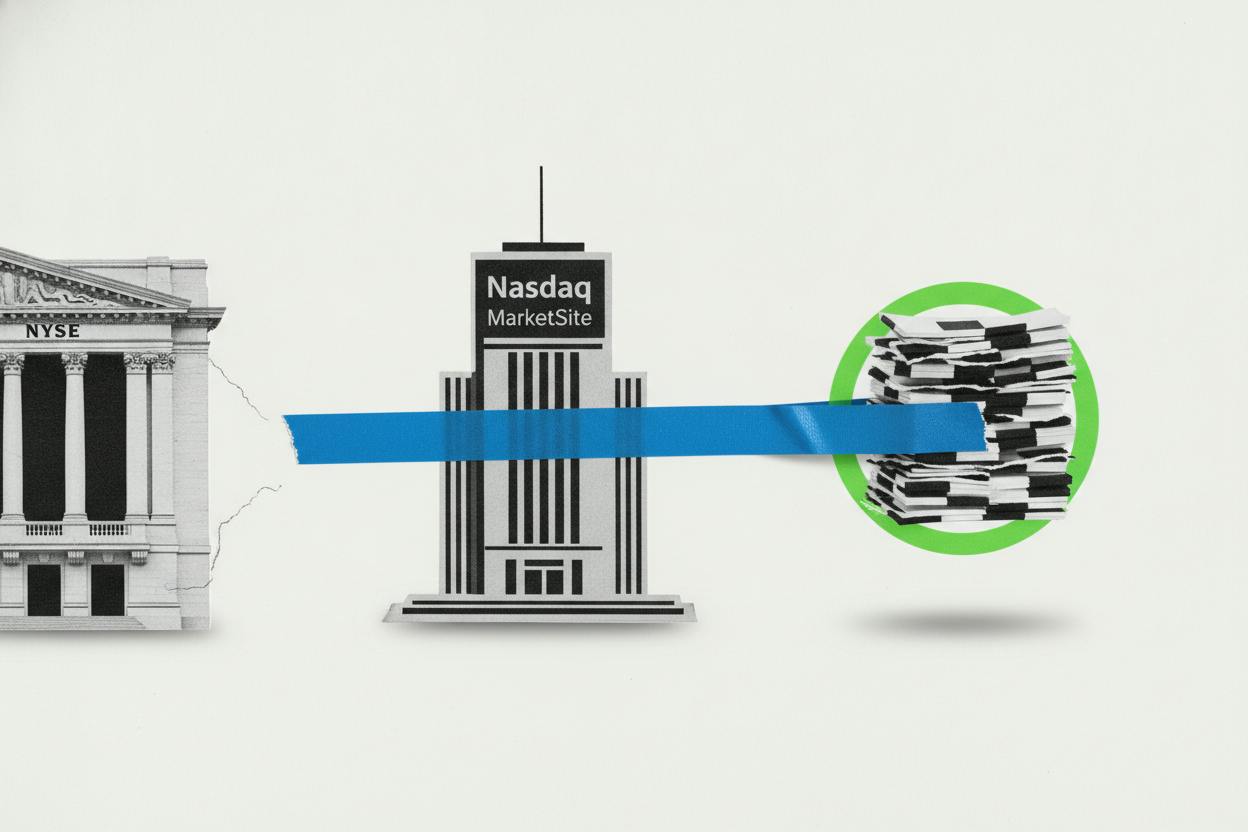
The competition between the world's two biggest stock exchanges has a new scoreboard, and it's not even close. After AI firm Anthropic's blockbuster debut, Nasdaq has widened its lead over the New York Stock Exchange in the race to host mega-IPOs, according to Reuters.
Dealogic data cited by Reuters shows that Nasdaq listings have raised roughly $201.8 billion across 64 IPOs so far this year, compared with just $20.8 billion from 42 IPOs on the NYSE. That marks the largest gap between the two exchanges since Dealogic began tracking the figures in 1995.
The numbers underscore a shift that has been building for years: the biggest, most anticipated public listings increasingly choose Nasdaq over its older rival. And the reason, according to market observers, goes beyond branding or the famous digital tower in Times Square.
Index inclusion is the new lure
Nasdaq's edge is increasingly about indexes. Founders and early investors are drawn to the prospect of fast-track inclusion in major benchmarks like the Nasdaq 100. Because index funds are required to hold every member of the index they track, inclusion can instantly expand a company's shareholder base and boost demand for its stock.
Reuters notes that Nasdaq has tweaked its rules earlier this year to make it easier for newly listed companies to join its flagship index. That move appears to be paying off, as Anthropic's debut—one of the most anticipated tech listings in years—chose Nasdaq over the NYSE.
For context, the NYSE has long been the traditional home of blue-chip industrial and financial giants, while Nasdaq has become synonymous with technology and growth stocks. But the recent trend suggests that even large, established companies are willing to switch or choose Nasdaq if it means quicker access to index-driven buying.
What this means for investors
For everyday investors, the exchange a company lists on might seem like a minor detail. But it can have real consequences for how a stock trades and who owns it.
When a company joins a major index like the Nasdaq 100, index funds and exchange-traded funds (ETFs) that track the index must buy the stock. That creates a wave of demand that can support the share price in the weeks and months after listing. It also means the stock becomes part of a broader basket that millions of investors own indirectly through their retirement accounts or index funds.
On the flip side, being on a major index also means the stock is more exposed to market-wide moves. If the tech sector sells off, a newly included stock can fall along with the rest of the index, as we've seen in recent sessions. For example, Anthropic's IPO pop couldn't lift AI stocks as rate fears weighed on the sector, and the broader US stock slide continued despite the debut.
Still, the appeal of index inclusion is clear. It provides liquidity and visibility that can be hard to achieve otherwise. That's why Nasdaq's rule tweak is seen as a strategic move to attract more mega-IPOs, and it seems to be working.
The bigger picture
The widening gap between Nasdaq and the NYSE is not just a matter of bragging rights. It reflects a broader shift in the economy toward technology and innovation-driven companies. As more of the world's most valuable businesses are tech firms, Nasdaq—with its tech-heavy reputation—becomes the natural landing spot.
But the trend also raises questions about competition and market structure. The NYSE has not been idle; it has its own index products and has fought to retain listings. Yet the numbers this year are stark.
For investors, the takeaway is that the exchange a company chooses can be a signal. A company that opts for Nasdaq may be positioning itself for index inclusion and the associated investor base. That can be a positive for long-term liquidity, but it also means the stock will be more tightly tied to the performance of the tech-heavy indexes.
As the IPO market continues to recover from a slow patch, the battle between the exchanges is likely to intensify. And with AI companies like Anthropic leading the charge, Nasdaq's momentum may not slow down anytime soon.