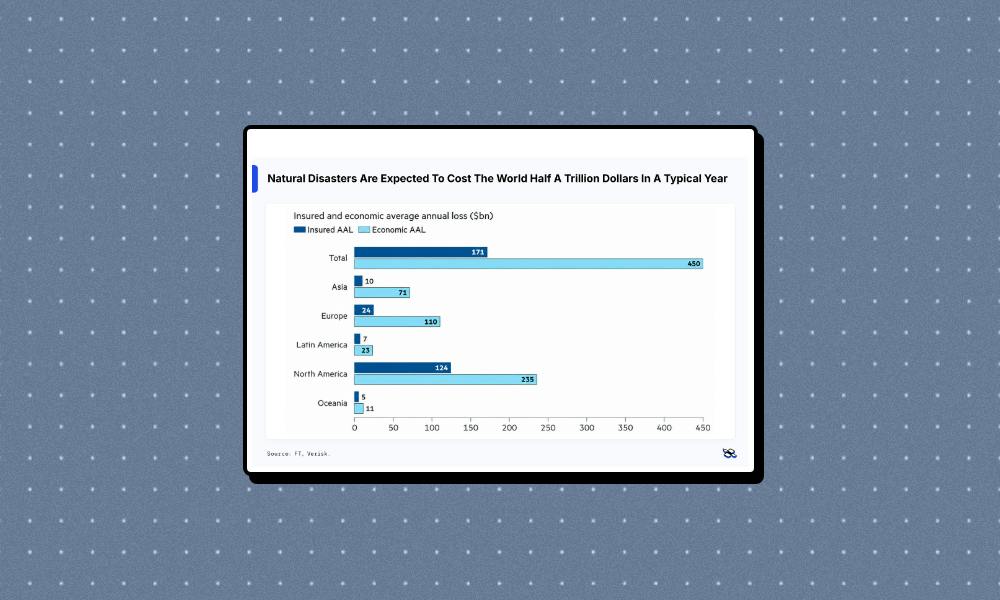
Natural disasters are becoming an increasingly expensive problem for the global economy, and a growing share of the bill is landing on households, businesses, and governments rather than insurers. New research from risk-modelling firm Verisk estimates that catastrophes will cost the global economy $450 billion a year, with a whopping 62% of those losses—around $279 billion—left uninsured.
That gap between total economic damage and insured losses is known in the industry as the "protection gap." It has been widening for years, and the latest figures suggest it is now a permanent feature of the risk landscape rather than a temporary blip.
Why the protection gap is growing
Climate change is often cited as the main driver of rising disaster costs, and it is certainly a factor. More frequent and intense storms, floods, and wildfires are pushing up the frequency and severity of catastrophic events. But the story is more complex than just a warming planet.
Urban expansion is putting more properties in harm's way. As cities grow, development often spreads into areas that are prone to flooding, wildfires, or other natural hazards. That means even if the number of storms stayed the same, the potential for damage would rise simply because more buildings and infrastructure are exposed.
Soaring construction costs are also making repairs pricier. When a disaster does strike, rebuilding a home or a business now costs significantly more than it did a decade ago, driven by higher prices for materials like lumber and steel, as well as labour shortages. That inflates the economic damage figure even when the physical destruction is unchanged.
At the same time, insurers are increasingly reluctant to foot the bill. In high-risk areas, premiums have risen sharply, and some insurers have pulled back from offering coverage altogether. That leaves more of the financial burden to fall on the uninsured or underinsured.
Insured losses top $100 billion again
The scale of the problem was underscored in 2025, when global insured catastrophe losses topped $100 billion for the sixth consecutive year. That streak is a clear sign that the industry is now operating in a new normal, where billion-dollar disaster years are the baseline rather than the exception.
California's devastating wildfires alone caused up to $65 billion in economic damage, with a significant portion of that likely uninsured. The fires highlighted how even wealthy, developed regions are not immune to the protection gap.
For insurers, the trend is a double-edged sword. On one hand, rising premiums and reduced exposure in high-risk areas can support profitability. On the other, the volatility of catastrophe losses makes earnings harder to predict, and reinsurers—who back up primary insurers—are also raising prices and tightening terms.
What it means for investors
For everyday investors, the widening protection gap has several implications. First, it is a reminder that natural disaster risk is not just an environmental issue—it is a financial one. Companies with significant exposure to disaster-prone regions, whether in real estate, construction, or tourism, could see their costs rise and their profits squeezed.
Second, the insurance sector itself is in a state of flux. While some insurers are benefiting from higher premiums, others are struggling with mounting claims. Investors should pay attention to how individual companies are managing their catastrophe exposure, as well as their reinsurance arrangements.
Third, the gap between economic and insured losses creates opportunities for innovation. Insurers and startups are exploring new ways to close the protection gap, from parametric insurance that pays out automatically based on trigger events, to public-private partnerships that share risk. These developments could reshape the industry in the coming years.
Finally, the trend underscores the importance of diversification. For investors, holding a mix of assets across different sectors and geographies can help cushion the impact of disaster-related losses in any single area.
As the world's disaster bill continues to grow, the question of who pays is becoming more pressing. For now, the answer is increasingly: households, businesses, and governments. That is a reality investors will need to factor into their decisions.