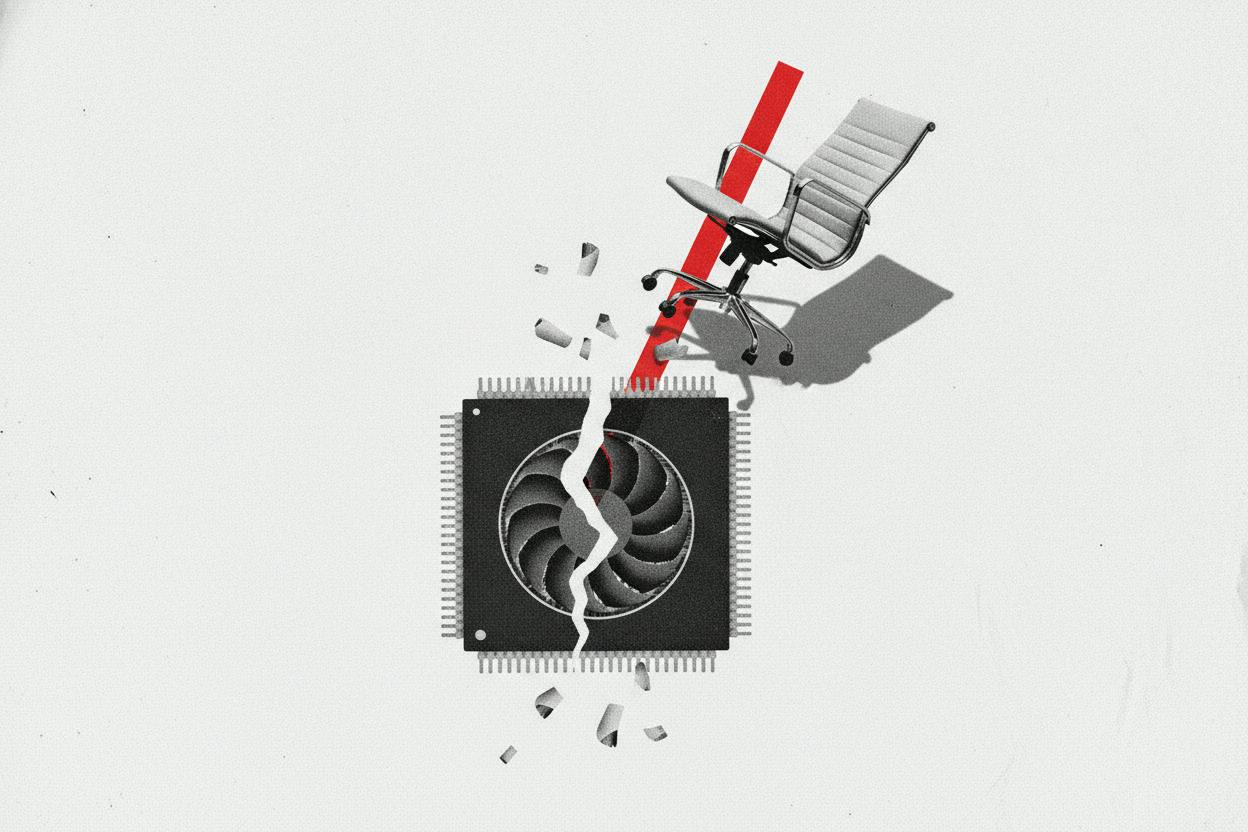
Nvidia, the world's most valuable chipmaker and a linchpin of the artificial-intelligence boom, saw its shares tumble as much as 8.8% in after-hours trading on reports that its board had discussed replacing CEO Jensen Huang. The news quickly spread beyond the company itself, dragging down other chip stocks and sending major Asian indexes lower.
The selloff highlights just how tightly Nvidia's fortunes are tied to the broader AI trade. As the dominant supplier of the graphics processing units (GPUs) that power AI data centers, Nvidia is a bellwether for the entire sector. When its leadership looks uncertain, investors start to question the stability of the whole AI buildout—from chipmakers and data-center operators to the cloud giants funding the expansion.
What happened
According to reports, Nvidia's board has weighed removing Huang as CEO, citing concerns about his personal conduct and potential national-security sensitivities related to China. The company has not publicly confirmed the discussions, and no decision has been announced. Still, the mere possibility of a leadership change at a company so central to the AI ecosystem was enough to spook markets.
The ripple effects were immediate and global. S&P 500 e-mini futures fell 0.5%, signaling a weaker open for U.S. stocks. In Asia, Taiwan's benchmark index dropped 2.6%, reflecting its heavy concentration in semiconductor stocks. South Korea's Kospi and Japan's Nikkei 225 each fell 0.9%, as investors in those markets also felt the chill.
Strategists noted that the timing could not be worse. The AI trade has already been under scrutiny, with questions swirling about how much capital spending the industry can sustain, how long the heavy investment cycle will last, and whether current valuations assume too-perfect outcomes. A governance distraction adds another layer of uncertainty to an already fragile narrative.
Why Nvidia matters
Nvidia is not just another tech stock. Its chips are the backbone of modern AI systems, used by everyone from startups to hyperscale cloud providers. The company's earnings reports are treated as a barometer for the entire AI sector, and its stock carries significant weight in major indexes like the S&P 500 and the Nasdaq.
Because so many investors gain exposure to Nvidia through exchange-traded funds (ETFs) and index funds, a sharp drop in the stock can quickly become a broader selloff. When Nvidia sneezes, the whole tech sector catches a cold—and sometimes the entire market does too.
The reports also come amid broader concerns about AI valuations. After a massive run-up in AI-related stocks, many investors are asking whether prices have gotten ahead of reality. A leadership crisis at the sector's most important company only amplifies those worries.
What it means for investors
For everyday investors, the key takeaway is that Nvidia's troubles are not just about one company. When a bellwether like Nvidia faces uncertainty, investors often demand a higher risk premium for the entire AI theme. In plain terms, they become less willing to pay rich prices for future growth, which can hit hardest the stocks whose profits are expected furthest out.
This dynamic helps explain why the shock traveled so quickly into Asia's semiconductor-heavy markets. Taiwan, home to TSMC and other chip suppliers, saw its index fall 2.6%. South Korea and Japan, which also have significant tech sectors, were not far behind.
For those holding Nvidia directly or through funds, the immediate reaction may be unsettling, but it's important to keep perspective. Leadership changes—even at major companies—do not always lead to long-term damage. However, the uncertainty could persist until the board clarifies its intentions and investors get a clearer picture of the company's direction.
Investors should also watch how competitors respond. If Nvidia appears distracted, rivals may look stronger by comparison. Customers, meanwhile, might rush to lock in supply if they fear disruptions or tighter U.S. export restrictions on China. These dynamics could reshape the competitive landscape in AI chips.
The bigger picture
The Nvidia news is a reminder that the AI trade, for all its promise, is not immune to human factors. Corporate governance issues, leadership transitions, and geopolitical tensions can all move markets just as much as earnings or product launches.
For now, the focus will be on how Nvidia's board handles the situation and whether any formal announcement follows. Until then, expect volatility in AI-related stocks and continued sensitivity in global markets to any headline involving the company.
As always, diversification remains a key defense. Investors who have concentrated their portfolios in AI or tech stocks may want to consider how much risk they are comfortable with, given the sector's heightened sensitivity to news like this.