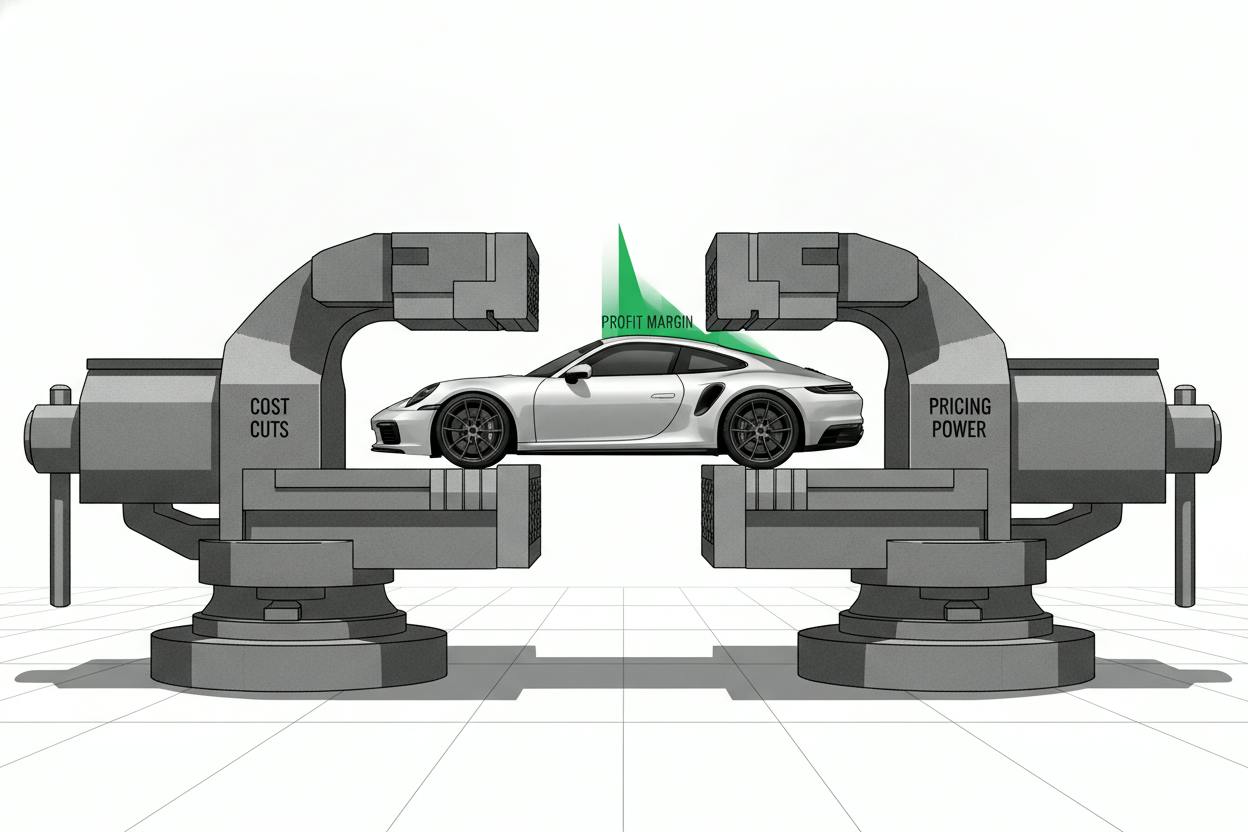
Porsche has unveiled a long-term strategy that signals a shift in how the German sports-car maker plans to grow. Instead of chasing higher sales volumes, the company wants to make each vehicle it sells more profitable. The plan, dubbed “Sportwagenschmiede ’35” (roughly “sports car forge ’35”), sets financial targets that rely less on booming demand and more on operational efficiency and premium pricing.
What Porsche is targeting
In the medium term, Porsche is aiming for an operating return on sales of 10% to 15%. That’s a measure of how much operating profit the company earns for every euro of revenue—a key profitability gauge for automakers. The company also wants an automotive net cash flow margin of 9% to 12%, which reflects how much cash its car business generates after covering costs.
To make these targets more resilient, Porsche plans to push its break-even point below 200,000 vehicles. The break-even point is the number of cars it needs to sell to cover its fixed costs—anything above that generates profit. By lowering that threshold, Porsche can remain profitable even if demand softens.
How it plans to get there
The strategy leans heavily on increasing “value per car.” That means selling more high-margin trims and offering more customization options, which typically carry fatter profit margins than base models. Porsche is also planning a roughly 20% price increase on its top-of-range models, a move that could boost revenue without adding production volume.
Cost-cutting is another pillar. The company intends to reduce headcount and streamline operations, though specific numbers weren’t disclosed in the announcement. This is a common approach for automakers facing margin pressure from rising material costs, electrification investments, and intensifying competition.
Why this matters for investors
For everyday investors, Porsche’s strategy reflects a broader trend in the auto industry: volume is no longer the only path to growth. Many premium carmakers are finding that selling fewer, more expensive vehicles can be more profitable than chasing mass-market sales. This approach can also make earnings less volatile, because it reduces exposure to economic downturns that hit car sales hard.
However, the plan carries risks. Raising prices on top models could alienate some buyers, especially if the economy weakens or if competitors offer similar performance at lower prices. And cutting headcount can lead to morale issues or operational hiccups if not managed carefully.
Investors will be watching how Porsche executes on these targets over the next few years. The company’s ability to maintain its premium brand image while improving efficiency will be key. If successful, the strategy could lead to more stable cash flows and potentially higher returns for shareholders. If not, the company could face margin pressure and a loss of market share.
Porsche’s move also comes at a time when the auto industry is grappling with the transition to electric vehicles, which requires heavy investment. By focusing on profitability per car, Porsche aims to fund that transition without relying on ever-increasing sales volumes.
For those invested in Porsche or considering it, the key takeaway is that the company is prioritizing quality of earnings over quantity of sales. That could be a positive sign for long-term investors who value consistency and margin strength. But as with any strategic shift, execution will be everything.