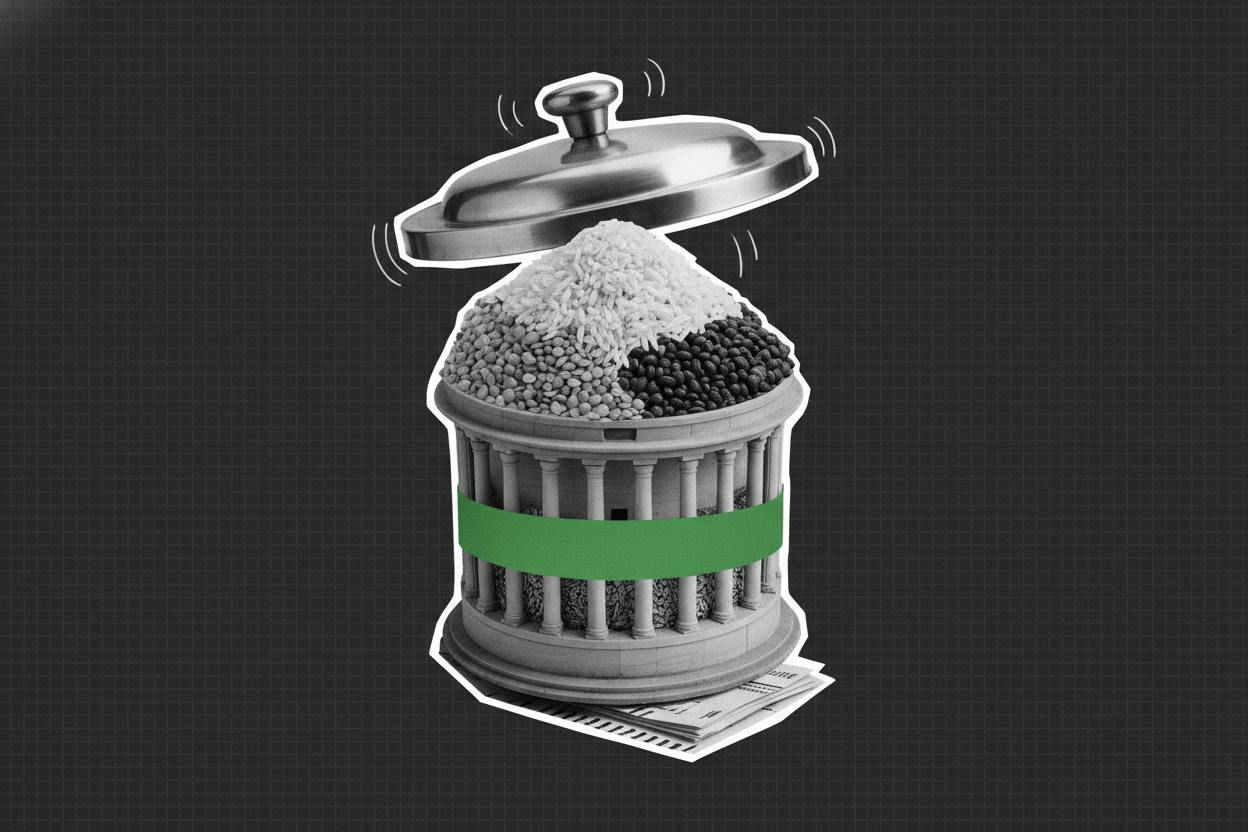
India's central bank is heading into its next policy meeting with a warning: food inflation is not just a blip, it's widespread. Consumer price inflation rose above 6% in October, and in its latest monthly bulletin, the Reserve Bank of India (RBI) flagged rising prices across key cereals, pulses, and edible oils, with mustard oil leading the way.
The timing is critical. The RBI's rate-setting committee is scheduled to announce its decision on December 4th, and the inflation data has put the central bank in a difficult spot. A Reuters poll suggests most economists expect another quarter-point rate increase, which would take the benchmark repo rate from its current 5.5% to 5.75%. But the RBI has also argued that India's growth remains resilient, supported by strong bank lending, which gives it room to focus on price stability.
Why food prices are so stubborn
Food is the heaviest component of India's consumer price index, so when staples like cereals and pulses get more expensive, the overall inflation number moves quickly. The RBI's bulletin points to a broad-based pickup in food prices, and Reuters has linked part of the pressure to weak monsoon rains. Poor rainfall can shrink harvests, reducing supply and keeping grocery bills elevated for months.
This is not just a statistical issue. For ordinary households, food inflation hits harder than other price increases because it eats up a larger share of budgets. It also complicates the central bank's job: raising rates can cool demand, but it does little to fix a supply-side problem like a bad harvest.
The rupee and the liquidity puzzle
While the RBI fights inflation, it has also been actively managing the currency. In September, it was a net buyer of $6.94 billion in the spot market, a move that typically injects rupees into the banking system. That can soften short-term interest rates, working against the central bank's tightening efforts.
But there's a counterweight. The RBI's net outstanding forward dollar sales climbed to nearly $240 billion by the end of September. Those forward contracts, which are agreements to sell dollars at a future date, can drain rupee liquidity as they mature. In effect, the central bank is pulling cash out of the system through one door while pushing it in through another.
This balancing act matters for bond investors. India's front-end bond yields and the shape of the government-bond curve don't just react to the policy rate; they also react to how much cash is sloshing around the banking system. A quarter-point hike on December 4th could feel bigger or smaller than the headline suggests, depending on how the RBI manages these liquidity flows.
What it means for investors
For investors, the key takeaway is that the RBI's policy stance is not just about the rate decision itself. The central bank's currency operations can have a significant impact on short-term money-market rates, which in turn affect bond prices and the cost of borrowing for companies.
If the RBI raises rates but also lets its forward book drain liquidity, the effective tightening could be more pronounced than a simple 25-basis-point move. Conversely, if it offsets the hike with spot dollar purchases, the impact on yields could be muted.
This complexity is especially relevant given the recent strength in Indian markets. Foreign investors have poured record amounts into Indian stocks, helping the rupee hit an eight-month high. But that influx can also complicate the RBI's liquidity management, as it may need to intervene more to prevent excessive currency appreciation.
For everyday investors, the practical implication is to watch not just the rate announcement but also the RBI's commentary on liquidity and currency. A rate hike is widely expected, but the real story may be in how the central bank balances its inflation fight with its currency goals.
As the December 4th decision approaches, markets will be parsing every signal from the RBI. The central bank's own bulletin makes clear that food inflation is still a live concern, and that alone suggests the policy bias remains tilted toward tightening. But the path forward is anything but straightforward.