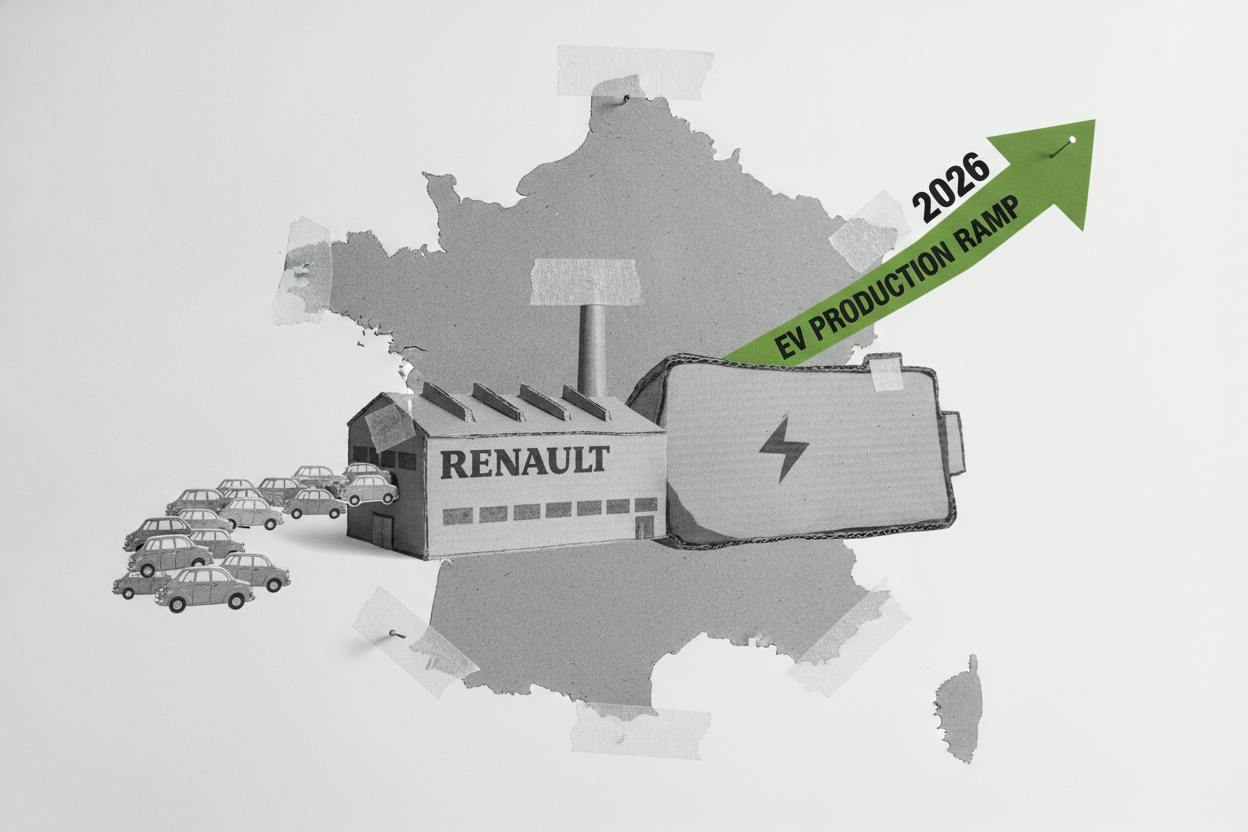
Renault is doubling down on its home turf. The French automaker says it will reinvest more than €10 billion in France over the next five years, building on a 2025 in which it produced 500,000 vehicles in the country. The announcement, made by CEO François Provost on France Inter radio and reported by Reuters, underscores the company's bet that its electric-vehicle (EV) transition can also revive domestic manufacturing.
Provost said Renault has already spent €13 billion in France over the past five years to retool factories for EVs. The new commitment is meant to continue that effort, though he added a caveat: the investment will proceed “if the social and political context allows it.” That phrasing reflects the delicate balance automakers face in Europe, where labor costs are high and governments are tightening emissions rules while also grappling with political uncertainty.
Why the production number matters
The headline figure is the €10 billion, but the more telling metric is output. Renault produced 500,000 cars in France in 2025 and expects at least 25% more in 2026 as EV volumes rise. That jump is significant because car plants are capital-intensive operations with high fixed costs—staff, equipment, and maintenance. Once a factory is running, producing additional vehicles spreads those fixed costs over more units, lowering the cost per car.
This is known as operating leverage, and it's crucial in the EV market, where competition has pushed prices down and squeezed profit margins. If Renault can lift production by a quarter, it could either protect its margins or give it room to price its “affordable” EVs more competitively without taking a full hit to profitability.
But the plan's value depends on execution. The €10 billion investment is only worthwhile if demand and labor conditions support the promised ramp-up. If the production increase doesn't materialize, the spending risks becoming capacity without enough orders to fill it.
What it means for investors
For investors, the key question is whether Renault can turn higher volumes into better financial performance. The company's push into lower-priced models and EVs is a response to intense competition, particularly from Chinese manufacturers and Tesla. A successful ramp in France could help Renault defend its market share and improve its cost structure.
Suppliers tied to Renault's domestic plants could also benefit from steadier, larger orders, from components to logistics. That ripple effect is one reason the announcement matters beyond just Renault's own stock.
However, there are risks. The French political and social climate has been volatile, with protests over pension reforms and other issues. Provost's conditional language hints that the investment could be scaled back if conditions deteriorate. Additionally, the broader European auto market is facing headwinds, including high energy costs and a slower-than-expected EV adoption in some countries.
Investors will also be watching how Renault's spending compares to its peers. The company is not alone in pouring money into EVs—rivals like Stellantis and Volkswagen are making similar commitments. But Renault's focus on France is distinctive, as it ties the transition to a domestic manufacturing rebound.
For context, the broader market has been jittery about French assets. The spread between French and German government bonds recently hit a 2012 high, reflecting investor concerns about political instability and fiscal policy. That backdrop could make it harder for Renault to secure favorable financing or for the government to support industrial policy.
The bigger picture
Renault's announcement is part of a larger trend of automakers reshoring production to be closer to customers and to reduce supply-chain risks. The pandemic exposed the fragility of global supply chains, and EVs have added new complexities, such as battery sourcing. By investing in France, Renault is betting that local production will pay off in the long run, even if it costs more upfront.
The company's shift toward lower-priced models is also notable. As EV prices have dropped, automakers have had to find ways to cut costs. Producing more vehicles in existing plants is one way to do that, but it requires sustained demand. If the European economy weakens, consumers may delay big purchases, and Renault's production targets could be at risk.
For everyday investors, the takeaway is that Renault's plan is a high-stakes bet on the future of European manufacturing. It's not just about building cars; it's about whether the company can make money doing it. The €10 billion investment is a signal of confidence, but the real test will come in 2026, when the production numbers are due.
As always, it's wise to keep an eye on how the company executes. Other companies have faced challenges when big plans meet market realities, and Renault is no exception. The next few quarters will show whether the French automaker can turn its ambitious targets into tangible results.