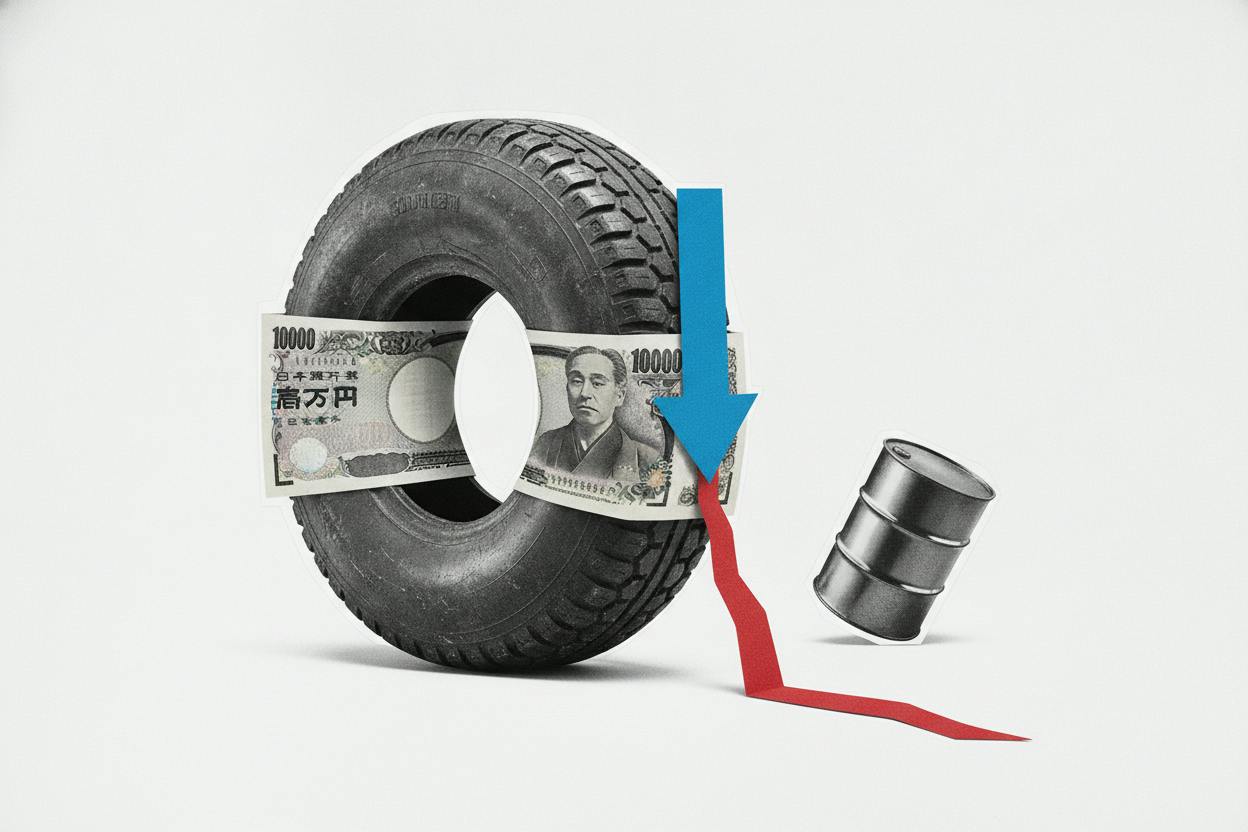
Rubber futures in Japan edged higher on Friday, putting the benchmark Osaka contract on track for its first weekly gain in five weeks. The move came as the yen weakened toward 160 per dollar and oil prices jumped about $3 a barrel, two forces that can shift the outlook for the natural rubber market.
The April contract on the Osaka Exchange rose 0.82% to 440.1 yen per kilogram, and was up 3.77% for the week. Prices were also firmer in China: the Shanghai Futures Exchange's natural rubber contract gained 0.31% to 19,550 yuan a ton, while butadiene rubber—a key synthetic rubber—climbed 2.36% to 15,860 yuan.
Why the yen matters for rubber
Rubber contracts traded in Osaka are priced in yen, so the currency's value plays a direct role in how those prices look to international buyers. When the yen weakens, the same yen price translates into fewer US dollars, making Japanese rubber appear cheaper to overseas traders. That can draw in additional demand and support prices, even if the local price barely moves.
But the yen's slide toward 160 per dollar carries a warning. Traders have long viewed that level as a potential trigger for official intervention by Japanese authorities to slow the currency's decline. The risk of a sudden rebound—if the government steps in—can inject short-term volatility into yen-denominated assets, including rubber futures. A stronger yen would instantly raise the dollar cost of the same contract, potentially unwinding cross-border buying flows just as quickly as they appeared.
This dynamic is not new. Japan has intervened in currency markets in the past when the yen moved too far, too fast. The possibility of such action is something investors in yen-priced commodities have to keep in mind, especially when the currency is trading near well-worn thresholds.
Oil's role in the rubber complex
Oil is the other major lever for rubber prices. Natural rubber competes with synthetic rubber, which is made from crude oil derivatives. When oil prices climb, synthetic rubber becomes more expensive to produce, which can make natural rubber relatively more attractive and lift the entire complex. Friday's $3-a-barrel jump in oil provided a fresh tailwind for rubber futures.
Still, the demand picture remains mixed. Tyres Europe, an industry group, reported that European replacement sales for passenger and light-truck tires fell 1% in the third quarter. That suggests softness in a key end-market for rubber. At the same time, EU anti-dumping duties have pushed some tire imports away from China and toward Southeast Asia, which could shift sourcing patterns and affect regional rubber demand.
What it means for investors
For everyday investors, the takeaway is that rubber futures are influenced by a mix of currency moves, energy prices, and end-market demand. A weaker yen can make Japanese rubber look cheaper to global buyers, but it also raises the risk of official intervention that could reverse the move quickly. Higher oil can support natural rubber prices by making synthetic alternatives costlier, but weak tire sales in Europe remind us that demand is not uniformly strong.
Investors who hold rubber futures or related exchange-traded products should watch the yen's path closely. A break above 160 could prompt a response from Japanese officials, and that could lead to sharp swings in yen-priced contracts. Similarly, oil price movements—driven by geopolitical events or supply changes—can feed through to rubber prices in ways that are not always obvious.
For those with broader market exposure, the yen's slide is part of a larger story about Japan's economy and monetary policy. The Bank of Japan has been gradually moving away from ultra-loose policy, but the yen's weakness persists, partly reflecting the interest rate gap between Japan and the US. If Japanese authorities step in to support the currency, it could have ripple effects across global markets, including commodities.
As always, it's worth remembering that commodity futures are volatile and can be influenced by factors that are hard to predict. The current uptick in rubber prices is a reminder of how interconnected global markets are—what happens in currency and oil markets can quickly show up in the price of a material used in everything from tires to medical gloves.



