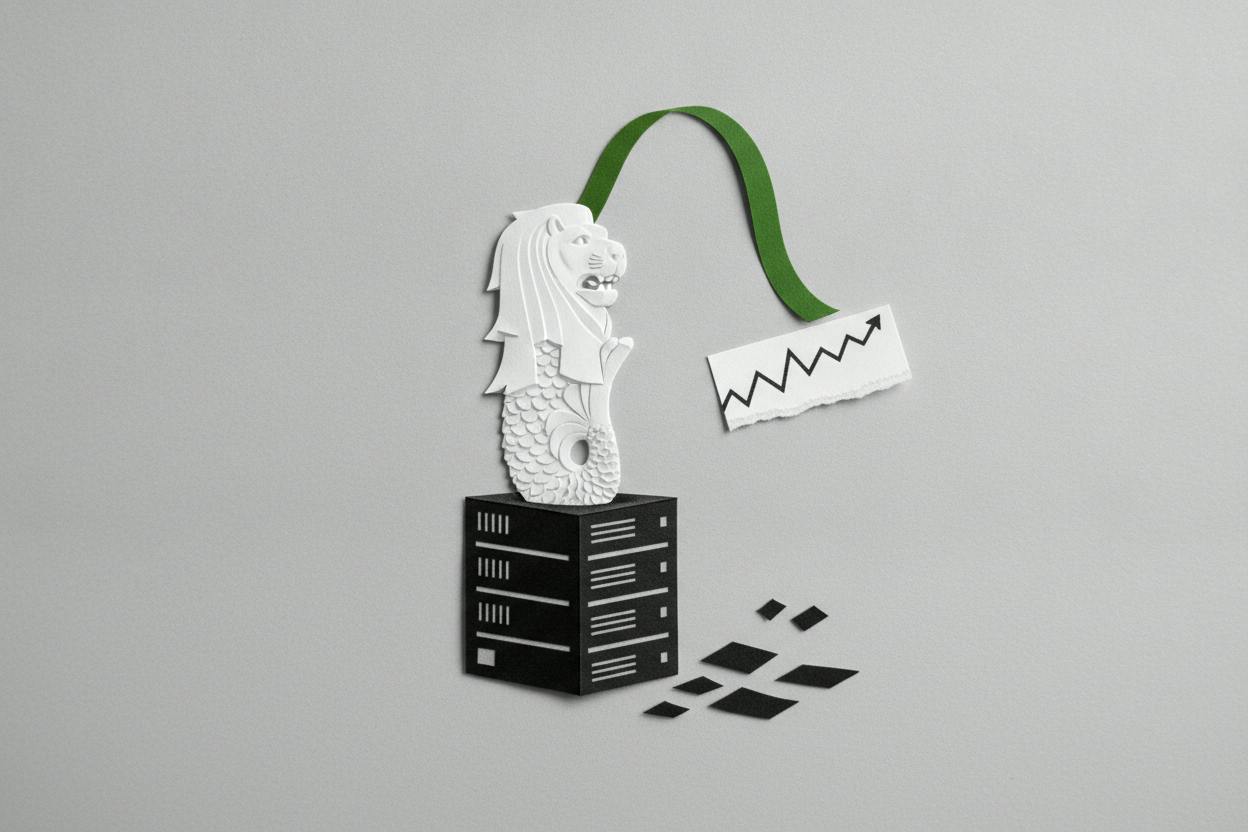
Singapore stocks closed slightly higher on Friday, as the global pullback in AI and semiconductor shares lost momentum. The Straits Times Index (STI) finished up 0.1%, with gains driven more by company-specific news than by broad market strength.
The calmer mood in tech helped set a steadier tone, but the day's moves were largely about individual stocks. Keppel DC REIT, a real estate investment trust focused on data centers, climbed 4% after reporting a rise in distributable income. Seatrium, a marine engineering firm, gained nearly 2% on new contract wins. CapitaLand China Trust, which invests in Chinese properties, also rose, though its operating numbers showed some softness.
Keppel DC REIT leads on higher payouts
Keppel DC REIT said its distributable income for the nine months ended September 30 rose to SG$228 million, up from SG$195.3 million a year earlier. That translated into a distribution per unit (DPU) of SG$0.0857, compared with SG$0.0767 in the same period last year.
For REIT investors, DPU is a key metric because it represents the cash payout they receive per unit. A higher DPU can make a REIT more attractive, especially when interest rates are elevated and investors are comparing yields against safer assets like government bonds. The jump in Keppel DC REIT's unit price reflects that logic: stronger expected cash flows can support a higher price while keeping the yield competitive.
But the move also highlights a sensitivity. Once a REIT's price rises to reflect better payouts, future DPU reports carry more weight. Investors will want to see that the higher distribution is sustainable, not a one-off boost. Data center demand, driven by cloud computing and AI workloads, has been a tailwind for the sector, but competition and rising power costs are factors to watch.
Seatrium and CapitaLand China Trust: mixed signals
Seatrium, which provides engineering and offshore solutions, gained nearly 2% after winning conversion and integration work on five Whale Class powerships for Karpowership. Powerships are floating power plants, and this contract adds to Seatrium's order book, which has been recovering as energy infrastructure spending picks up.
CapitaLand China Trust rose nearly 1%, even as its nine-month gross revenue slipped to 1.22 billion yuan from 1.28 billion yuan a year earlier. The decline is a reminder that not every part of the market is seeing improving trends. China's property sector has faced headwinds, and retail and office demand in the country remains uneven. The trust's modest gain suggests investors were looking past the revenue dip, possibly focusing on other factors like asset quality or potential recovery in the region.
What it means for investors
The STI's small gain on Friday underscores how dividend-heavy indexes can behave. When the broader market is quiet, a large REIT or a single stock with outsized moves can have a disproportionate effect on the headline number. For everyday investors, this is a reminder to look beyond the index level and understand what is driving it.
Keppel DC REIT's performance also illustrates the mechanics of REIT investing. Higher distributable income can lead to a higher DPU, which can justify a higher unit price. But the flip side is that once the price adjusts, future DPU growth becomes more important. Investors should watch whether the company can maintain or grow its payouts, rather than assuming a single good quarter means a permanent step-up.
The broader context is a global market that has been jittery about AI spending. Recent concerns about the scale of capital expenditure by big tech firms have hit semiconductor and AI-related stocks, as seen in emerging Asian markets. Singapore's relative calm on Friday suggests that some of that selling pressure may be easing, at least for now.
For investors, the key takeaway is that Singapore's market remains driven by fundamentals like earnings and dividends, rather than just tech sentiment. That can be a source of stability, but it also means that company-specific news—like a REIT's distribution update or a contract win—can move the index more than global headlines.
Looking ahead, investors will likely keep an eye on how the AI sell-off evolves, as well as on upcoming earnings and economic data. The STI's modest gain is a sign that the market is holding up, but the path forward will depend on whether the calm in tech persists and whether corporate results continue to support valuations.



