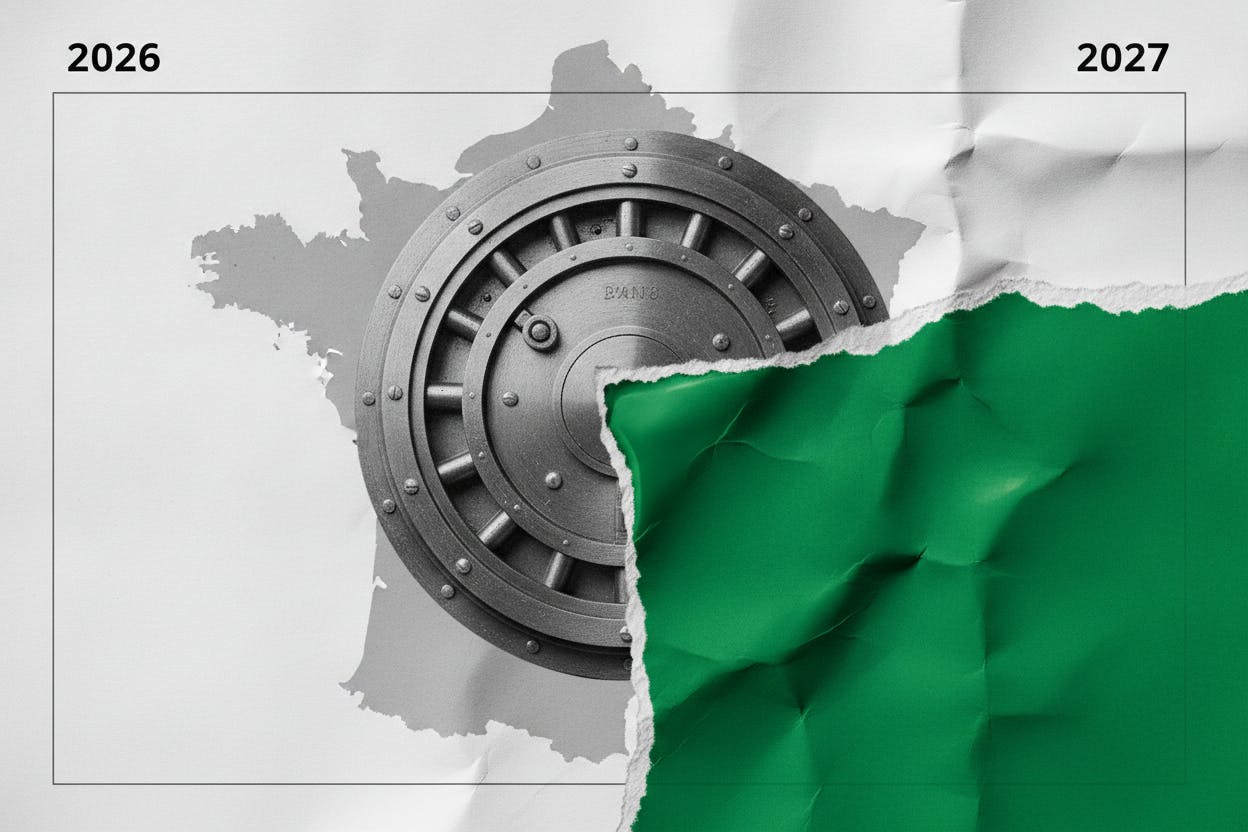
Investors watching French banking giant Société Générale got a mixed signal this week. Analysts at AlphaValue/Baader Europe raised their profit forecast for 2026, but they turned noticeably more cautious about 2027, citing a deteriorating economic and political backdrop in France.
In a research note published Tuesday, the firm lifted its 2026 earnings-per-share (EPS) estimate by 10.1% to €9.19. The upgrade was driven largely by a slightly higher revenue outlook and what analysts describe as a continuing recovery in SocGen's French retail banking division. However, the same note cut the 2027 EPS forecast by 16.7% to €9.24, even while nudging revenue expectations higher. The reason: the analysts expect the French economy to weaken later this year, pushing borrower stress into late 2026 and early 2027.
Why the split outlook?
The divergence between the two years reflects a common challenge for banks: near-term momentum versus longer-term risk. For 2026, the picture looks relatively bright. SocGen's retail operations in France have been recovering, and revenue trends are improving. That gives analysts confidence that this year's earnings will come in stronger than previously thought.
But the outlook for 2027 is clouded by rising concerns about loan losses. When an economy slows, borrowers—both households and businesses—are more likely to struggle repaying debt. Banks must set aside money to cover those potential defaults, which directly eats into profits. AlphaValue/Baader has raised its expected loan-loss provisions for 2027, reflecting a view that France's macro environment will deteriorate and that political uncertainty will weigh on business confidence.
France has been grappling with political instability, including a fragmented parliament and ongoing budget debates. That uncertainty can dampen investment and consumer spending, which in turn affects the quality of a bank's loan book. For SocGen, a large domestic lender, the health of the French economy is a key driver of its profitability.
What this means for investors
For everyday investors, this note is a reminder that bank stocks are sensitive to the broader economy. When analysts change their earnings forecasts, it often moves the share price, because investors use those estimates to value the company. A higher 2026 forecast is supportive, but a lower 2027 number suggests that the market may need to brace for a tougher period ahead.
It's also worth noting that this is just one analyst firm's view. Other analysts may have different assumptions about France's economic trajectory or SocGen's ability to manage risk. Still, the move highlights a key tension: banks can look good in the short term while facing headwinds that may not show up until later.
For those holding SocGen shares, the key question is how the French economy evolves. If growth holds up better than expected, loan losses could stay low and 2027 earnings might beat the revised forecast. If the economy weakens more sharply, the bank could face higher provisions and pressure on profits.
Investors should also keep an eye on broader market signals. Recent data on consumer confidence slipping and a dimmer outlook in the US suggest that global sentiment is fragile, which could spill over into Europe. Meanwhile, stock markets are watching Nvidia earnings and other corporate results for clues about the health of the global economy.
The bigger picture
Société Générale is one of Europe's largest banks, with significant operations in retail banking, corporate and investment banking, and asset management. Its fortunes are closely tied to the French economy, which has been growing slowly but faces headwinds from high public debt and political gridlock.
Banks generally benefit from higher interest rates, as they can charge more for loans. But they also face the risk that higher rates make it harder for borrowers to repay. In France, the European Central Bank's rate policy has been a double-edged sword: it boosts net interest income but also increases the risk of defaults.
The analysts' decision to raise 2026 estimates while cutting 2027 is a classic example of how forecasters try to balance near-term optimism with longer-term caution. It also underscores the importance of looking beyond a single year when evaluating a bank stock.
For investors, the takeaway is to consider the full picture. A bank can post strong earnings this year, but if the economy is expected to weaken, future profits may be at risk. That's why analysts spend so much time modeling loan losses and macro scenarios.
As always, no single analyst note should drive an investment decision. But it's a useful signal that the market is starting to price in more risk for 2027, and that could influence how SocGen's stock trades in the coming months.