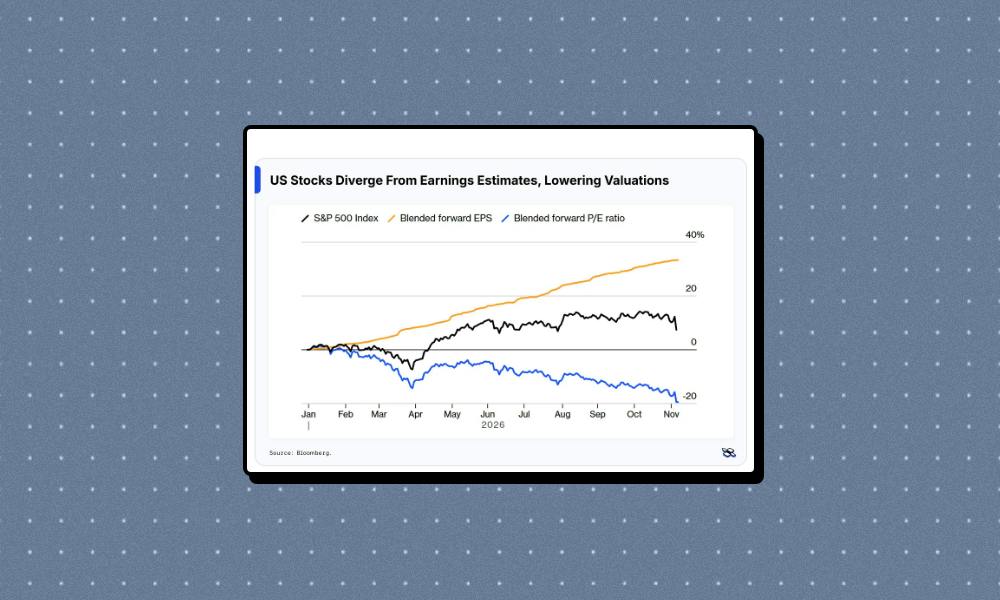
US stock prices have been sliding, but the earnings forecasts that often anchor them have barely budged. That gap is doing the math for investors: valuations—the price you pay for each dollar of expected profit—are coming down.
For everyday investors, this is a shift worth understanding. When prices fall faster than earnings expectations, stocks look cheaper on paper. But cheaper isn't always a bargain if the earnings themselves are at risk.
Why the divergence matters
Valuations are a simple ratio: the stock price divided by expected earnings per share. If the numerator (price) drops while the denominator (earnings estimates) holds steady, the ratio falls. That's exactly what's happening across broad swaths of the US market.
The recent tech selloff was brutal, exposing just how fragile sentiment has become. A modest rebound has followed, but investors remain jittery. The core worry: whether Big Tech's enormous spending on artificial intelligence will ever generate the returns that justify it.
AI has been the market's main engine for years. Companies have poured billions into data centers, chips, and cloud infrastructure, betting that AI will transform industries and boost profits. But if those bets don't pay off quickly, the stocks that rode the wave could face a painful repricing.
Political and regulatory headwinds
It's not just AI anxiety. US political uncertainty is adding to the fog. Following the midterm election, tougher permitting rules and rising grid-connection costs could delay data center construction. That's a direct threat to chipmakers, whose revenues depend on those facilities being built.
Semiconductor valuations have already started to slip, and the sector is now caught between high expectations and operational hurdles. If data centers get delayed, chip demand could soften, and earnings estimates—the ones that have held up so far—might finally start to fall.
This is a reminder that markets don't move on fundamentals alone. Sentiment, politics, and regulation all feed into the price you see on your screen.
What it means for investors
For the average investor, the takeaway isn't to panic or to rush in. It's to recognize that a falling valuation can be a signal of caution, not just an opportunity. When prices drop but earnings forecasts stay high, the market is essentially saying: "We're less sure those profits will materialize."
That uncertainty cuts both ways. If AI investments do deliver, today's lower valuations could look like a gift. If they don't, earnings estimates will eventually catch down to reality, and the stocks won't look cheap anymore.
Investors should also keep an eye on the broader economy. US growth is slowing, and any downturn would hit corporate profits across the board. The recent rise in Treasury yields has already put pressure on rate-sensitive sectors, and that dynamic could continue.
Meanwhile, geopolitical risks—like oil price swings tied to Iran tensions—can ripple through markets in unexpected ways. And the AI trade itself has shown signs of strain, even as rivals rally on any hint of weakness from the leader.
The road ahead
No one can say with certainty whether the market has bottomed or has further to fall. What's clear is that the old playbook—buy the dip because earnings will save you—is being tested. With AI spending under scrutiny and political and regulatory risks mounting, the path to a swift recovery is far from guaranteed.
For now, the smartest move for most investors is to stay diversified, avoid making big bets on a single narrative, and remember that valuations are just one piece of the puzzle. The market is telling you it's nervous. It's worth listening.



