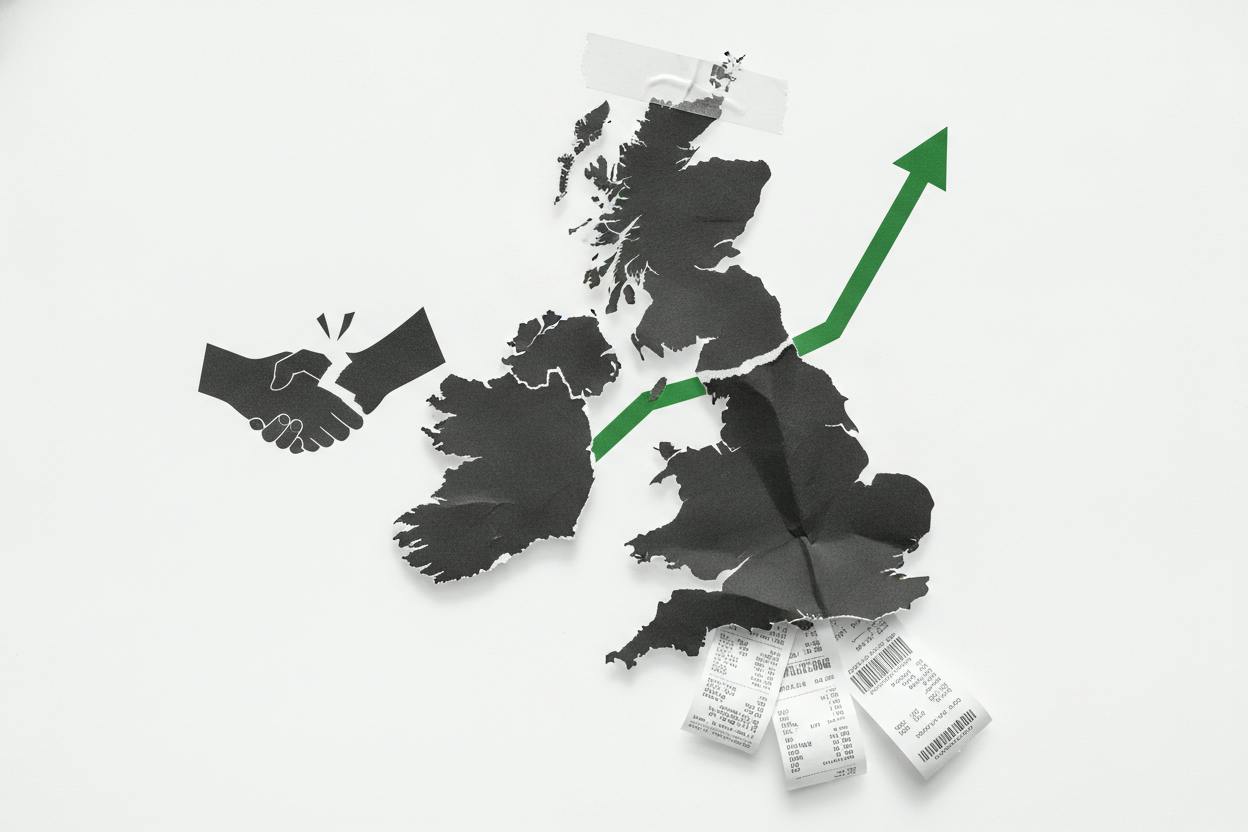
London's FTSE 100 is expected to open modestly higher on Friday, with futures up 0.2%, even as two pieces of news pointed in the opposite direction. Official data showed UK retail sales fell 0.4% in September, and merger talks between medical-device maker Smith & Nephew and US healthcare giant Johnson & Johnson (J&J) collapsed.
The split-screen is typical for the UK's flagship index. Many of its largest members are global businesses that earn in dollars and other currencies, so they can shrug off a weak domestic economy. But beneath the surface, the data and the failed deal highlight risks that could hit UK-focused companies harder.
Retail sales and consumer confidence point to softer demand
The 0.4% drop in September retail sales was worse than economists had expected. It follows a consumer-confidence survey that recorded its sharpest month-on-month fall since early in the COVID-19 pandemic. Together, they suggest households are tightening their belts, likely due to persistent cost-of-living pressures and uncertainty about the economic outlook.
For investors, weaker consumer spending is a red flag for companies that rely on UK shoppers. Analysts often cut revenue forecasts for such firms when spending dips, which can lead to a wave of earnings downgrades. The FTSE 250, which is packed with more domestically focused businesses, typically feels this pressure sooner than the FTSE 100.
That's why a green start for the headline index can coexist with growing strain under the surface. The FTSE 100's multinationals can offset a weak home market with overseas sales, and a weaker pound can boost the value of their foreign earnings when converted back to sterling.
Smith & Nephew and J&J: a deal that fell apart
The proposed $34 billion tie-up between Smith & Nephew and J&J's orthopedics unit was one of the biggest potential deals in the medical-device sector. According to the Financial Times, the talks broke down over who would run the combined company. Control and governance issues can kill a deal even when the business logic makes sense.
Smith & Nephew, a UK-based maker of implants and surgical equipment, had been seen as a possible takeover target for some time. The collapse of the talks removes that premium from the stock, though it also leaves the company independent to pursue its own strategy. For J&J, the failure means it must look elsewhere to bolster its orthopedics business, which has faced pricing pressure and supply-chain issues.
M&A activity is often a driver of stock moves, and failed deals can lead to sharp declines in the target's share price. Investors who bought in anticipation of a takeover may now sell, putting downward pressure on the stock.
What it means for investors
For everyday investors, the key takeaway is that the FTSE 100's performance doesn't always reflect the health of the UK economy. A 0.2% rise in futures says more about global exposure and currency effects than it does about the high street.
If you hold funds or ETFs that track the FTSE 100, you're mostly betting on global giants like oil companies, banks, and consumer goods firms. Their fortunes are tied to the world economy, not just Britain's. In contrast, the FTSE 250 or smaller UK-focused funds are more sensitive to domestic spending and sentiment.
The failed Smith & Nephew deal is a reminder that M&A can be unpredictable. While a takeover premium can boost a stock, the collapse of talks can erase those gains quickly. It's also a sign that even large, logical deals can stumble over issues like management control.
Looking ahead, investors will watch for further clues on consumer health, such as upcoming inflation and jobs data. They'll also keep an eye on any new deal activity in the healthcare sector, as companies may look for other ways to grow. For now, the UK market's split-screen remains: global strength, domestic caution.



