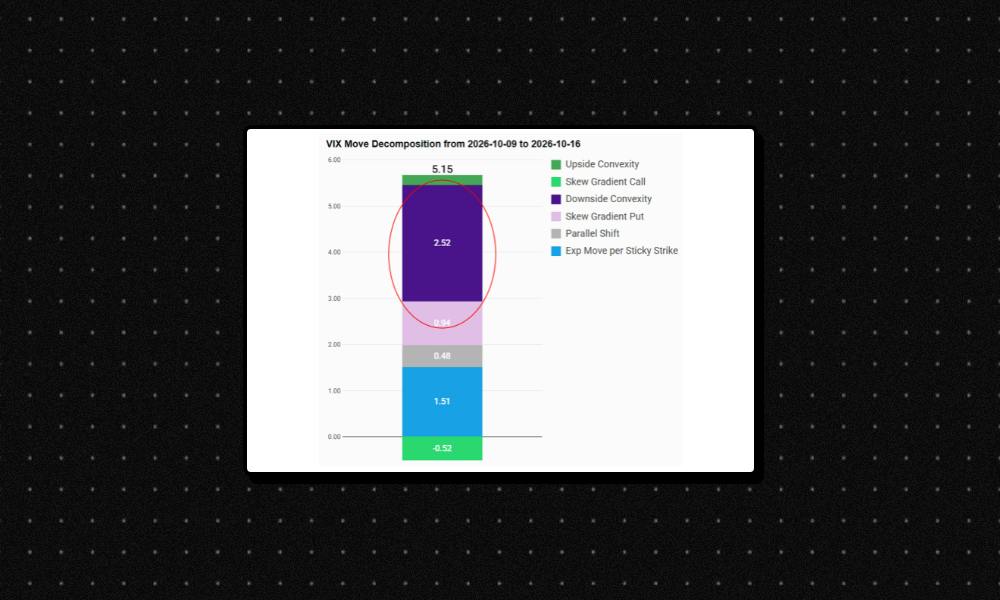
Last week, the Cboe Volatility Index—better known as the VIX—jumped by about 5 points to 20, its highest level in recent weeks. The index, which measures expected volatility in the S&P 500 based on the prices of S&P 500 Index options (SPX), is often called Wall Street's "fear gauge." A reading of 20 is not extreme, but the speed and size of the move have caught attention.
The jump came as investors rushed to protect against a sharper market fall ahead of Big Tech's earnings. With several mega-cap technology companies set to report results, traders are bracing for potential surprises that could move the entire market. These companies are so large that their earnings can sway the S&P 500, and investors are paying up for options that would cushion a drop.
What the VIX tells us
The VIX is calculated from the prices of options on the S&P 500. When investors expect big swings, they bid up the price of options, which pushes the VIX higher. A level around 20 is above the long-term average (which is often cited as roughly 17-18) but well below panic levels seen during crises, when it can spike above 30 or 40.
What makes last week's move notable is that it wasn't just a typical reaction to falling stock prices. According to Cboe's VIX decomposition tool, which breaks down the index's 5.15-point increase between October 9th and October 16th, the biggest contributor was not the usual hedging tied to market declines. Instead, it appears investors were actively positioning for something uglier—perhaps a sharp selloff triggered by disappointing earnings or guidance from Big Tech.
This kind of behavior is common ahead of major events. When uncertainty is high, investors buy put options (which gain value if the market falls) as insurance. The cost of that insurance rises, and the VIX reflects it. But the decomposition suggests that the demand for protection was more aggressive than normal, indicating that investors are not just passively worried—they are taking action.
Why Big Tech earnings matter
Big Tech companies—think Apple, Microsoft, Alphabet, Amazon, and Meta—account for a huge portion of the S&P 500's market capitalization. Their earnings reports can move the index significantly, both up and down. If one of these companies misses expectations or gives weak guidance, it can drag down the entire market. Conversely, strong results can lift the whole index.
This earnings season, investors are particularly focused on how these companies are managing costs, whether their cloud businesses are growing, and how much they are spending on artificial intelligence infrastructure. The stakes are high, as tech stocks have been a major driver of market gains this year.
Given that concentration, a single disappointing report could trigger a broader selloff. That's why investors are buying protection now, before the results come out. The VIX jump is a sign that they are not taking any chances.
What it means for everyday investors
For most people with diversified portfolios, a VIX spike is not a reason to panic. It's a signal that market participants expect more turbulence in the near term. But it doesn't predict the direction of the market—just the magnitude of potential moves.
If you're a long-term investor, the key takeaway is that volatility is a normal part of investing. Trying to time the market based on the VIX is rarely successful. Instead, focus on your asset allocation and time horizon. If you have a well-diversified portfolio, you're already positioned to weather short-term swings.
That said, the VIX jump does highlight the importance of understanding your own risk tolerance. If you're uncomfortable with the idea of a 10% or 20% drop in your portfolio, it might be worth reviewing your allocation to ensure it matches your comfort level. But making sudden changes based on a single week's move is usually not advisable.
Investors should also keep an eye on how the earnings season unfolds. If Big Tech delivers strong results, the market could rally, and the VIX would likely fall back. If not, we could see more volatility. Either way, the VIX is just a snapshot of sentiment—not a crystal ball.
As mega-cap earnings and Treasury yields remain in focus, the coming weeks will tell us whether the market's nervousness was justified or overblown.