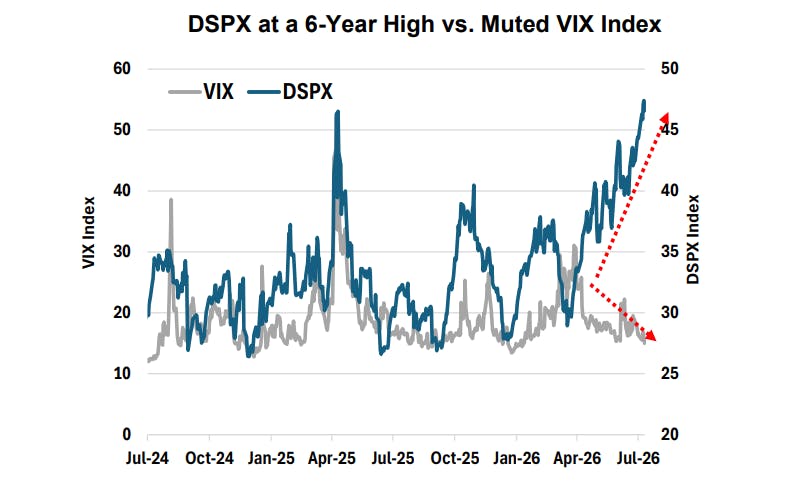
The overall US stock market looked pretty calm during the week beginning July 6th. But that calm hid a lot of action underneath.
The Cboe Volatility Index, or VIX Index, fell by 0.8 points to around 15 over the week, leaving it near the lowest level so far this year. That’s telling: the VIX Index is a forward-looking measure of expected market volatility, based on a basket of S&P 500 Index options, so it gives a read on how much movement investors are pricing in for the broader US stock market. Put simply, investors weren’t anticipating a particularly bumpy ride for the index itself.
But beneath that placid surface, something unusual was happening. A metric called dispersion — which tracks how much individual stocks within the index are moving in different directions — surged to its highest level in six years. Dispersion measures the spread of returns across stocks. When it’s low, most stocks move together. When it’s high, some stocks are soaring while others are plunging, even if the overall index barely budges.
What Drove the Divergence?
The week saw a sharp rotation among sectors. Tech and AI-related stocks, which had led the market higher for much of 2024, faced profit-taking and regulatory headwinds. Meanwhile, value-oriented sectors like financials and energy gained ground as investors bet on a resilient economy and higher interest rates. This rotation created wide gaps in performance: some stocks rose 5% or more while others fell by similar amounts, all within the same index.
This kind of divergence often signals that investors are reassessing their assumptions about the economy, interest rates, or corporate earnings. In this case, the backdrop included mixed economic data and shifting expectations for Federal Reserve policy. While the VIX remained low — suggesting confidence in the overall market’s stability — the high dispersion indicated that investors were making big bets on individual companies and sectors rather than betting on the market as a whole.
What It Means for Investors
For everyday investors, this split between a calm VIX and high dispersion is a reminder that index-level numbers can be misleading. A low VIX might make the market feel safe, but it doesn’t mean your individual holdings are safe. If you own a diversified portfolio of stocks, you may have experienced wide swings in your holdings even as the S&P 500 barely moved.
This environment also highlights the importance of diversification. When dispersion is high, stock-picking becomes riskier because the gap between winners and losers widens. Index funds or ETFs that track the broad market can help smooth out those swings, but they won’t eliminate them entirely. Investors should also pay attention to sector exposure: if your portfolio is heavily weighted toward one sector that’s falling, you could feel the pain even if the overall market looks calm.
Looking ahead, the key question is whether this divergence will persist or converge. If the rotation continues, we could see more volatility in individual stocks even if the VIX stays low. That would make it a challenging time for active traders but potentially a good one for long-term investors who can ride out the noise.
For more on how global markets are reacting to similar dynamics, check out our coverage of Nikkei's rise amid chip stock optimism and China's market split as investors rotate out of chip stocks.
In summary, the VIX’s low reading might suggest smooth sailing, but the six-year high in dispersion tells a different story. Investors should look beyond the headline index numbers and understand what’s happening under the hood — because that’s where the real action is.



