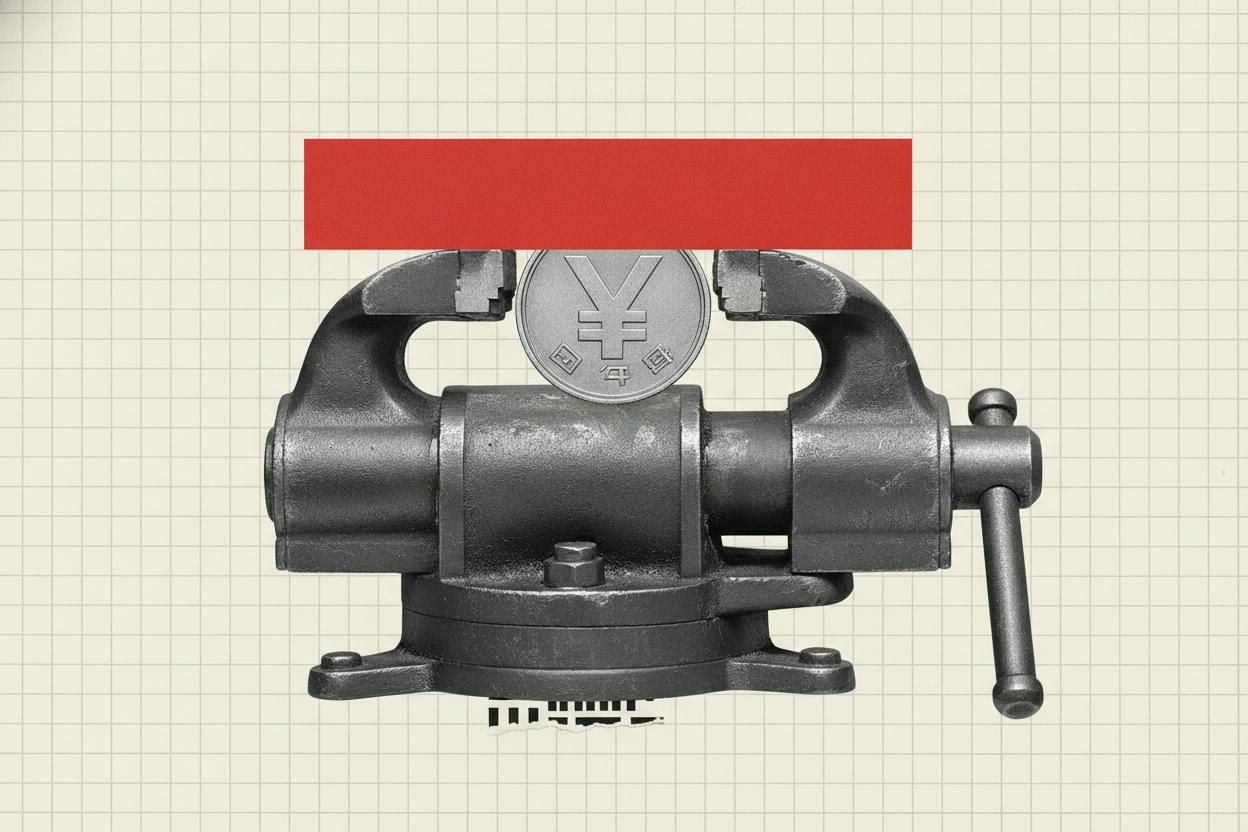
The yen hovered just below 160 per dollar on Monday after Japan reported a surprise economic contraction, leaving traders to balance weaker growth against the risk that officials step in to support the currency.
Japan's gross domestic product shrank at a 0.1% annualized pace in the July-September quarter, according to the government's initial reading. Economists had expected modest growth, making the decline a clear miss. The data adds to a mixed picture for the world's fourth-largest economy, which has struggled to regain momentum after a prolonged period of subdued expansion.
Normally, softer growth data would push the Bank of Japan (BOJ) toward a more cautious stance, keeping interest rates lower and putting further downward pressure on the yen. But strategists say the central bank may look past this particular number.
Why the BOJ might shrug off the contraction
Masahiko Loo, a strategist at State Street, said the BOJ could treat the GDP drop as a “soft patch” unless weakness starts showing up in wages, services, and broader domestic demand. That distinction matters because the central bank has been signaling a gradual path toward normalizing monetary policy after years of ultra-low rates.
In recent months, Japan has seen signs that inflation is becoming more broad-based, and the BOJ has hinted at further rate hikes if that trend continues. A single quarter of negative growth may not be enough to derail that plan, especially if the underlying drivers of domestic demand remain intact.
Investors will be watching upcoming data on wages and household spending for clues. If those numbers stay firm, the BOJ could still raise rates later this year or early next, which would support the yen. But if the weakness spreads, the central bank may be forced to hold off, leaving the currency vulnerable.
Intervention risk looms near 160
With USD/JPY trading near 159.72, the exchange rate is close to levels where Japan has previously stepped into currency markets. Loo noted that “strong resistance” could emerge deeper into the 160s as “intervention risk rises” and new short-yen positions look less appealing.
Japan's finance ministry has a history of intervening to support the yen when it weakens too quickly. The last confirmed intervention was in 2022, when the yen fell to around 150 per dollar. More recently, the U.S. joined Japan in supporting the yen for the first time since 1998, underscoring how sensitive policymakers are to excessive currency moves.
For traders, the key change is “tail risk” – the chance of a sudden, policy-driven move that can quickly strengthen the yen and hit anyone positioned for further weakness. That kind of risk is hard to manage in the spot market, so it often shows up first in hedging: more demand for protection that pays off if USD/JPY drops sharply, and less appetite to add fresh short-yen bets.
The upshot is that even if the dollar stays supported, trading around 160 can become more stop-start, with bigger swings driven by positioning and volatility.
What's driving the dollar
At the same time, a firmer US dollar backdrop is still doing the heavy lifting. The dollar index stood around 103.46 after hawkish commentary from Federal Reserve officials and a hotter-than-expected October inflation reading.
That inflation print has led markets to scale back expectations for aggressive Fed rate cuts, which in turn supports the dollar. Higher US interest rates make dollar-denominated assets more attractive, drawing capital away from yen and other currencies.
The combination of a resilient US economy and a cautious BOJ has kept the yen under pressure for much of the year. But the closer the exchange rate gets to 160, the more the intervention risk becomes a factor in its own right.
What it means for investors
For everyday investors, the yen's slide has a few practical implications. If you hold Japanese stocks or funds, a weaker yen can boost the value of overseas earnings when converted back, but it can also signal underlying economic weakness. For those with exposure to Japanese bonds, the BOJ's policy path will be crucial.
Currency moves also affect multinational companies. A weaker yen makes Japanese exports cheaper and more competitive, which can help large manufacturers. But it raises the cost of imported energy and raw materials, squeezing households and smaller businesses.
Investors should also be aware that intervention risk can create sudden, sharp moves in the yen. If you're trading currencies or have exposure to Japanese assets, it's worth understanding that a policy surprise could happen with little warning.
For now, the market is in a waiting game. The BOJ's next policy meeting will be closely watched for any shift in language. Meanwhile, the yen's fate may hinge on whether the US dollar continues to strengthen or whether Japan's economy shows signs of stabilizing.
As always, it's important to remember that currency markets are complex and influenced by many factors. This article is for informational purposes only and does not constitute financial advice.