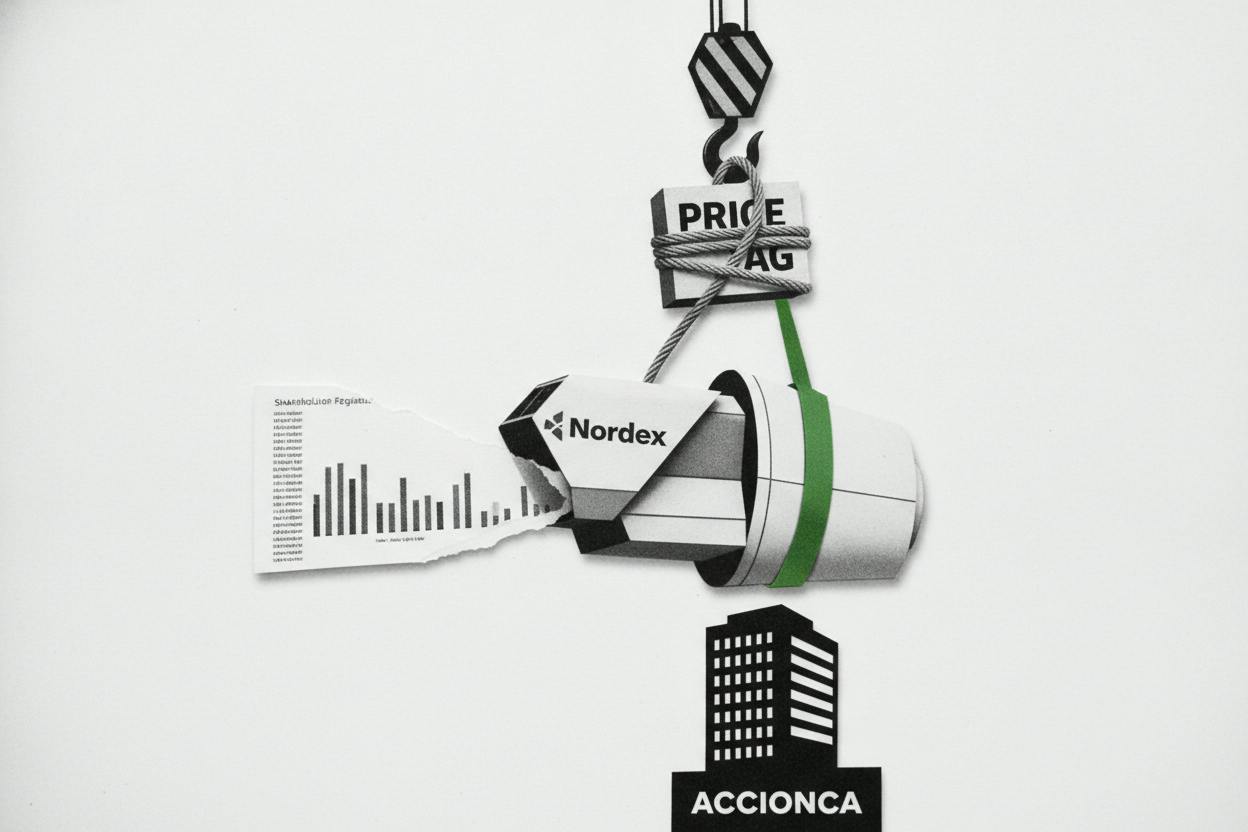
Acciona, the Spanish infrastructure and renewables group, is seeing its earnings outlook brighten thanks to its large stake in wind-turbine maker Nordex. But at least one equity research firm thinks the market has already noticed — and that the boost doesn't fully belong to Acciona's own shareholders.
AlphaValue/Baader Europe, a European equity research house, raised its earnings per share (EPS) forecasts for Acciona for 2026 and 2027 to €9.79 and €10.90, up from €8.18 and €9.55. Yet the firm simultaneously cut its price target to €225 from €248 and downgraded its rating to “add” from “buy.” The move is a reminder that better earnings estimates don't always translate into a higher stock price.
What's driving the upgrade?
Nordex, in which Acciona holds a significant stake, has been in the middle of a turnaround. The turbine maker's nine-month earnings before interest, taxes, depreciation, and amortization (EBITDA) nearly doubled to €633 million. Nordex also raised its longer-term margin outlook for 2026 to 11.5%–12.5%, up from a previous range of 8%–11%.
That momentum is clearly feeding into Acciona's own numbers, since Acciona consolidates Nordex's results. But AlphaValue/Baader Europe's decision to trim its rating even while raising forecasts highlights a key nuance: not all of Nordex's improved profits will flow to Acciona's shareholders.
Nordex has minority shareholders of its own. A large portion of the subsidiary's earnings is attributable to those outside investors, not to Acciona. As a result, the market may be willing to pay less for each euro of Acciona's reported earnings, because a meaningful slice of those profits belongs to someone else.
Why the rating cut despite better numbers?
The analyst firm also pointed to two other concerns. First, Acciona's debt reduction has stalled, which could limit how much the company can return to shareholders or invest in growth. Second, there is uncertainty around Acciona Energía, the company's renewable energy unit, which has faced its own challenges in a tough market for clean-power developers.
These factors, the firm argues, could cap how much the stock rerates even with improved forecasts. In other words, the market may already be pricing in the Nordex tailwind, and the remaining upside is limited.
What it means for investors
For everyday investors, this is a useful case study in how markets value companies with partial ownership of subsidiaries. When a subsidiary's outlook improves, the parent company's headline earnings get a boost. But investors often look past the headline number and focus on what's actually attributable to the parent's shareholders.
That's a common issue for conglomerates and holding companies. Think of a parent that owns 60% of a subsidiary — the other 40% of profits go to minority shareholders. If the subsidiary's earnings jump, the parent's reported EPS rises, but the value to the parent's shareholders is only the portion they actually own. Markets frequently apply a lower valuation multiple to those earnings, which can cap the share-price upside even in a stronger operating environment.
This dynamic is not unique to Acciona. It's something investors see across Europe and beyond, from European ADRs to large industrial groups with multiple listed units. The lesson: always check how much of a company's profit actually belongs to its shareholders.
What to watch next
Investors will be watching Acciona's next earnings report for signs that the Nordex momentum is continuing and that the company is making progress on debt reduction. They'll also look for clarity on Acciona Energía's outlook, which has been a drag on sentiment.
The broader European market has been volatile lately, with tech stocks sliding and ADRs under pressure from dollar strength. In that environment, a stock like Acciona — with its mix of infrastructure, renewables, and a recovering manufacturing business — could still attract attention, but the easy gains may be behind it.
For now, the analyst's move is a cautionary tale: higher earnings forecasts don't automatically mean a higher stock price. Sometimes the market has already figured it out.