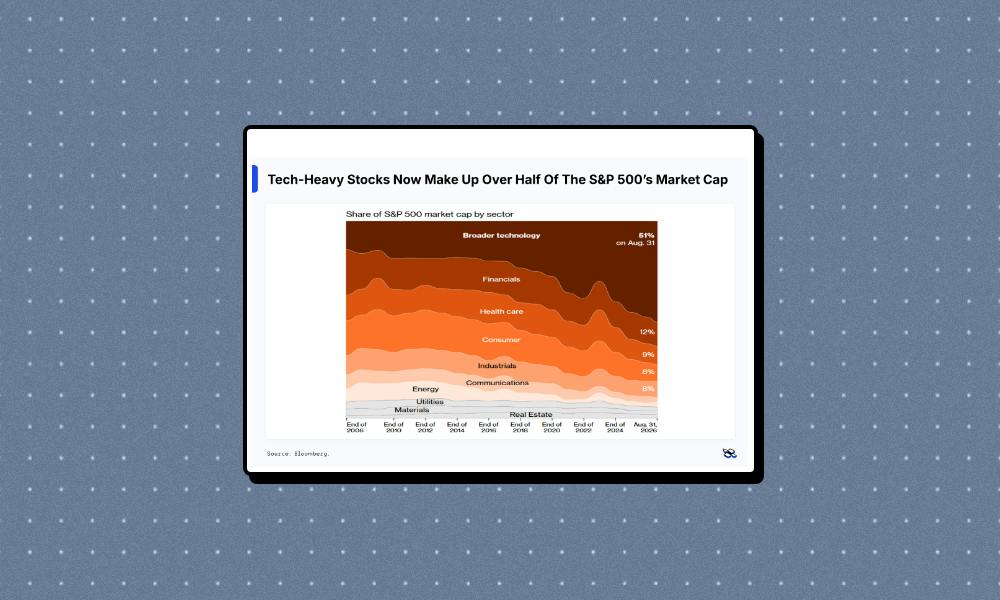
If you own a broad stock index fund, you might think you're diversified across hundreds of companies. But a closer look at today's market reveals a surprising truth: a huge chunk of that diversification is actually a bet on one theme—artificial intelligence.
Tech stocks now account for a whopping 51% of the S&P 500's total market value, according to recent data. That's the highest concentration in decades. And the AI wave isn't just lifting tech giants like Nvidia and Microsoft—it's also rippling through bonds, private equity, and even the companies that build the physical infrastructure for AI.
AI's footprint stretches far beyond tech stocks
When most people think of AI investing, they picture chipmakers and software firms. But the reality is that AI exposure now touches nearly every corner of the financial markets.
Take bonds, for example. The biggest issuers of corporate debt are often the "hyperscalers"—the massive cloud and data-center operators like Amazon, Microsoft, and Google parent Alphabet. These companies are borrowing heavily to build the data centers that power AI. According to Apollo data, AI-related companies account for 49% of all investment-grade bond issuance this year. That means even bond funds, which investors often buy for safety, are quietly tied to AI's fortunes.
Private markets are even more exposed. Venture capital has poured an extraordinary 87% of its funding into AI startups this year, according to the same data. And when private equity firms invest in everything from software to logistics, a growing share of that money ultimately flows toward AI-related businesses.
Even traditional infrastructure spending now increasingly means one thing: data centers. Utilities, construction firms, and equipment makers are all seeing demand driven by the need to power and cool AI servers.
One theme, many disguises
Goldman Sachs estimates that AI infrastructure firms alone account for roughly 40% of the S&P 500's value. That's a staggering figure when you consider that the index is supposed to represent the broad U.S. economy.
For everyday investors, the implication is clear: your "diversified" portfolio may be far more concentrated than you think. If you own an S&P 500 index fund, a tech-heavy growth fund, or even a corporate bond fund, you're likely making a big bet on AI's continued success.
That's not necessarily a bad thing—AI has been a powerful driver of corporate profits and market gains. But it does mean your portfolio's fate is tied to a single technological trend, and that carries risks. If AI adoption slows, if regulation tightens, or if the biggest players stumble, the impact could be felt across stocks, bonds, and private investments all at once.
What it means for investors
For most people, the takeaway isn't to abandon AI or to try to time the market. Instead, it's about understanding what you actually own. A fund labeled "diversified" may not be as diversified as it appears.
Investors who want to reduce concentration risk might consider looking beyond the S&P 500—for example, into small-cap stocks, international markets, or sectors like healthcare and consumer staples that are less tied to AI. But even those areas aren't immune, as AI's influence spreads through the economy.
It's also worth remembering that concentration can work both ways. When a theme is this dominant, it can drive outsized gains—but it can also amplify losses if sentiment turns. The recent AI-driven rally in stocks shows how powerful the trend can be, but it also highlights how much of the market's fate now rests on a handful of companies.
For bond investors, the rise of AI-related issuance means credit quality is increasingly tied to tech firms' ability to generate cash. That's a shift from the past, when investment-grade bonds were dominated by banks and industrial giants.
And for those with exposure to private markets—through venture capital funds or startup investments—the concentration is even more extreme. With 87% of VC funding going to AI, a downturn in that sector could hit private portfolios hard.
None of this means you should panic or make drastic changes. But it does suggest that a little extra scrutiny of your portfolio's true exposures could be wise. After all, the goal of diversification is to protect against any single event—and right now, AI is that single event for much of the market.
As always, the key is to understand what you own, why you own it, and whether it still fits your goals and risk tolerance. The AI wave may be reshaping markets, but your investment plan should remain your own.