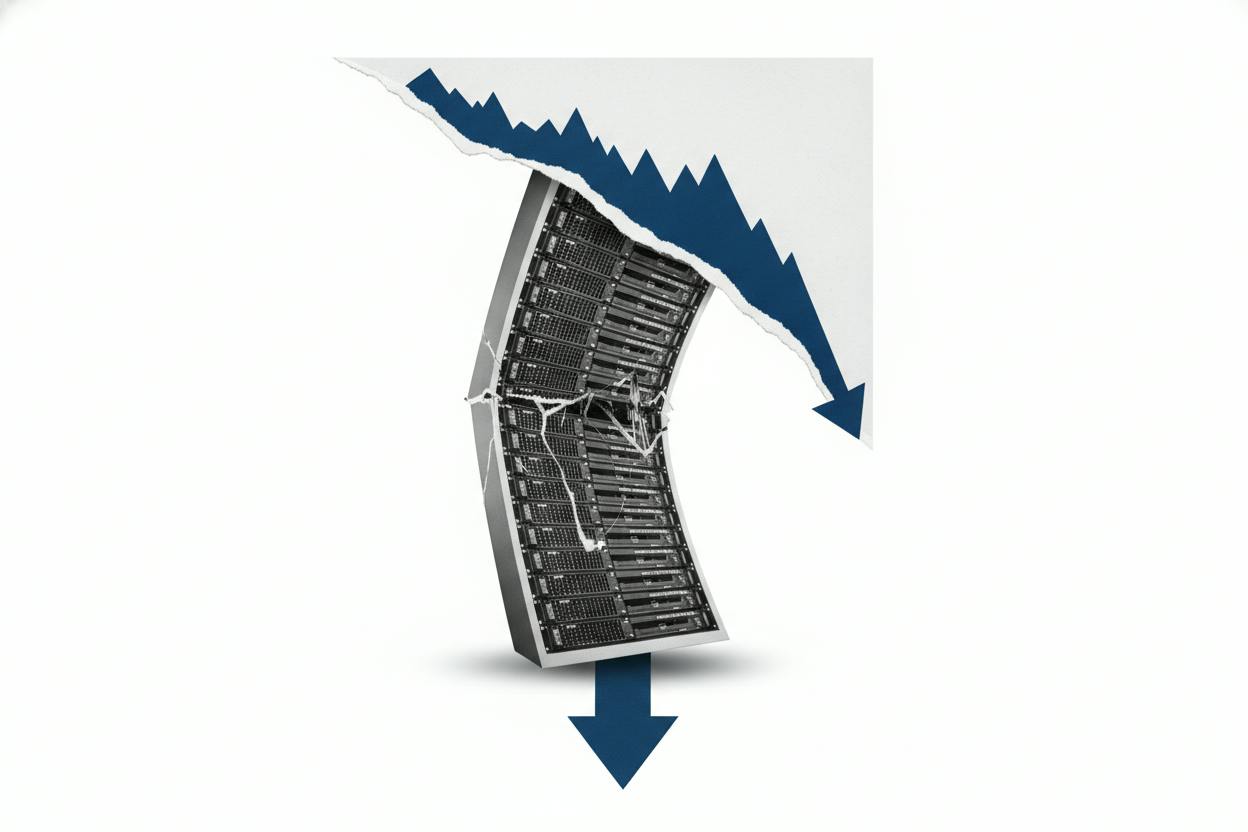
AI-linked stocks in China and Hong Kong tumbled on Friday, as a sharp selloff in US technology shares rippled across global markets. By midday, Hong Kong's Hang Seng Artificial Intelligence Index had fallen 4%, while China's CSI 300, a broad benchmark of large-cap stocks, was down 1.5%.
The slide began on Wall Street, where the Nasdaq composite posted its steepest one-day drop since April 2025. That triggered a wave of risk aversion that quickly spread to Asia, hitting the tech-heavy corners of the region's markets hardest.
Why AI stocks are leading the decline
When global investors shift into "risk-off" mode, they tend to reduce exposure to the most crowded trades first. Artificial intelligence has been one of the most popular and heavily traded themes in recent years, so it is often the first to be sold when sentiment turns cautious.
In Asia, the pressure showed up as broad tech weakness, then sharper losses in China's AI supply chain. Reuters noted that AI-related gauges such as Shanghai's STAR 50 index and a China AI index fell as much as 5% at one point. The STAR 50 tracks the 50 largest companies on Shanghai's STAR Market, a board focused on technology and innovation.
The selloff was not confined to China and Hong Kong. Japan's Nikkei plunged 5% as AI favorites led a tech-led decline, and South Korea's KOSPI fell 8%, triggering a circuit breaker as chip stocks collapsed. The AI trade has turned political and risky, with investors reassessing valuations and the sustainability of the massive spending on AI infrastructure.
What this means for investors
For everyday investors, the key takeaway is that AI stocks are not immune to broader market swings. In fact, because they have been so popular, they can be more volatile than the overall market when sentiment shifts.
"When a trade is crowded, everyone heads for the exit at the same time," said one market strategist, speaking on condition of anonymity. "That can amplify the downside."
The drop also highlights how interconnected global markets have become. A selloff in US tech can quickly spread to Asia, affecting companies that supply components or services to the AI ecosystem. This is a reminder that diversification across regions and sectors can help cushion the impact of such moves.
Investors should also watch how the selloff affects other assets. The AI selloff has driven the yen and franc higher as investors seek safe havens, while the dollar has held steady. Commodities have also been affected, with copper heading for its biggest weekly drop since March as AI-driven demand hopes cool.
What to watch next
Investors will be watching whether the selloff continues into next week or stabilizes. Key factors include any further moves in US tech stocks, as well as earnings from major Chinese companies. SMIC and Moutai headline a chip-heavy week on China's CSI 300 earnings calendar, which could provide clues about the health of the tech sector.
Also on the radar is the broader economic backdrop. If the AI selloff persists, it could weigh on global growth expectations, affecting everything from commodity prices to currency markets. The Nikkei's 5% plunge and the KOSPI's 8% drop show that the pain is widespread across Asia.
For now, the message is clear: AI stocks, once seen as a sure bet, are proving just as susceptible to market cycles as any other sector. Investors should be prepared for continued volatility and consider whether their portfolios are positioned to weather it.