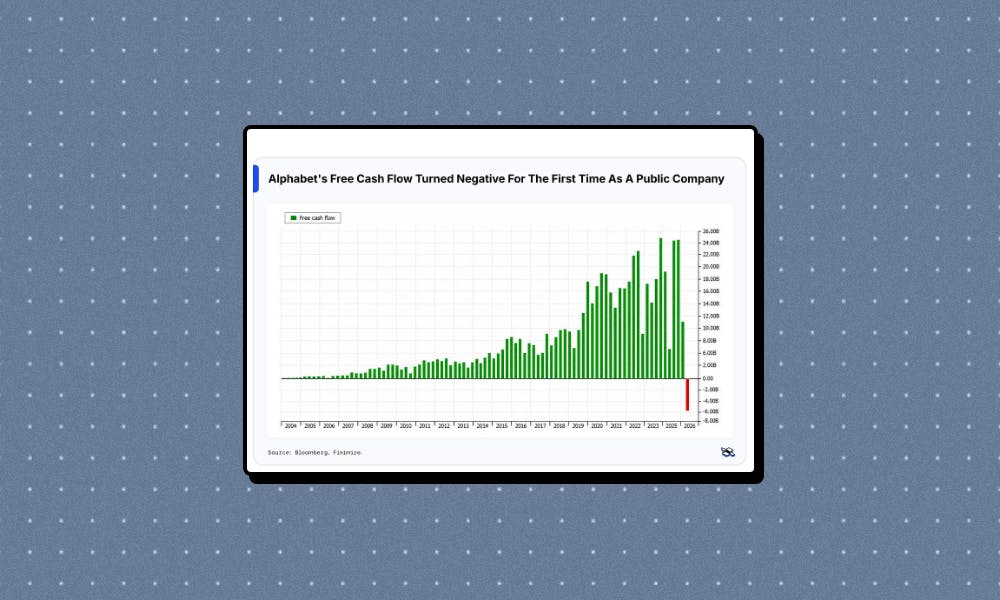
For the first time in over two decades as a public company, Alphabet has reported negative free cash flow. The tech giant burned through $5.9 billion in the latest quarter, as its massive spending on artificial intelligence infrastructure finally outpaced its still-considerable profits.
The news marks a significant milestone for Google's parent company, which has long been known for generating enormous piles of cash from its search and advertising businesses. But the race to build and deploy AI at scale is proving extraordinarily expensive, even for one of the world's most profitable companies.
What Happened
Free cash flow is the money a company has left after paying for operating expenses and capital expenditures — essentially, the cash it can use for dividends, buybacks, acquisitions, or paying down debt. When it turns negative, it means the company is spending more on long-term investments than it is generating from its operations.
Alphabet's negative free cash flow was driven by a surge in capital spending, particularly on data centers, specialized AI chips, and other infrastructure needed to train and run large language models. The company also raised its 2026 capital expenditure guidance to as much as $205 billion, up from a previous forecast of $190 billion. That upward revision underscores just how much the company expects to keep pouring into AI.
This isn't just an Alphabet story. Across Big Tech, companies are locked in an arms race to dominate AI, and the spending is staggering. Wall Street has been watching closely, with some investors growing nervous about whether the returns on this investment will materialize.
Why It Matters for Investors
For everyday investors, negative free cash flow at a company like Alphabet is unusual and worth paying attention to. Free cash flow is often used to fund dividends and share buybacks, which directly benefit shareholders. If that cash is instead being consumed by AI spending, it could mean slower growth in those shareholder returns — at least in the near term.
However, it's important to put the number in context. Alphabet still generates tens of billions in net income each quarter. The negative free cash flow is a result of deliberately choosing to invest heavily, not a sign that the business is struggling. The company is betting that these AI investments will eventually drive new revenue streams, particularly through its cloud business. Google Cloud revenue has been surging, and the company sees AI as a key driver of that growth.
Still, the raised guidance for 2026 capital expenditure suggests that the spending will continue for years. Investors will want to watch whether Alphabet can translate this investment into higher revenue and profits, or whether the spending simply eats into margins without delivering the expected returns.
The Broader AI Spending Picture
Alphabet is far from alone in this. Other tech giants, including Microsoft, Amazon, and Meta, are also spending heavily on AI infrastructure. The collective spending is so large that it has begun to affect broader markets. Asian chip stocks have rallied on the back of these spending plans, as investors bet that companies like Nvidia and TSMC will benefit from the demand for AI hardware.
But the spending also carries risks. If the AI boom doesn't deliver the expected returns, or if competition drives down prices for AI services, the massive capital outlays could become a drag on earnings for years. Some analysts have drawn comparisons to the dot-com era, when companies spent heavily on internet infrastructure that eventually paid off — but only after a painful bust that wiped out many investors.
For now, the market's reaction has been mixed. Wall Street pulled back on news of Big Tech's AI spending, with some investors worried about the lack of immediate returns. But others see the spending as a necessary investment in the future, similar to how companies once invested in building out the internet itself.
What to Watch Next
Investors should keep an eye on several things in the coming quarters. First, whether Alphabet's free cash flow turns positive again, and how quickly. Second, whether the company's cloud revenue growth continues to accelerate, as that is the most direct path to monetizing its AI investments. Third, any signs that the company is pulling back on spending or changing its strategy.
It's also worth watching how Alphabet's competitors are spending. If the entire industry is investing at similar levels, it may be harder for any one company to gain a lasting advantage. But if Alphabet can build AI capabilities that its rivals can't match, the spending could prove to be a wise long-term bet.
For the average investor, the key takeaway is that even the most profitable companies are making big bets on AI, and those bets come with real costs. Negative free cash flow at a company like Alphabet is a reminder that in the world of investing, nothing is guaranteed — not even cash flow from the king of search.