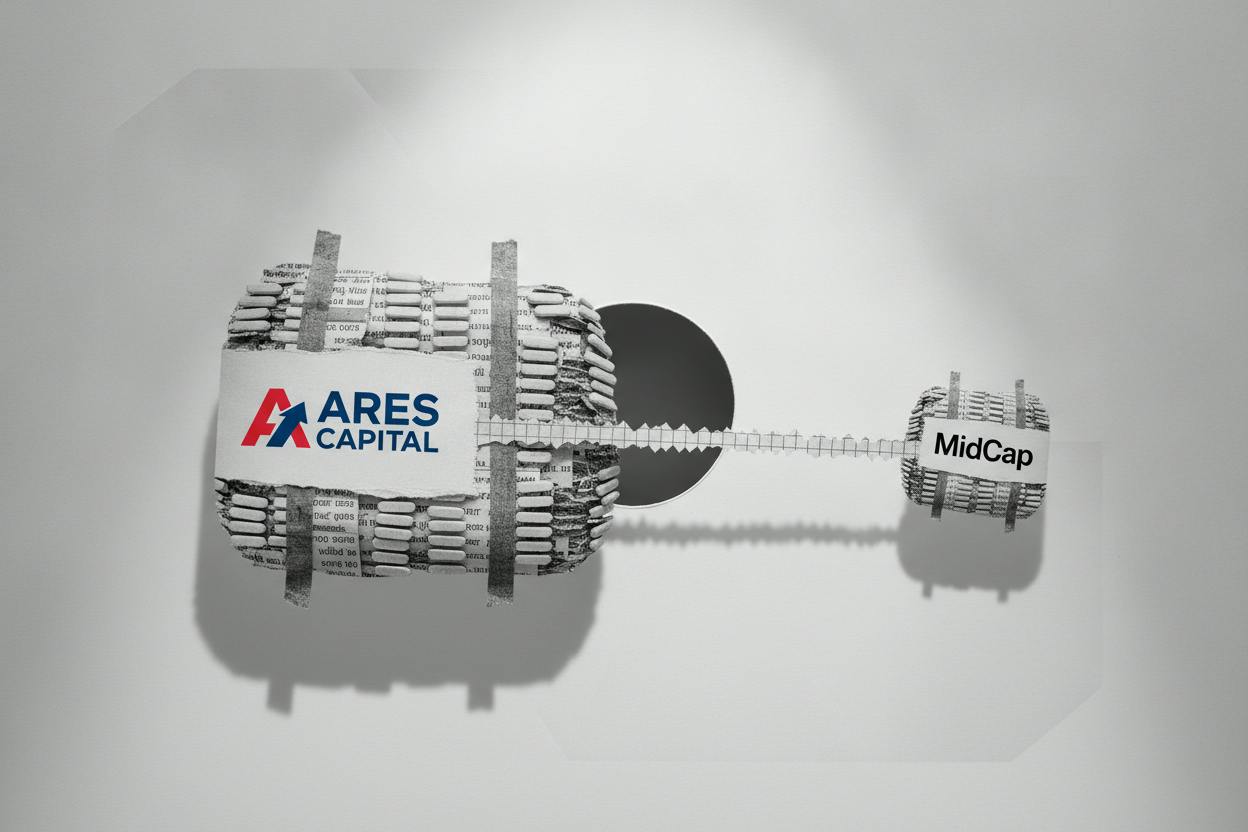
Ares Capital, a major business development company (BDC), has agreed to acquire MidCap Financial Investment in a deal valued at roughly $2.6 billion, paid in a combination of stock and cash. The announcement stole the spotlight on a day when US financial stocks were otherwise subdued, with the NYSE Financial Index down 0.3% and the Financial Select Sector SPDR ETF slipping 0.2%.
The market's reaction followed a familiar script for mergers and acquisitions. MidCap's shares jumped 22% as investors quickly repriced the stock toward the offer value. Ares, meanwhile, dipped 0.3%, reflecting concerns about dilution from issuing new shares and the risk that the deal might take longer to close or deliver less value than initially hoped.
Because part of the payment is in Ares stock, the effective value of the deal to MidCap shareholders will move with Ares' share price. This creates a live "spread" between where MidCap trades and what the offer implies, a dynamic that can dominate day-to-day trading until the deal closes.
What is a business development company?
For everyday investors, it helps to understand what a BDC is. BDCs are investment companies that provide financing to small and mid-sized businesses, often in the form of loans. They are required to distribute at least 90% of their taxable income to shareholders as dividends, which makes them popular among income-focused investors. Ares Capital is one of the largest BDCs, and this acquisition would expand its portfolio significantly.
MidCap Financial Investment, which is backed by Apollo Global Management, focuses on lending to middle-market companies. The deal is part of a broader trend of consolidation in the private credit space, where larger players are buying smaller rivals to gain scale and diversify their loan books. For a deeper look at the deal's structure, see our earlier coverage of Ares Capital's acquisition of MidCap.
Broader market backdrop: consumer confidence rises
While the Ares-MidCap deal captured attention, the broader economic picture remained mixed. The Conference Board's consumer confidence index rose to 91.7 in October, up from 84.2 in September and beating expectations. This suggests households are feeling a bit steadier even with interest rates still elevated.
At the same time, the 10-year Treasury yield nudged up to 4.993%, reflecting ongoing concerns about inflation and the Federal Reserve's next moves. Higher yields can pressure rate-sensitive sectors like financials, but they can also boost net interest margins for lenders, a key factor for BDCs like Ares.
What it means for investors
For those watching the financial sector, the Ares-MidCap deal offers a clear lesson in how stock-and-cash acquisitions play out. The target's shares typically jump toward the offer price, while the acquirer's shares may dip on dilution worries. But with a stock component, there's an extra twist: the target's implied takeout price floats with the acquirer's share price. So a small move in Ares can change what the market thinks MidCap is "worth" under the offer.
Until the deal closes, MidCap may trade less like a standalone lender and more like a bet on Ares' share price and the odds of completion. This can dominate day-to-day moves, even if the broader financial sector barely budges. For investors holding either stock, it's important to monitor the spread and any regulatory or shareholder approvals that could affect the timeline.
This deal also highlights the ongoing consolidation in private credit, a sector that has grown rapidly in recent years. As larger players like Ares absorb smaller competitors, they gain scale and pricing power, but they also take on integration risks. Investors should watch how Ares manages the integration and whether the promised synergies materialize.
For a broader view of recent deal activity, our coverage of multibillion-dollar deals shows that M&A is picking up across sectors. And for those interested in the private credit space, the potential for SME investment is a related theme worth watching.
In the meantime, the financial sector's modest decline on the day suggests that investors are taking a wait-and-see approach, balancing the optimism from stronger consumer confidence against the headwind of higher Treasury yields. For everyday investors, the key takeaway is that M&A deals can create short-term trading opportunities, but they also carry risks that require careful attention to the details.