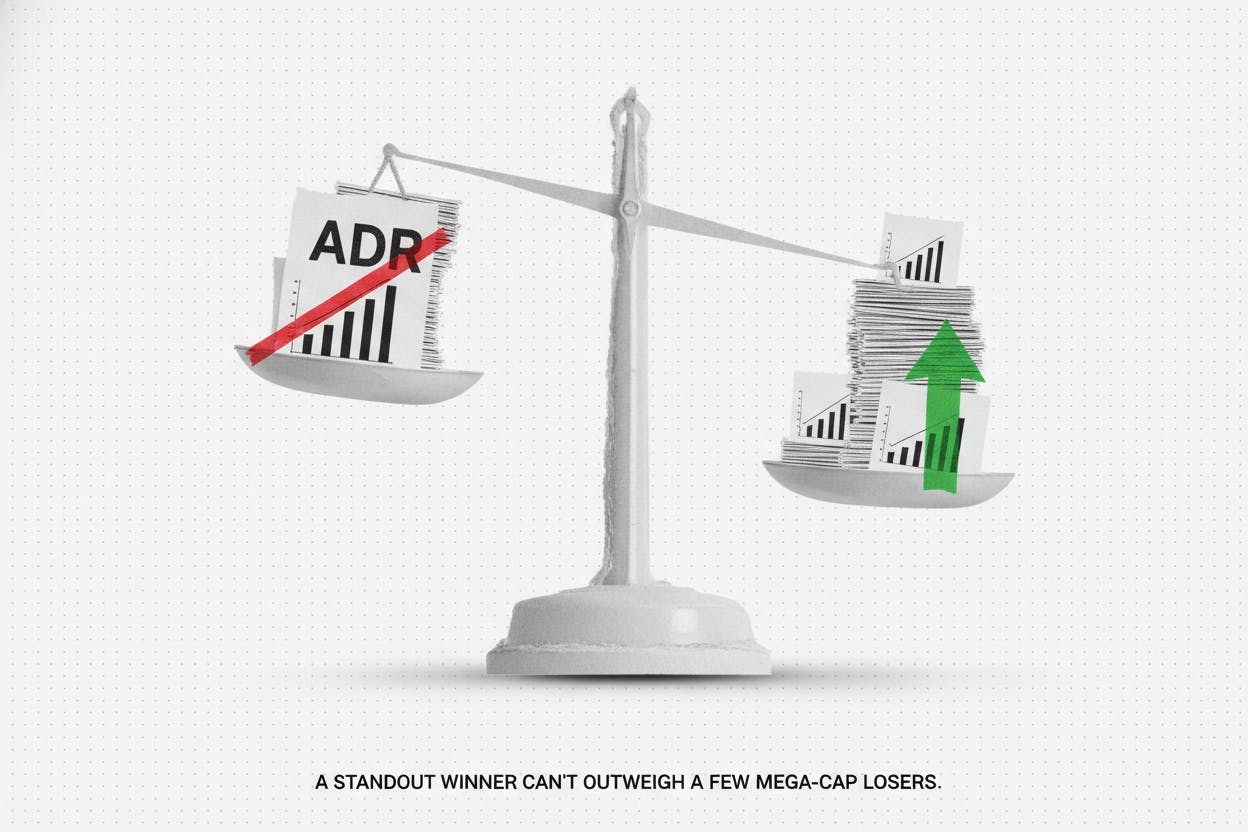
US-listed shares of major Asian companies slipped in early trading Thursday, as the S&P Asia 50 ADR Index edged down 0.34% to 2,958.28. The modest decline came even as one standout—chipmaker Canaan—surged 11%, highlighting the mixed picture for investors holding American depositary receipts (ADRs) of Asian firms.
ADRs are a way for US investors to buy shares of foreign companies without dealing with overseas exchanges. Each ADR represents a certain number of shares in the underlying company, and they trade on US exchanges just like domestic stocks. The S&P Asia 50 ADR Index tracks the performance of 50 of the largest and most liquid Asian companies that trade in the US, giving investors a snapshot of how the region's blue chips are faring in American markets.
What's moving: Canaan up, Alibaba and Bilibili down
The biggest gainer in the index was Canaan, a Chinese company that designs and sells cryptocurrency mining hardware and, more recently, has expanded into artificial intelligence chips. The 11% jump in Canaan's stock suggests strong investor interest, possibly tied to renewed enthusiasm for AI-related plays or a bounce in crypto sentiment. However, the company's shares are known for high volatility, and such moves are not unusual.
On the downside, two of China's most well-known internet names—Alibaba and Bilibili—were sliding. Alibaba, the e-commerce and cloud giant, has been a key player in the AI race, with its cloud division recently reporting a 45% jump in AI-related revenue. That growth, however, has come with heavy spending, which can weigh on short-term profitability. Bilibili, a video-sharing platform popular with younger audiences, has also faced pressure from competition and a slower advertising recovery.
The declines in these heavyweight stocks likely dragged the overall index lower, offsetting Canaan's sharp gain. Because Alibaba and Bilibili are among the most heavily traded Chinese ADRs, their moves have an outsized impact on the index.
Why this matters for everyday investors
For ordinary investors, a dip in the Asia 50 ADR Index is a reminder that international diversification comes with its own set of risks and rewards. Asian markets, particularly China, have been volatile in recent years due to regulatory crackdowns, geopolitical tensions, and uneven economic recovery. Even when US markets are calm, ADRs can swing sharply based on news from their home countries.
Investors who hold ADRs directly or through funds that track Asian equities should pay attention to the underlying fundamentals. For example, Alibaba's AI cloud growth is a positive long-term story, but the company's heavy capital spending—up 75% in the latest quarter—means profits may stay under pressure in the near term. Similarly, Bilibili's user growth is solid, but monetization remains a challenge.
On the other hand, Canaan's surge shows how a single stock can move dramatically on sentiment, especially in sectors like crypto and AI. While such jumps can be exciting, they also carry significant risk, and investors should be cautious about chasing momentum without understanding the business.
Broader context and what to watch
The modest decline in the Asia 50 ADR Index comes amid a mixed backdrop for global markets. Investors are weighing the pace of interest rate cuts by the Federal Reserve, corporate earnings, and economic data from China, which has been struggling to reignite growth. A weaker-than-expected Chinese recovery could continue to weigh on ADRs of Chinese companies, while a stronger one could provide a tailwind.
For those interested in the region, there are other indicators to watch. For instance, the Baltic Dry Index, a measure of shipping costs for dry bulk commodities, has been cooling recently, which can signal softer demand for raw materials and, by extension, economic activity in Asia. Additionally, Hong Kong Exchanges and Clearing (HKEX) recently posted record first-half profit as IPOs and trading rebounded, suggesting some renewed appetite for Asian equities.
Investors should also keep an eye on company-specific news. Alibaba's AI initiatives, including tools like HappyShrimp that turn text prompts into songs, are part of its broader push to monetize AI. How well these efforts translate into revenue will be a key driver for the stock.
The bottom line
Thursday's early dip in the S&P Asia 50 ADR Index is a small move, but it underscores the volatility that can come with investing in foreign stocks. While Canaan's 11% jump offers a bright spot, the declines in Alibaba and Bilibili remind us that even the biggest names can face headwinds. For everyday investors, the takeaway is to stay diversified, understand the risks of ADRs, and focus on long-term fundamentals rather than short-term price swings.