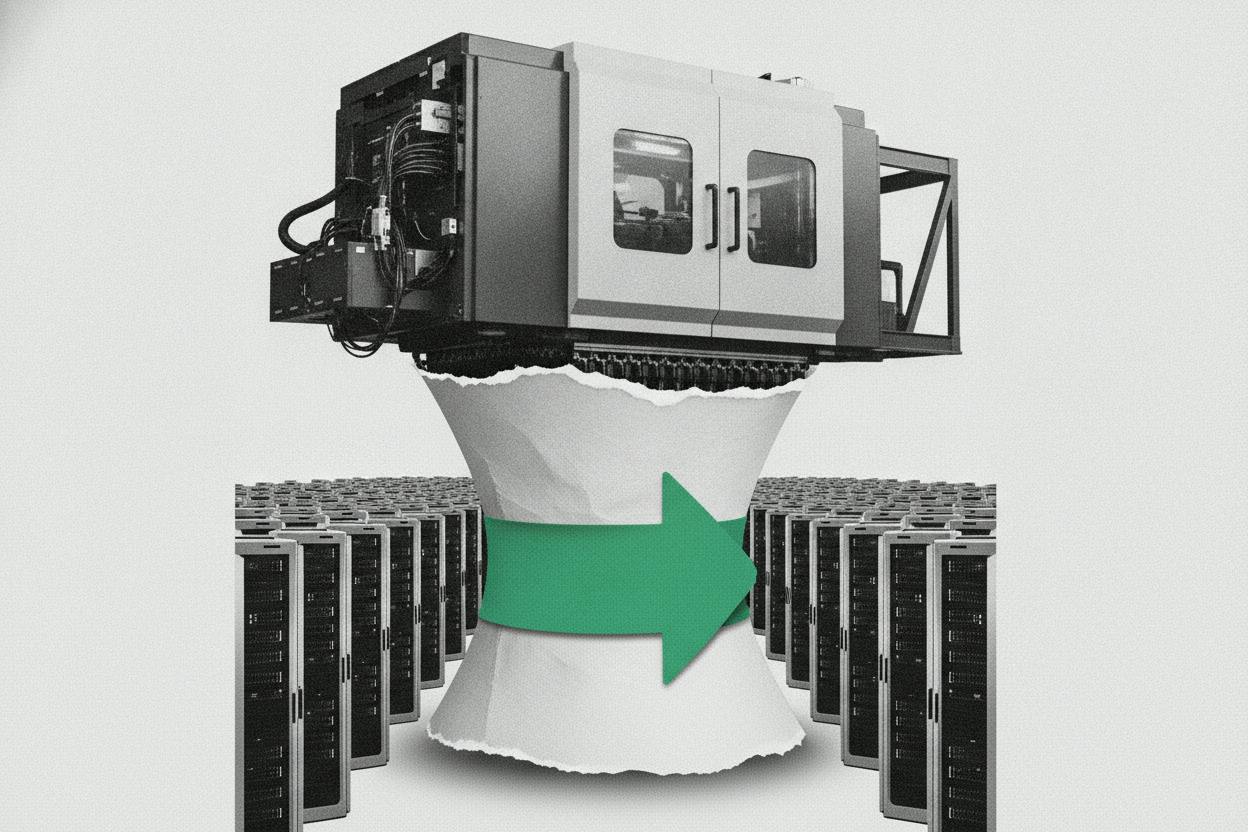
ASML, the Dutch company that dominates the market for advanced chipmaking equipment, has cautioned that the explosive growth in artificial intelligence could push demand for its tools beyond what it can produce, even as it ramps up output. The warning came as the company issued its latest sales forecast, projecting fourth-quarter 2026 revenue of €14.2 billion to €15.2 billion.
Why ASML's capacity matters
ASML is the world's sole supplier of extreme ultraviolet (EUV) lithography machines, the most advanced tools used to etch microscopic circuits onto silicon wafers. These machines, which cost hundreds of millions of dollars each, are essential for producing the most powerful chips used in AI data centers, smartphones, and other cutting-edge electronics. Because of this near-monopoly, ASML's production capacity effectively sets a ceiling on how many advanced chips the world can make.
The company's statement that it may not fully meet customer demand in 2027 or 2028 is a significant signal. It suggests that even with planned increases in manufacturing capacity, the appetite for AI-related chips—and the tools that make them—is growing faster than ASML can scale up. This is not a short-term hiccup but a structural constraint that could persist for years.
What the sales forecast tells us
ASML's fourth-quarter 2026 sales guidance of €14.2-15.2 billion points to continued strong demand. For context, that would represent a substantial jump from recent quarterly figures, reflecting the accelerating adoption of AI across industries. The forecast also implies that ASML expects its order book to remain full, with customers eager to secure access to its limited supply.
The company's ability to raise prices or allocate tools to the highest-paying customers could boost its profitability, but it also highlights a broader challenge: the semiconductor industry's reliance on a single supplier for a critical piece of equipment. Any disruption to ASML's production—whether from supply chain issues, export restrictions, or technical hurdles—could ripple through the entire tech sector.
What it means for investors
For everyday investors, ASML's warning is a double-edged sword. On one hand, it underscores the company's pricing power and the long-term growth potential of AI-driven demand. Companies that can consistently sell everything they make, and then some, are often in a strong position. On the other hand, it also highlights the risks of concentration: if ASML stumbles, there is no easy backup.
Investors should also consider the broader context. The AI boom has fueled a surge in demand for chips, but it has also led to concerns about overcapacity in some segments. ASML's comments suggest that, at least for the most advanced tools, the opposite is true—demand is outstripping supply. This could mean sustained revenue growth for ASML and its suppliers, but it also means that chipmakers may face higher costs and longer lead times for new capacity.
For those holding ASML stock, the news is largely positive, as it signals a strong order pipeline. However, the company's ability to execute on its production plans will be key. Any delays in ramping up output could disappoint investors who are counting on those future sales.
Looking ahead
ASML's outlook is likely to be watched closely by the entire semiconductor industry. If the company cannot meet demand, chipmakers may be forced to prioritize certain products, potentially affecting the availability of AI accelerators, memory chips, and other components. This could have knock-on effects for tech companies that rely on these chips, from cloud providers to automakers.
The company's next earnings report will provide more details on its order backlog and production plans. Investors will also be listening for any updates on export controls, which have previously affected ASML's sales to China, a major market. For now, the message is clear: AI is reshaping the chip industry, and ASML is at the center of it, but even the most dominant players have limits.
As always, it's important to remember that past performance and forward-looking statements are not guarantees. ASML's forecasts could change if the AI boom cools or if geopolitical tensions escalate. But for now, the company's own words suggest that the race to build AI infrastructure is far from over—and that the tools to build it are in short supply.