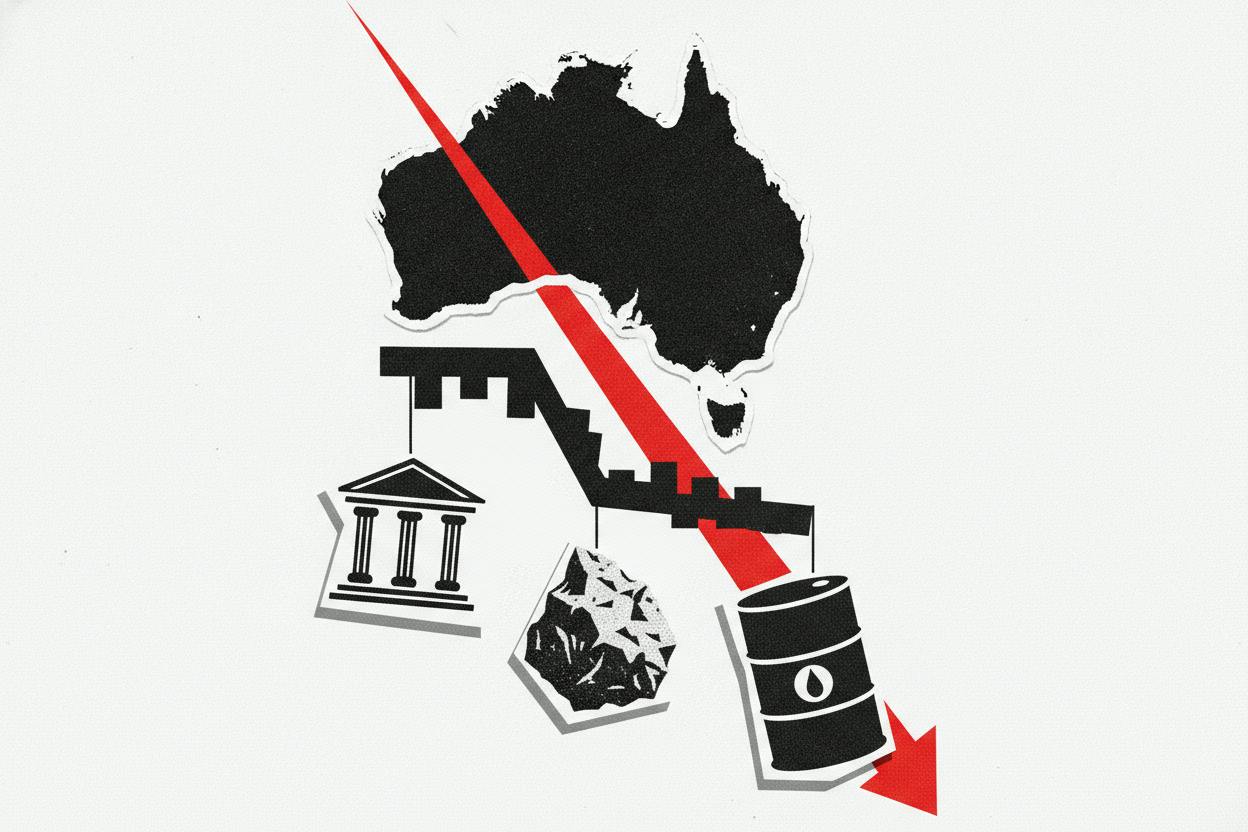
Australia's benchmark stock index took a hit on [day], with the S&P/ASX 200 slipping 0.7% to 8,775.30. The decline was broad-based, as three of the market's heaviest sectors—banks, miners, and energy—all moved lower in the same session.
When these groups fall together, they tend to drag the entire index, because together they account for a large portion of the ASX 200's total value. That's exactly what happened, as financials slipped 0.3%, miners dropped 0.9%, and energy fell 2%.
Energy leads the decline
The energy sector did the most damage, falling 2% after Santos, an Australian oil and gas producer, cut the top end of its annual production forecast. The company's shares dropped, and the news also weighed on other producers. Woodside, another major energy player, sank nearly 4%, adding to the sector's losses.
Santos's revised guidance suggests that the company expects lower output than previously anticipated, which can signal weaker demand or operational challenges. For investors, this is a reminder that commodity producers' earnings are closely tied to both prices and production volumes.
Miners and banks also under pressure
Miners fell 0.9% after copper prices eased, pushing the mining sub-index to its lowest level since July 21. Heavyweights like BHP and Rio Tinto were among the decliners. Copper is often seen as a bellwether for global economic health, so a dip in its price can weigh on mining stocks.
Meanwhile, financials slipped 0.3% as most of the "Big Four" banks—Commonwealth Bank, Westpac, NAB, and ANZ—fell. Bank stocks are sensitive to interest rate expectations and the health of the broader economy, so any sign of weakness can prompt selling.
Bright spots were too small to matter
Not everything was red. Tech stocks rose 0.6%, and data-center operator NEXTDC rebounded sharply after a prior-day plunge. However, these gains were too small to offset the losses in the heavyweight sectors.
This is a common pattern on the ASX: when banks, miners, and energy all decline at once, the index can swing more than the rest of the market feels. Even if smaller sectors are green, they often can't move the needle.
What it means for investors
For everyday investors, this session highlights how the ASX 200 isn't an even mix of industries. It's heavily influenced by banks, miners, and energy. So when these sectors line up on the downside, the headline index can drop more than you might expect from the broader economy.
Index-linked products, including ASX 200 futures, can behave more like a "cycle check" on such days—reflecting commodity prices and investors' appetite for bank risk—rather than a broad snapshot of the market.
For those holding diversified portfolios, it's worth remembering that sector-specific news, like Santos's production cut, can have outsized effects on the index. But that doesn't necessarily mean the whole market is in trouble—just that the heavyweights are having a rough day.
Investors will likely keep an eye on commodity prices, especially copper and oil, as well as any updates from the major banks. If these sectors stabilize, the index could recover quickly. But if they continue to slide, the ASX 200 may face further pressure.