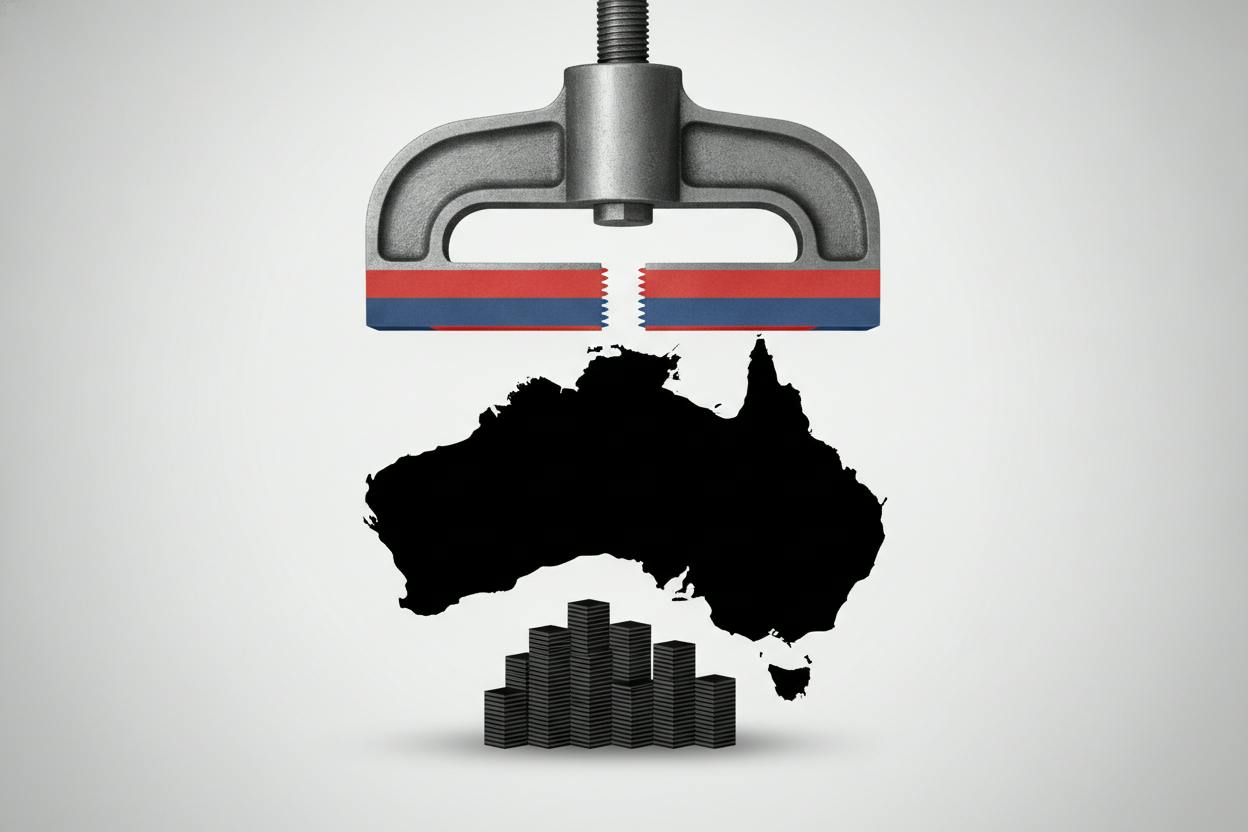
Australian businesses are telling a two-sided story: day-to-day trading is holding up, but their outlook for the months ahead is getting gloomier. That's the takeaway from NAB's latest monthly business survey, which found conditions flat in September even as confidence fell for another month.
The bank's business conditions index—a measure of how firms are faring right now across sales, employment and profitability—stayed at -1 in September. That's essentially unchanged and suggests the economy is still ticking along, if not exactly booming.
But the confidence index tells a different tale. It dropped 4 points to -13, with sentiment weakening in five of the eight industries NAB tracks. The gap between the two numbers is worth paying attention to, because they measure different things.
Conditions vs. confidence: why the gap matters
Conditions are a rear-view mirror. They tell you how businesses are doing today—whether orders are coming in, whether they're hiring, whether they're making money. Confidence is a windshield. It reflects where business owners think things are headed, and that shapes the decisions they make now.
When confidence slides but conditions stay steady, it often signals that firms are bracing for tougher times even before they show up in the hard data. Companies in that position tend to protect their cash flow first. That usually means slowing down hiring, delaying capital spending, and being more cautious about expanding—even if sales haven't weakened yet.
NAB's survey points to two main culprits behind the souring mood: higher oil prices and elevated interest rates. Fuel is a major input cost for many businesses, from transport and logistics to manufacturing and retail. When oil climbs, those costs ripple through the economy. At the same time, borrowing costs remain high after a long run of interest rate increases, which makes it more expensive for businesses to finance expansion or even day-to-day operations.
What this means for the broader economy
The survey is one of the most closely watched reads on the Australian economy, and the divergence between conditions and confidence has historically been a useful signal. When confidence falls far below conditions, it often foreshadows a slowdown in hiring and investment down the track.
That matters for the Reserve Bank of Australia, which has been trying to cool inflation without tipping the economy into recession. If businesses pull back on hiring and spending, that could help bring inflation down—but it also raises the risk of a sharper slowdown in growth.
For everyday investors, the survey is a reminder that the economic picture is mixed. The labour market has been resilient, and many companies are still reporting solid earnings. But the mood among business owners is increasingly cautious, and that caution can eventually show up in corporate results.
What investors should watch next
Investors will be watching to see whether the slide in confidence starts to translate into weaker conditions. If businesses act on their pessimism—by cutting jobs or shelving investment plans—that could show up in future employment data and in company earnings reports.
It's also worth keeping an eye on the sectors where sentiment is weakest. NAB's survey showed declines in five of eight industries, suggesting the caution is fairly broad-based rather than confined to one corner of the economy.
For those with exposure to Australian equities, the survey adds to a backdrop of uncertainty. High interest rates and energy costs are squeezing margins across many industries, and while conditions have held up so far, the confidence data suggests the risks are tilted to the downside.
That said, it's important not to overreact to a single month's survey. Confidence readings can be volatile, and conditions have remained steady even as confidence has drifted lower over recent months. The key question is whether the gap between the two starts to close—and in which direction.
If conditions start to follow confidence lower, that would be a clearer warning sign for the economy and for corporate earnings. If confidence stabilises or rebounds, it would suggest businesses are simply being cautious rather than preparing for a downturn.
For now, the message from Australian businesses is one of resilience mixed with unease. They're still open for business, but they're watching costs closely—and they're not betting on an easy road ahead.