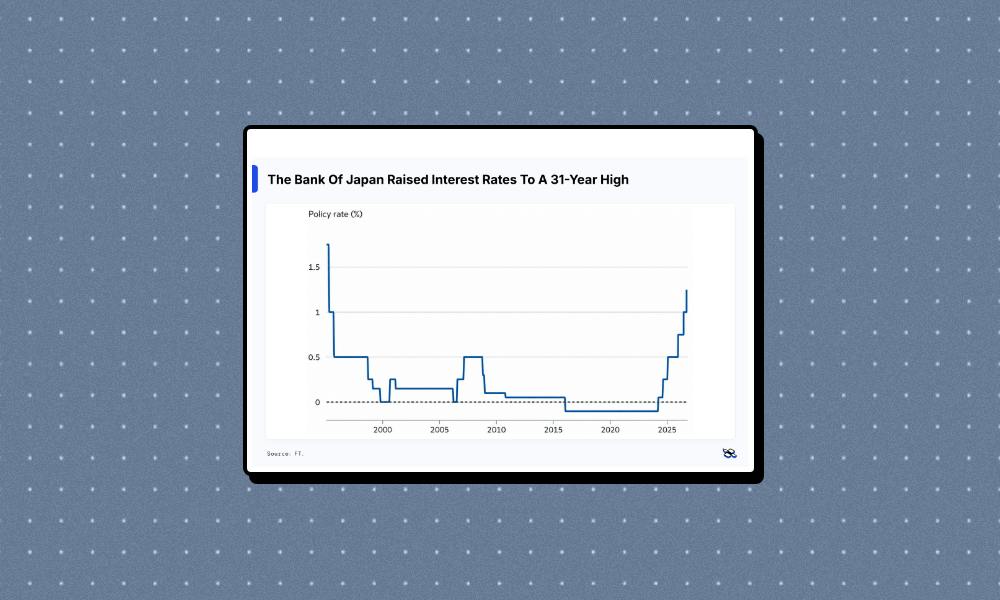
The Bank of Japan (BoJ) delivered a decisive step in its long march away from ultra-easy monetary policy on [day], raising its benchmark interest rate by 0.25 percentage points to 1.25% — the highest level in 31 years. The decision, passed by a 7-2 vote, came just three months after the previous hike, making it the fastest back-to-back tightening since 1990.
For everyday investors, the move is a clear signal that Japan's era of near-zero borrowing costs is firmly in the rearview mirror. But the central bank's statement left some market participants wanting more clarity on how far rates will go, and how quickly.
Why the BoJ is moving faster
The primary driver is inflation. Japan's key inflation gauge has now stayed above the BoJ's 2% target for four consecutive years — a remarkable stretch for an economy that spent decades battling deflation. The central bank warned that rising wages, companies' growing willingness to pass on higher costs, and elevated inflation expectations could keep price pressures bubbling.
That's a notable shift. For years, Japanese firms were reluctant to raise prices for fear of losing customers. Now, with labor shortages and higher input costs, many are finding they can pass increases along — a dynamic that feeds into the BoJ's thinking.
The international angle also matters. US Treasury Secretary Scott Bessent has reportedly been pushing for Japan to normalize policy, adding external pressure on the BoJ to move away from its ultra-loose stance. While the BoJ insists its decisions are data-driven, the global backdrop of higher interest rates makes Japan's low-rate policy increasingly out of step.
What this means for investors
For investors with exposure to Japanese assets, the rate hike has several ripple effects. Higher rates typically boost bank profits, as they can charge more for loans. Indeed, Japanese bank stocks have been among the beneficiaries of the BoJ's tightening cycle, as seen in recent moves in Asian ADRs.
However, the reaction in broader markets has been muted. In New Zealand, shares were flat after the announcement, suggesting that the hike was largely priced in. Similarly, Japanese bond yields dipped ahead of the decision, as investors awaited the BoJ's guidance.
For global investors, the key question is how this affects the yen. A higher rate tends to support the currency, which could impact Japanese exporters' competitiveness and the value of overseas earnings when converted back to yen. It also has implications for carry trades, where investors borrow in yen at low rates to invest elsewhere — a strategy that becomes less attractive as rates rise.
What to watch next
The BoJ's statement didn't provide a clear roadmap for future moves, and that's precisely what investors were hoping for. The 7-2 vote shows some internal dissent, suggesting not all policymakers are comfortable with the pace of tightening.
Market participants will now scrutinize Governor Kazuo Ueda's press conference for hints about the next step. Will the BoJ pause to assess the impact, or continue with quarterly hikes? The answer will shape expectations for Japanese interest rates, the yen, and Japanese equities.
For now, the BoJ's move is a reminder that the global era of cheap money is ending, even in the last major holdout. Investors with Japanese bonds or yen-denominated assets should brace for continued volatility as the central bank navigates this transition.
As always, it's wise to keep a diversified portfolio and avoid making sudden moves based on a single rate decision. The BoJ's path is likely to be gradual, but the direction is clear: Japan is leaving easy money behind.