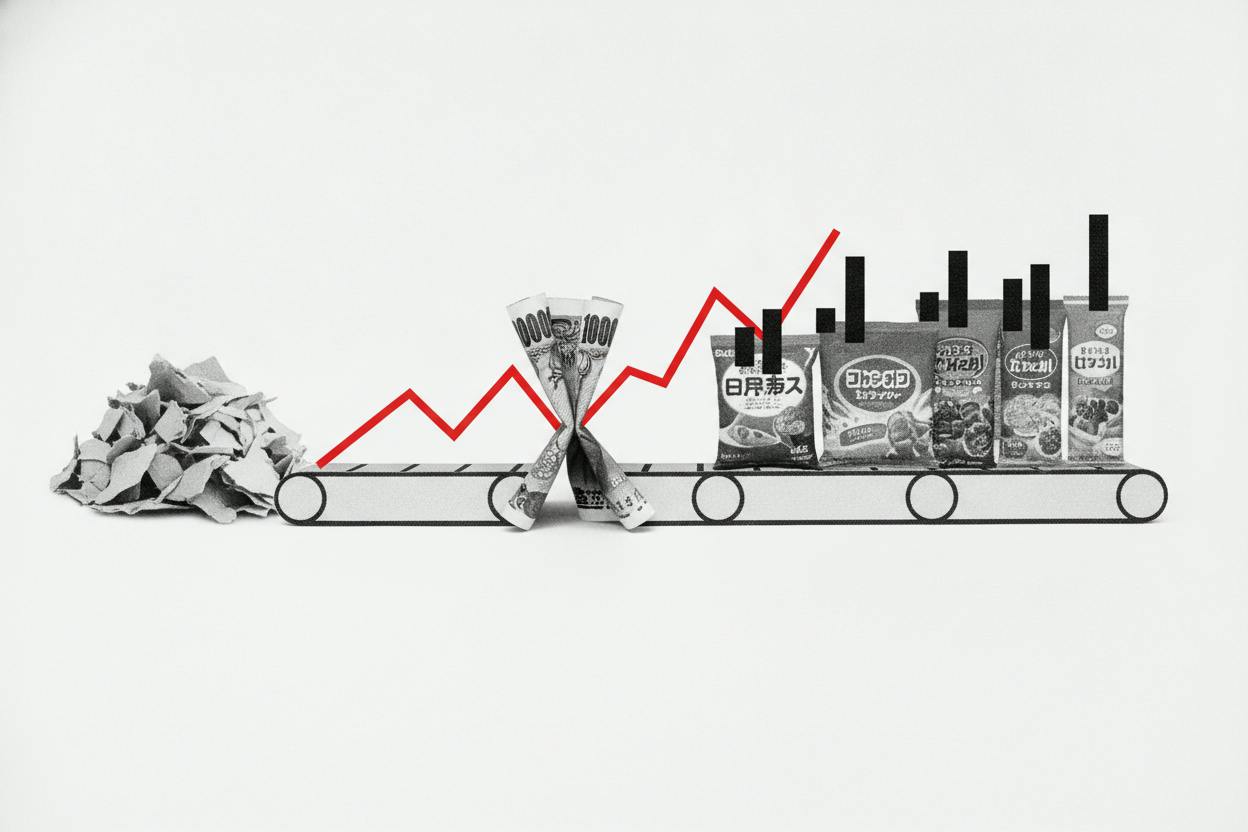
The Bank of Japan (BOJ) said on Monday that inflation pressures are broadening beyond imports and factory gates, with more companies raising prices more often as raw material, yen, and labor costs work their way toward consumers. The assessment, based on the central bank's quarterly survey of its regional branch managers, offers a ground-level view of price trends across the country.
In its latest regional economic report, the BOJ described what economists call “cost-push” inflation: higher input costs that began with raw materials are now showing up more widely in finished goods and services. Firms are passing along everything from energy and shipping swings to a softer yen and higher wages, according to the central bank.
What the BOJ is seeing
The BOJ's regional branch managers meet with local businesses and report back on conditions in their areas. This quarter, the recurring theme was that price increases are no longer confined to imported goods or industrial inputs. Instead, they are appearing on store shelves and in service prices as companies adjust more frequently.
“Some firms are raising prices more often,” the BOJ said in its report, highlighting a shift from the earlier pattern where price hikes were sporadic and limited to specific sectors. The central bank noted that the pass-through of costs is becoming more widespread, a sign that inflation is becoming more entrenched.
This matters because Japan has struggled with deflation for decades, and the BOJ has long aimed to achieve a stable 2% inflation rate. Recent data have shown inflation running above that target, but the central bank has been cautious about declaring victory, wary that the current price pressures could fade if global commodity prices fall or if the yen strengthens.
Why the yen and wages matter
A weaker yen makes imported raw materials and energy more expensive in local currency terms, adding to the cost pressures that Japanese firms face. At the same time, a tight labor market is pushing up wages, which gives households more spending power but also raises companies' costs.
The combination of these factors is what the BOJ is watching closely. If firms continue to raise prices and workers demand higher pay to keep up, inflation could become self-reinforcing—a development that would have significant implications for monetary policy.
The BOJ has kept interest rates at ultra-low levels for years, but it has begun to edge away from that stance. In March, it ended its negative interest rate policy, and in July it raised its short-term rate target. Investors are now watching for signals about the pace of future hikes.
What it means for investors
For everyday investors, the BOJ's assessment is a reminder that inflation is not just a statistic—it affects the prices you pay and the returns you earn. If inflation broadens, the BOJ may feel more pressure to raise interest rates further, which could affect bond yields, the yen, and Japanese stocks.
Higher rates tend to be a headwind for stocks, as they increase borrowing costs for companies and make bonds more attractive relative to equities. However, they can also signal a healthier economy, which supports corporate earnings. The yen could strengthen if the BOJ tightens policy, which would benefit Japanese consumers but could hurt exporters.
For those with exposure to Japanese assets, the key is to watch how far and how fast the BOJ moves. The central bank has stressed that it will be data-dependent, and this regional report is one of the data points it considers.
Related reading: Japan's Eco Watchers Index edges up, but outlook dims and Tokyo Exchange launches BOJ overnight rate futures.
Investors should also keep an eye on global inflation trends, as US consumers' one-year inflation expectations rose to 3.9% in September, according to the New York Fed. That suggests price pressures are not unique to Japan.
The BOJ's next policy meeting is scheduled for later this month, and this report will likely feed into the debate. While the central bank has not signaled an imminent move, the broadening of inflation gives it more reason to consider normalizing policy further.
For now, the message is clear: Japan's inflation is no longer just an import problem. It is becoming a domestic one, and that has consequences for investors everywhere.