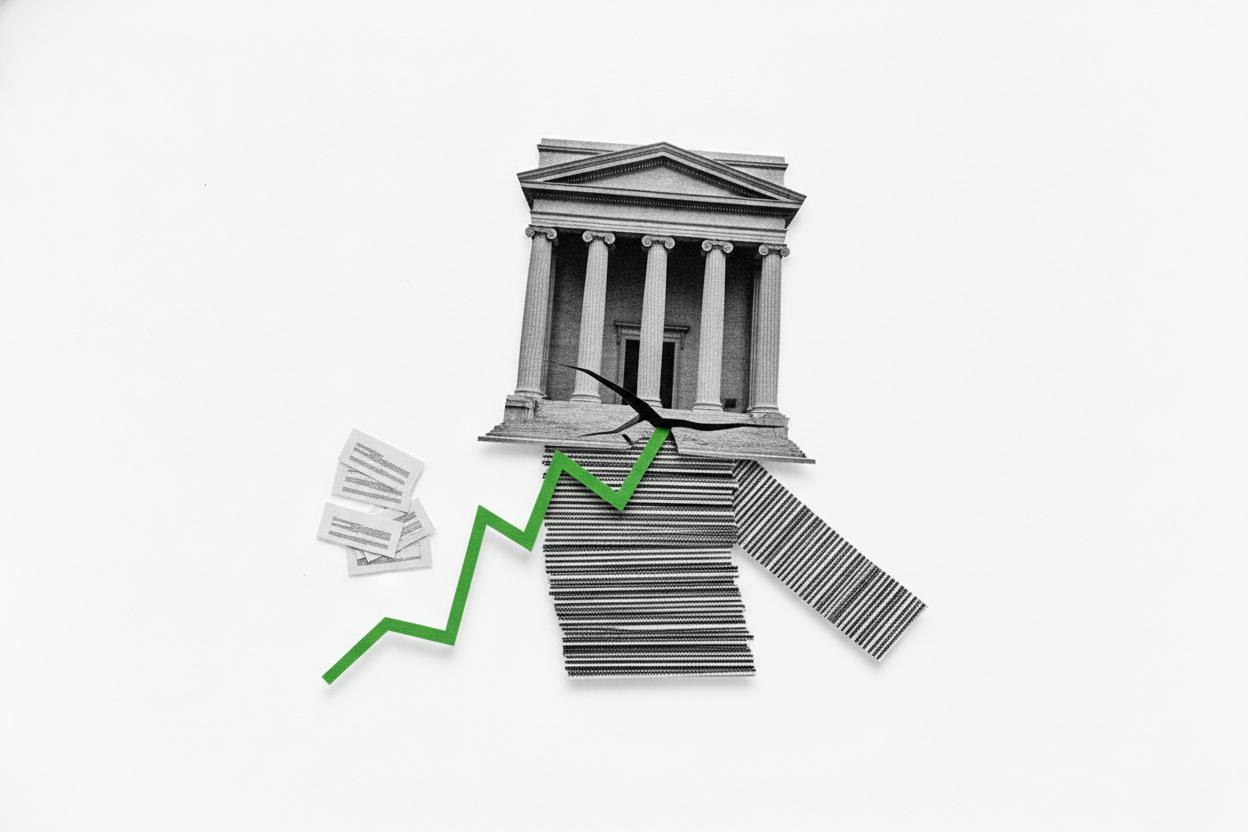
Wall Street's biggest banks just showed how a rough third quarter for bonds can squeeze fixed-income trading, even as equities desks put up big gains.
Treasury yields climbed to multi-decade highs during the quarter, with sharp day-to-day swings as investors kept resetting expectations for where interest rates end up. That sort of whiplash can make clients hesitate, which showed up in FICC (fixed income, currencies, and commodities) results: Morgan Stanley said revenue fell 7% year-on-year, JPMorgan's dropped 4%, and Bank of America's slid 17%, while Goldman Sachs was flat and Citigroup rose 4%, Reuters reported. Bank executives also pointed to slower activity in corners like credit, mortgages, and municipal bonds.
Why bond swings hurt trading desks
When Treasury yields move sharply in both directions, clients often pull back from trading, waiting for clarity. That directly hits banks' FICC businesses, which earn fees and spreads from helping clients buy and sell bonds, currencies, and commodities. A calmer market usually means more activity; a volatile one can freeze decision-making.
The pain wasn't uniform. Citigroup managed a 4% gain, while Goldman Sachs held steady. But the overall picture was one of pressure, with the biggest declines at Bank of America and Morgan Stanley.
The $109 billion paper loss at Bank of America
Higher long-term yields created another headache: unrealized losses on banks' bond portfolios widened as prices fell. Bank of America said those paper losses rose to $109 billion at the quarter ended September, up from $85 billion at the end of June, mostly in “held-to-maturity” securities the bank doesn't plan to sell.
When yields rise, the market value of Treasuries and mortgage-backed securities falls, which mechanically inflates “unrealized losses” like Bank of America's jump. Because most of those losses sit in held-to-maturity buckets, they're harder to “manage away”: selling to raise cash or reshape the balance sheet would lock in the hit.
That can make investors judge US banks – especially Bank of America – less by quarter-to-quarter trading results and more by how much rate risk is embedded on their balance sheets if yields climb again. It's a rate-risk signal, not just an accounting footnote.
Equities desks shine, but analysts warn of fragility
Equities trading told the opposite story, with big jumps at firms like Goldman Sachs and Morgan Stanley. Stock markets were active, and clients were willing to trade. But Oppenheimer, an investment research firm, warned that these “easy come, easy go” revenues can fade quickly if the equity tailwind turns.
Equity trading revenue is often more volatile than fixed-income because it depends on market momentum and client risk appetite. If stocks stall or reverse, those gains can evaporate as quickly as they appeared.
What it means for investors
For everyday investors, the takeaway is that bank earnings are a mixed bag. A weak trading quarter can flip if clients return, but a hole in a securities portfolio tends to linger as long as long-term yields stay high.
Investors should watch how banks manage their bond portfolios and whether they can generate steady revenue from trading in a choppy rate environment. The broader market context matters too: if yields keep climbing, banks with large held-to-maturity portfolios could face continued pressure on their reported capital and investor sentiment.
Related coverage: Big banks eye AI data-center boom but fear risky loans and weak returns and Wall Street sees deal pipeline intact, but higher yields may delay M&A and IPOs.