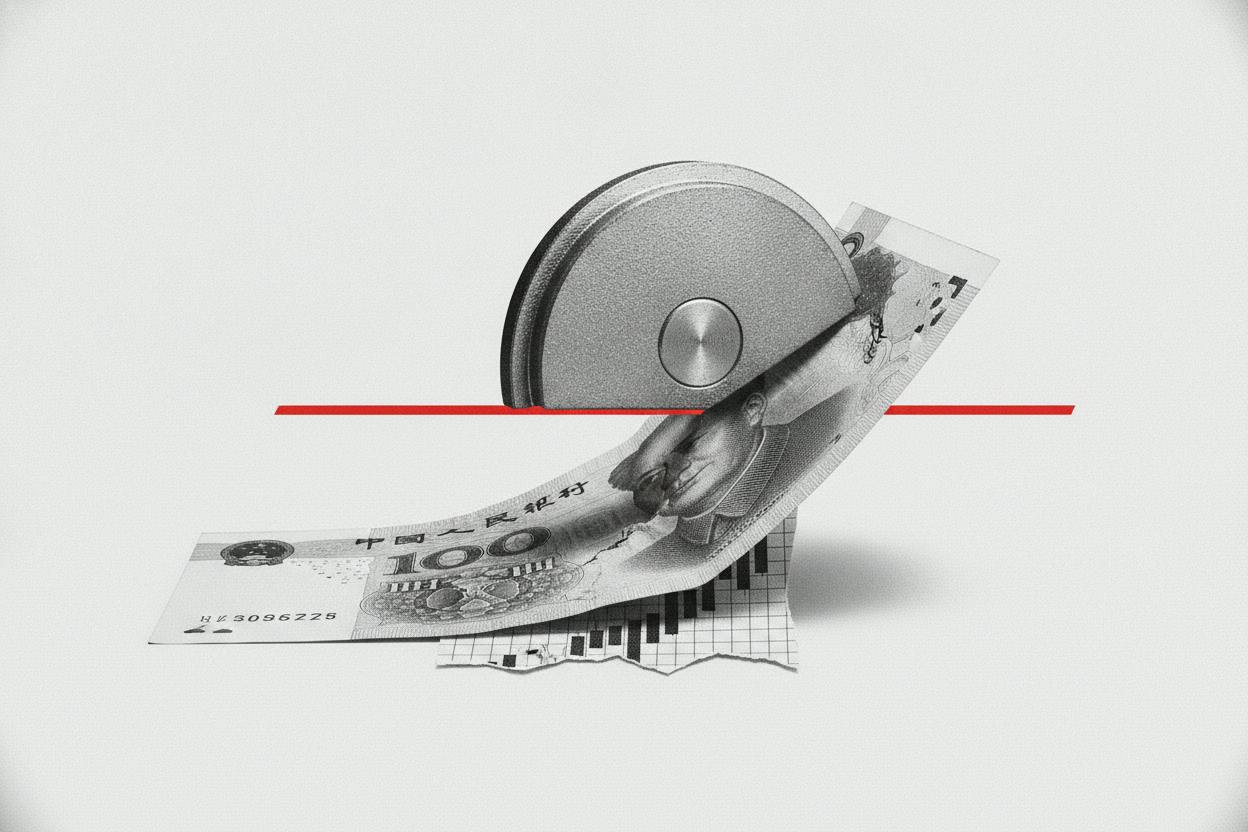
China's central bank has moved to cool the yuan's rapid appreciation, and the currency responded by slipping to its weakest level in more than two weeks against the U.S. dollar. The move is a reminder that Beijing still has tools to manage the pace of its currency's rise, even as broader trends favor a stronger yuan.
What happened
On Tuesday, the People's Bank of China (PBOC) raised the foreign exchange reserve requirement ratio to 6% from 4%. That means banks operating in China must now set aside a larger share of their foreign-currency deposits as reserves that cannot be freely used. In effect, this reduces the supply of dollars available in China's onshore market, making it more expensive for banks and companies to hold or trade dollars.
The following day, the PBOC set the daily midpoint for the yuan at 6.7180 per dollar, a level weaker than markets had expected. Because onshore trading of the yuan is allowed to move only 2% on either side of that official fixing, the midpoint acts as a near-term guide rail for daily currency moves.
The result: the yuan fell to a more than two-week low against the dollar, a clear signal that policymakers wanted to take some air out of the currency's rally.
Why the PBOC is stepping in
The yuan has been on a strong run this year, supported by China's economic recovery, solid export performance, and inflows of foreign capital. A stronger currency can help reduce the cost of imports and ease inflationary pressures, but it also makes Chinese exports more expensive abroad, which can hurt competitiveness.
By raising the reserve requirement on foreign currency, the PBOC is making it costlier for banks to hold dollars, which in turn can make it more expensive for investors to maintain positions that bet on further yuan appreciation—especially through derivatives like forwards and swaps, which lock in exchange rates for future dates.
This is a classic 'plumbing' move: it doesn't directly target the yuan's level, but it changes the mechanics of how dollars flow through the system. The goal is to slow the pace of appreciation, not necessarily to reverse the trend.
Indeed, the trade-weighted CFETS yuan index, which measures the currency against a basket of trading partners' currencies, stood at 103.75 according to Reuters calculations. That's down from a recent high but still up about 5.9% this year. So while the yuan has cooled against the dollar, its broader strength remains intact.
What it means for investors
For everyday investors, the immediate impact is likely to be felt in the cost of currency hedging. Companies that do business across borders, or investors with exposure to Chinese assets, may find it pricier to buy protection against currency swings. That can ripple into the pricing of forward contracts and swaps tied to the yuan, both onshore (USD/CNY) and offshore (USD/CNH).
But the bigger picture is about policy signaling. The PBOC is telling markets that it can and will lean on short-term liquidity tools and the daily fixing to smooth out one-way bets. This is a familiar pattern: Beijing often uses such measures to manage the pace of currency moves, especially when they become too rapid or one-sided.
For investors with exposure to Chinese equities or bonds, the move is a reminder that currency risk is part of the equation. A slower yuan appreciation could slightly reduce the dollar value of returns from Chinese assets, but it also reduces the risk of a sharp reversal that could hurt those who piled into yuan bets.
It's also worth noting that this is not an isolated event. China has been using a range of tools to support its markets and economy, from halting IPOs and insider sales to market rescue measures. The currency move is part of a broader toolkit aimed at maintaining stability.
What to watch next
Investors will be watching whether the PBOC takes further steps to cool the yuan, such as adjusting the daily fixing more aggressively or introducing other measures to reduce speculative flows. They'll also be monitoring the yuan's trade-weighted index, which gives a clearer picture of its competitiveness than the dollar pair alone.
For now, the message from Beijing is clear: the yuan's rise is welcome, but not at any speed. The central bank has shown it can tap the brakes when needed, and markets would be wise to expect more of the same if the currency's rally resumes.
For those with international investments, keeping an eye on China's currency policy is essential, as it can influence everything from export earnings to the value of overseas holdings. As always, diversification and a long-term perspective remain the best defenses against short-term currency swings.