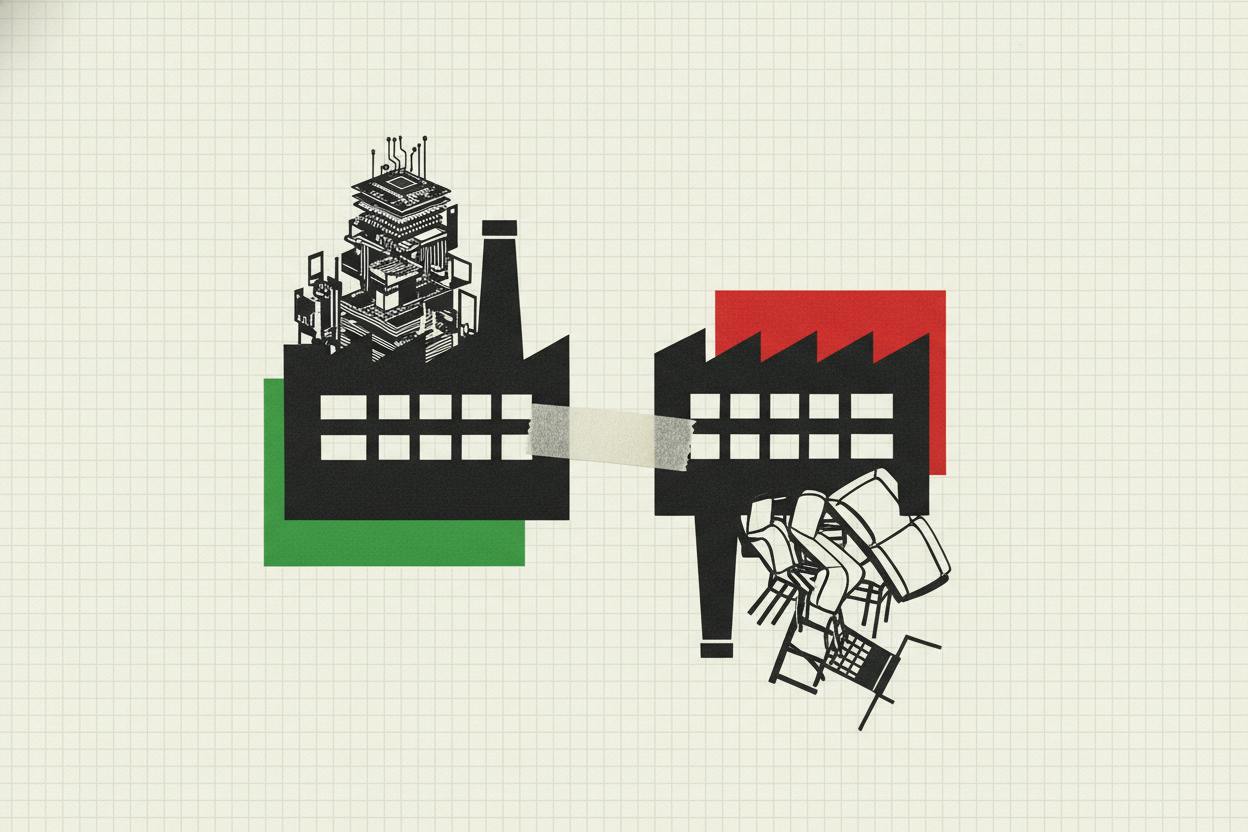
China's factory profits grew at a faster clip in October, but the headline number masks a widening gap between the country's export champions and the industries tied to its sluggish domestic economy.
Data from the National Bureau of Statistics, reported by Reuters, showed industrial profits rose 20.1% in October compared with the same month last year. That's a step up from September's 14.4% gain. Over the first ten months of the year, profits were still up overall, but the composition of that growth tells a more complicated story.
Export winners vs. domestic laggards
The standout performer was electronics. Profits in computer, telecommunications, and other electronic equipment manufacturing roughly doubled over the first ten months of the year. That surge reflects strong global demand for tech hardware and China's central role in the supply chain for everything from smartphones to data-center equipment.
On the other end of the spectrum, furniture-sector profits fell 52.4% over the same period. Furniture is closely tied to the housing market and consumer spending, both of which remain weak. The property slump that began a few years ago continues to weigh on demand for everything from sofas to kitchen cabinets, and households are still cautious about big-ticket purchases.
This split is not just about furniture. It points to a broader pattern: manufacturers that sell into overseas markets are doing far better than those that depend on Chinese consumers. While exports have been a bright spot for the world's second-largest economy, domestic demand has been slow to recover.
Policy support has limits
Beijing has been trying to support the economy by lowering borrowing costs and directing more credit toward technology and manufacturing. The idea is that cheaper loans will encourage investment and help businesses expand. But as Reuters noted, the results so far look mixed. Lower interest rates don't automatically create demand. If consumers aren't spending and property developers aren't building, cheaper money alone won't fill the gap.
The policy push has been more effective in sectors that are already benefiting from strong global demand, like electronics. Companies there have solid cash flow, which lowers their perceived risk and makes banks more willing to lend. That creates a virtuous cycle for the winners. Meanwhile, weaker sectors face a tougher time getting credit, even with lower rates, because their financial health is shakier.
This dynamic can widen the gap between industries. Banks and local governments tend to steer credit toward companies with stronger earnings, which reinforces the advantage of export-oriented manufacturers. Domestically exposed sectors can get stuck, because the real problem isn't the cost of borrowing—it's the lack of end-demand.
What it means for investors
For investors looking at Chinese equities or corporate bonds, the October profit rebound may be less encouraging than it appears. The headline number is strong, but it's driven by a narrow set of industries. A broad-based recovery would show up in more sectors, not just electronics.
That's an important distinction. If you're invested in a fund that tracks Chinese stocks broadly, the performance of electronics exporters can lift the average, even if many other companies are struggling. But the underlying reality is more uneven. The same logic applies to credit markets: a company's ability to service its debt depends on its own cash flow, not the aggregate profit figure.
The export outlook also carries its own risks. There's talk of higher tariffs and other trade restrictions from the US and the European Union, which could cloud the picture for China's manufacturers. If those measures materialize, even the winners could face headwinds. For context, recent trade tensions have already affected other commodities, as seen in iron ore prices sliding on cooling steel demand.
For now, the data suggests that China's factory sector is not uniformly healthy. The profit rebound is real, but it's concentrated. Investors should look beyond the headline and consider which parts of the economy are actually driving the numbers.
As always, it's wise to diversify and not bet everything on a single sector or region. The divergence between electronics and furniture is a reminder that even in a large economy like China's, the fortunes of different industries can diverge sharply.