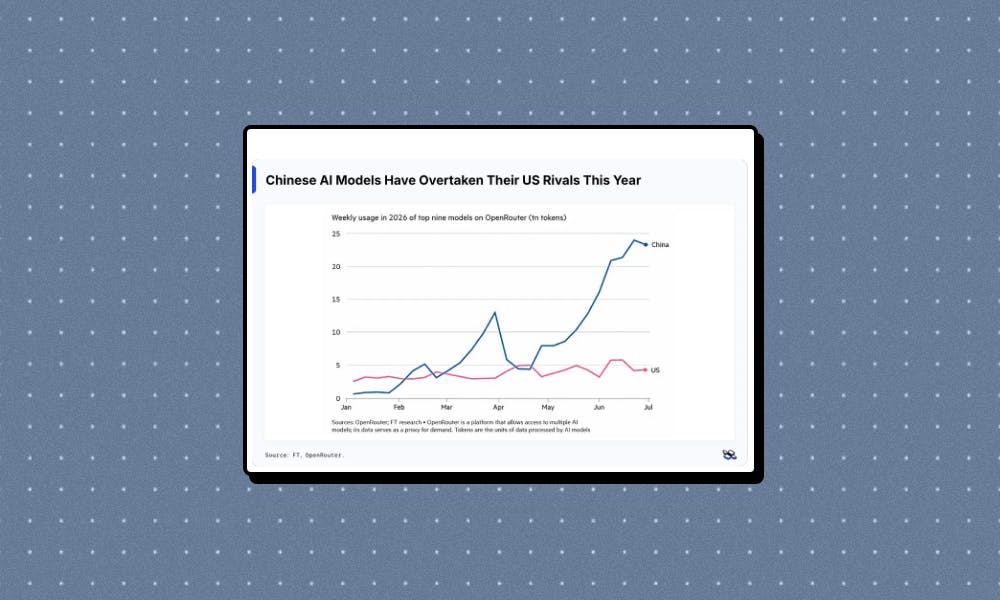
For years, the narrative around Chinese artificial intelligence was simple: Chinese models were catching up, but they were still a step behind Silicon Valley's best. That story is changing fast.
In 2025, a wave of Chinese AI startups—including DeepSeek, Zhipu (z.ai), MiniMax, and Moonshot—are releasing models that can go toe-to-toe with the top offerings from US giants like OpenAI, Google, and Anthropic. And it's not just because they're cheaper.
Andreessen's Blunt Assessment
Marc Andreessen, co-founder of venture capital powerhouse Andreessen Horowitz, made headlines last month when he declared that Zhipu's latest model, GLM-5.2, was "the first Chinese AI model to match and often beat the American big lab public AI models with no compromises."
That kind of praise from one of Silicon Valley's most influential investors carries weight. It signals that the competitive gap between US and Chinese AI has narrowed dramatically—and in some areas, may have closed entirely.
Zhipu Hits a Revenue Milestone
Zhipu has since become the first Chinese AI firm to surpass $1 billion in annual recurring revenue (ARR). ARR is a key metric for subscription-based businesses, measuring the revenue a company can expect to repeat each year from its customers. Hitting that milestone puts Zhipu in elite company, alongside major US AI players.
The achievement underscores a broader trend: Chinese AI companies are not just building impressive technology—they're also finding ways to monetize it at scale. That combination of technical capability and commercial traction is what makes them a genuine threat to US dominance.
More Than Just Cost Advantage
Earlier this year, much of the discussion around Chinese AI focused on cost. Models like DeepSeek's R1 were significantly cheaper to train and run than comparable US models, raising questions about whether American companies were overspending on compute.
But the latest wave of Chinese models goes beyond cost efficiency. They are competing on raw performance, benchmark scores, and real-world capabilities. This suggests that Chinese AI labs have made genuine breakthroughs in model architecture, training techniques, and data efficiency—not just found ways to cut corners.
As MiniMax recently demonstrated with its 2.7 trillion-parameter model, Chinese firms are now building some of the largest and most capable AI systems in the world.
What It Means for Investors
For everyday investors, the rise of competitive Chinese AI models has several implications.
First, it changes the competitive landscape for US AI leaders. Companies like OpenAI, Google, and Anthropic can no longer assume they have a technology moat. Chinese competitors are closing the gap, which could pressure margins and force faster innovation cycles.
Second, it creates new investment opportunities. Chinese AI startups are attracting significant capital. MiniMax recently raised HK$16 billion in a Hong Kong share and bond deal, while Chinese tech firms have raised $17.5 billion in Hong Kong listings and share sales this year. For investors with exposure to Chinese markets, these companies represent a new growth frontier.
Third, it could reshape the global AI supply chain. If Chinese models become the default choice for developers and enterprises outside the US, it could shift demand away from American cloud providers and chipmakers. That's a risk for companies like Nvidia, Microsoft, and Amazon that have bet heavily on AI infrastructure.
Geopolitical Context
The rise of Chinese AI also has a geopolitical dimension. The US has imposed export controls on advanced AI chips to slow China's progress, but Chinese companies have found workarounds—including building more efficient models that require less computing power.
Meanwhile, Beijing is actively promoting its AI sector. President Xi Jinping recently unveiled a Global AI Alliance, pushing open-source models as a counter to US dominance. This government support gives Chinese AI firms a strategic advantage, including access to capital, talent, and data.
At the same time, US companies face regulatory hurdles in China. Apple recently cleared a regulatory hurdle to bring its AI features to China by partnering with local firms Alibaba and Baidu—a sign that even US tech giants must adapt to the Chinese market.
What to Watch Next
Investors should keep an eye on several developments:
- Benchmark comparisons: Watch for independent evaluations of Chinese models against US counterparts. If Chinese models consistently match or beat US models on key benchmarks, the narrative will shift further.
- Revenue growth: Zhipu's $1 billion ARR milestone is impressive, but the key question is whether other Chinese AI firms can replicate that success. Revenue growth will be a critical indicator of commercial viability.
- Regulatory responses: Both the US and EU may respond to China's AI rise with new policies. The EU has already imposed anti-dumping duties on Chinese goods in other sectors, and AI could be next.
- IPO activity: If Chinese AI startups begin listing on US or Hong Kong exchanges, it could provide new investment opportunities for global investors.
The bottom line: Chinese AI is no longer a distant second. It's a direct competitor. For investors, that means rethinking assumptions about which companies will dominate the next wave of AI innovation.