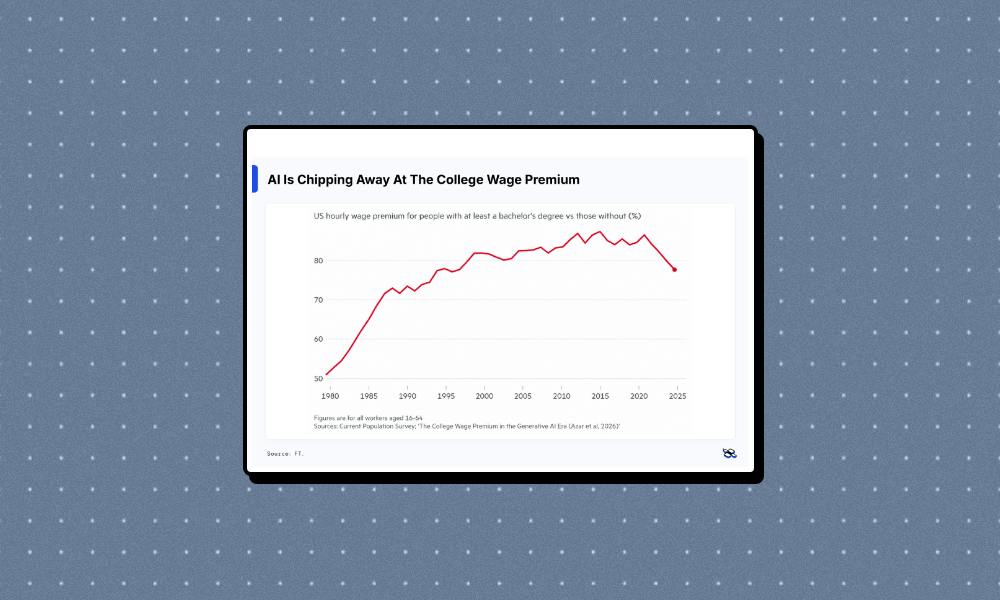
For decades, a university degree was one of the most reliable routes to higher earnings. Graduates could expect to earn substantially more than non-graduates, as technology created ever more complex, knowledge-heavy jobs. But that relationship is starting to crack, and artificial intelligence may be accelerating the shift.
New data show that in the United States, the college wage premium—the extra pay that graduates earn compared with non-graduates—has fallen for four straight years, dropping almost 10%. That marks the first sustained decline since the 1970s. Britain is seeing a similar trend, including among STEM graduates and workers in London’s knowledge economy.
What makes this decline particularly striking is that it is happening even as the supply of new graduates levels off. In economic terms, when the supply of a good stays flat but its price falls, it usually points to weaker demand. Here, that suggests employers are no longer willing to pay as much of a premium for a degree as they once were.
Why the premium is shrinking
The college wage premium has been a cornerstone of the modern labor market. As economies shifted from manufacturing to services, and as technology made jobs more complex, employers increasingly used degrees as a filter for talent. A bachelor’s degree became a ticket to higher-paying professional roles, while those without one were often locked out.
That filter is now being questioned. One major factor is the rise of artificial intelligence. AI tools can now perform many tasks that once required a college-educated mind—writing reports, analyzing data, even coding. As a result, employers may be reassessing which skills they are willing to pay up for. A degree may no longer signal the same level of unique capability it once did.
The trend is not limited to the US. In Britain, the wage premium is eroding even among STEM graduates—those in science, technology, engineering, and math—who have long been considered the most employable. Workers in London’s knowledge economy, the heart of the country’s professional services and tech sectors, are also seeing a squeeze. This suggests the shift is not just about oversupply in one field, but a broader change in how employers value formal education.
What it means for investors
For everyday investors, this trend has several implications. First, it affects companies that rely heavily on college-educated talent. If the premium for degrees falls, firms may find it cheaper to hire, which could boost profit margins. But it also means that companies investing heavily in AI tools—like those in the tech sector—may see a clearer payoff as they replace or augment human labor. For example, Microsoft's AI spending shows a clearer payoff as its Azure cloud business grows, and similar dynamics could play out across the economy.
Second, the trend could reshape consumer spending. If younger workers earn less than previous generations relative to their education, they may have less disposable income. That could affect sectors from housing to retail. Changing consumer cravings are already reshaping markets, and a shift in earning power could accelerate that.
Third, the decline in the wage premium may have implications for student debt. If a degree no longer guarantees a large earnings boost, the financial calculus of taking on significant debt to pay for college becomes less favorable. This could affect lenders and institutions that depend on student loan payments, though the impact may take years to materialize.
What to watch next
Investors should keep an eye on how employers adjust their hiring criteria. If companies increasingly drop degree requirements in favor of specific skills, that could signal a lasting change. Also watch for how AI adoption affects wage growth in different sectors. AI heavyweights are facing rising debt insurance costs as investors question the payoff from massive spending, but the labor market effects may be more immediate.
For now, the data point to a clear trend: the golden age of the college degree may be fading. That doesn’t mean education is worthless, but it does mean the financial return is no longer as automatic as it once was. For investors, understanding this shift is key to spotting which companies and sectors are best positioned for a changing labor market.