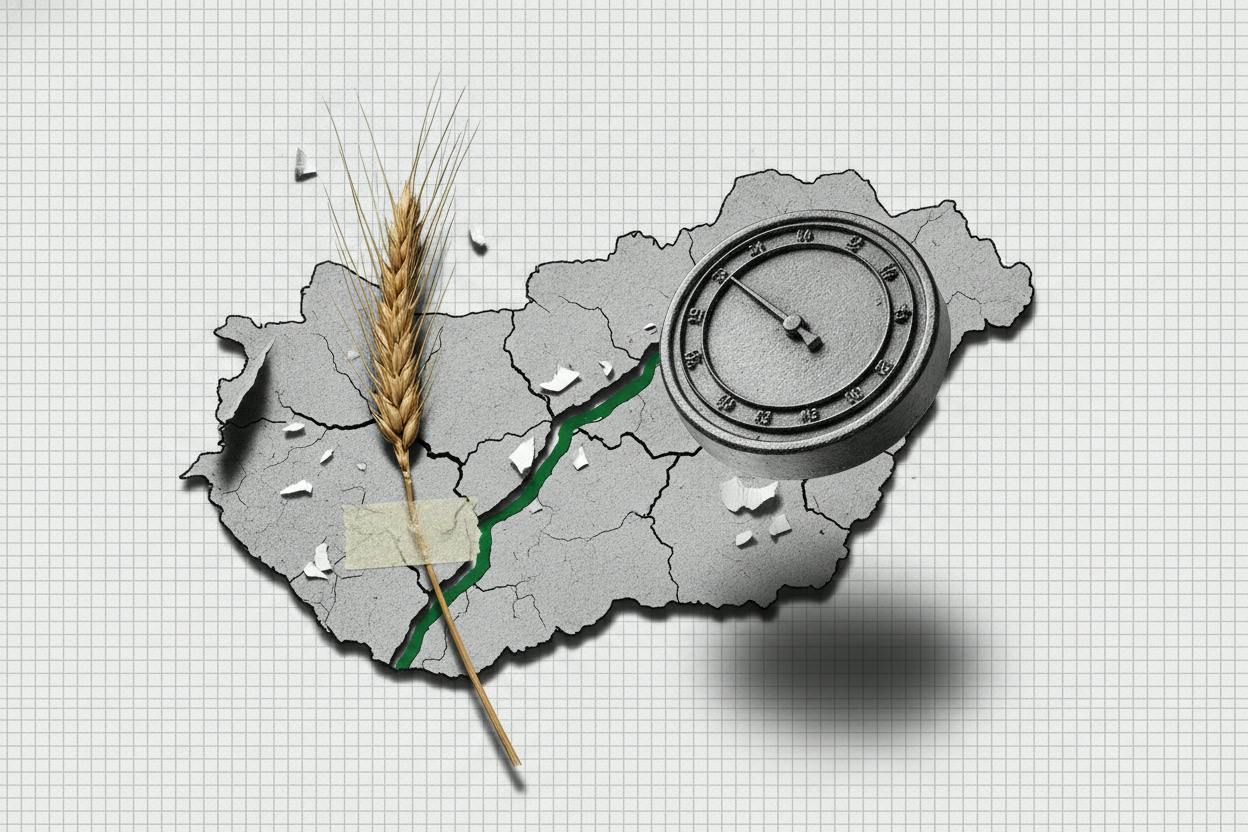
Central Europe's economic picture is looking uneven as new data shows Hungary's growth slowed in the third quarter, dragged down by a severe summer drought, while the Czech Republic's expansion came in a touch softer than expected. The figures offer a mixed signal for investors watching the region's recovery from last year's energy shock.
Hungary: drought bites into farming
Hungary's statistics office reported that the economy grew 1.5% year-on-year in the third quarter, but barely moved from the previous quarter. The main culprit: agriculture, which "significantly" dragged on output as a heat-driven drought pushed river levels to record lows. That disrupted everything from cargo shipping to operations at the Paks nuclear plant, which relies on river water for cooling. Weaker crop yields also weighed on activity.
The drought is a reminder of how vulnerable economies can be to extreme weather. For Hungary, farming is a meaningful slice of output, so a bad harvest can ripple through the whole economy. Analysts at ING and Erste Bank think growth could pick up late in the year if investment and consumption improve and industrial momentum holds. But they flagged global risks and high energy prices as potential brakes.
For investors, the key question is whether the slowdown is temporary. If the drought was a one-off shock, then a rebound in agriculture could give a boost to GDP in the coming quarters. But if high energy costs and weak external demand persist, the recovery could stay sluggish.
Czech Republic: growth misses, but rate hike still on the table
Next door, the Czech economy expanded 0.5% quarter-on-quarter in the third quarter, slightly below the 0.6% expected in a Reuters poll. That softer print would normally ease pressure on the central bank to keep raising rates. But some economists still see the Czech National Bank lifting its policy rate by 0.25 percentage points to 4.00% at its meeting next Thursday, arguing that energy costs and external risks keep inflation concerns alive.
This is a delicate balancing act. The Czech economy is cooling, but inflation is still a worry. If the central bank hikes again, it would be a signal that it prioritises fighting price pressures over supporting growth. That could have real consequences for borrowers and savers.
What it means for investors
For markets, the possibility of a 4.00% Czech policy rate matters because short-term interest rates tend to follow the central bank's lead. If the bank keeps pushing rates higher, yields on shorter-dated government bonds usually rise, and banks typically pass those higher funding costs on through pricier loans. That can support the koruna in the near term, since higher rates make Czech assets relatively more attractive than lower-yielding alternatives.
The trade-off is tighter financial conditions at home. Households and companies that need new credit or refinancing can feel the pinch even if the economy is already cooling. For everyday investors, that means borrowing costs could stay elevated, affecting everything from mortgages to business loans.
In Hungary, the growth slowdown is a reminder that economic data can be volatile, and that weather can be a wildcard. For investors with exposure to Hungarian assets, the key is to watch whether the drought's impact fades and whether the economy can regain momentum.
Both countries are also part of the broader European picture, where growth has been sluggish and inflation has been sticky. As France's borrowing costs climb amid similar pressures, the region's central banks are walking a tightrope between supporting growth and containing inflation.
For now, the Czech National Bank's decision next week will be the main event for the region. If it hikes, expect the koruna to firm and short-term yields to rise. If it holds, markets may see that as a sign that the tightening cycle is over, which could ease pressure on borrowers.
In Hungary, the focus will be on whether the economy can bounce back in the fourth quarter. Analysts are cautiously optimistic, but the risks are real. High energy prices and global uncertainty could keep a lid on growth, even if the drought fades.
For everyday investors, the takeaway is that central Europe is not a monolith. Hungary and the Czech Republic are facing different challenges, and their currencies and bond markets may move in different directions. Keeping an eye on the data and central bank signals is key.