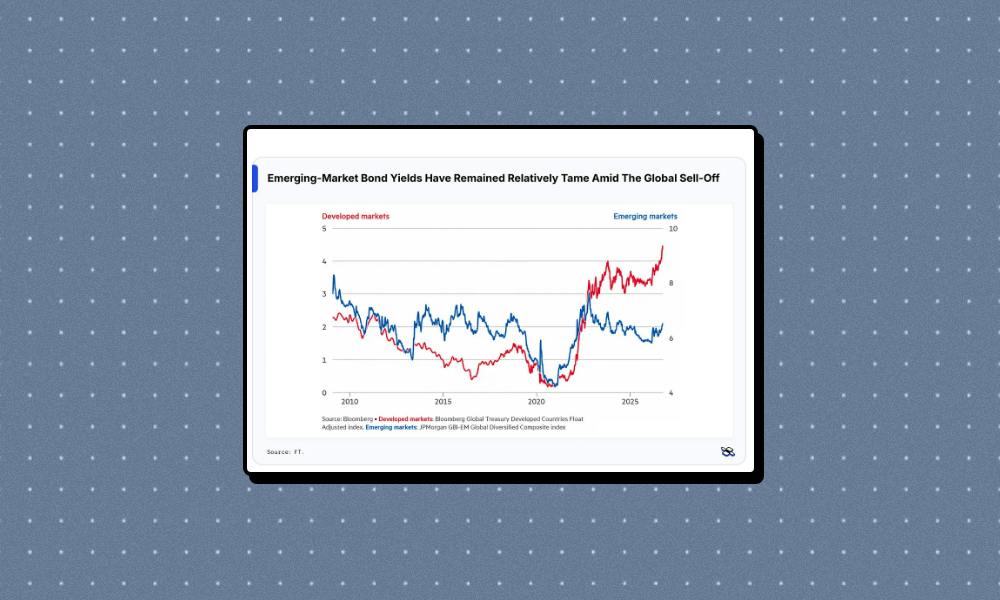
When US Treasury yields spike, emerging market bonds usually feel the pain. But not this time. Over the past month, the yield on the 10-year Treasury has climbed from 4.8% to 5.3% — a sharp move that typically sends investors fleeing riskier assets. Yet government bonds in countries like South Africa and Chile have risen far less, and Brazil's yields have actually fallen.
That resilience is unusual. Historically, a surge in US yields would trigger a selloff in emerging markets, as investors demand higher returns to compensate for risk. But this time, many developing economies are in a much stronger position than they used to be.
Years of discipline pay off
The current calm didn't happen overnight. Over the past several years, many emerging economies have tightened fiscal policy, strengthened their central banks, and tackled post-pandemic inflation earlier and more aggressively than their developed-market peers. These moves have built credibility and reduced vulnerability to external shocks.
For example, Brazil's central bank began raising interest rates well before the Federal Reserve, and many emerging governments have cut budget deficits and reduced dollar-denominated debt. That has made their bonds less sensitive to US rate moves.
The payoff is showing up in performance. JPMorgan's index of emerging-market local-currency bonds gained 18% last year and is roughly flat so far in 2026, despite the recent turbulence in global bond markets.
What this means for investors
For everyday investors, this divergence is a reminder that emerging market bonds are not a monolith. They can offer diversification benefits, especially when developed-market bonds are under pressure. But they also come with risks, including currency swings and political instability.
Investors should note that while emerging market bonds have held up well recently, that doesn't guarantee future performance. The global economy remains uncertain, and a further spike in US yields could still test their resilience.
Still, the fact that these markets are holding their own is a sign of how much they have matured. As Treasury yields climb even on weak jobs data, the contrast with emerging markets is striking.
Broader market context
The recent move in US yields has been driven by a combination of factors, including concerns about inflation and fiscal deficits. That has put pressure on global markets, as seen in New Zealand stocks falling and other developed markets struggling.
Meanwhile, some emerging markets are benefiting from a softer dollar, which eases pressure on their currencies and makes their debt more manageable. As African markets rally on a softer dollar, the divergence between developed and emerging markets becomes even more pronounced.
For investors, this is a good time to review their fixed-income allocations. Emerging market bonds may offer attractive yields, but they are not without risk. It's important to understand the specific country and currency exposure before diving in.
Looking ahead
The key question is whether this resilience can last. If US yields continue to climb, emerging markets could eventually feel the heat. But for now, the structural improvements of the past few years are providing a buffer that didn't exist in previous cycles.
As always, diversification and a long-term perspective are crucial. Emerging market bonds can be a valuable part of a portfolio, but they should be chosen carefully and monitored closely.