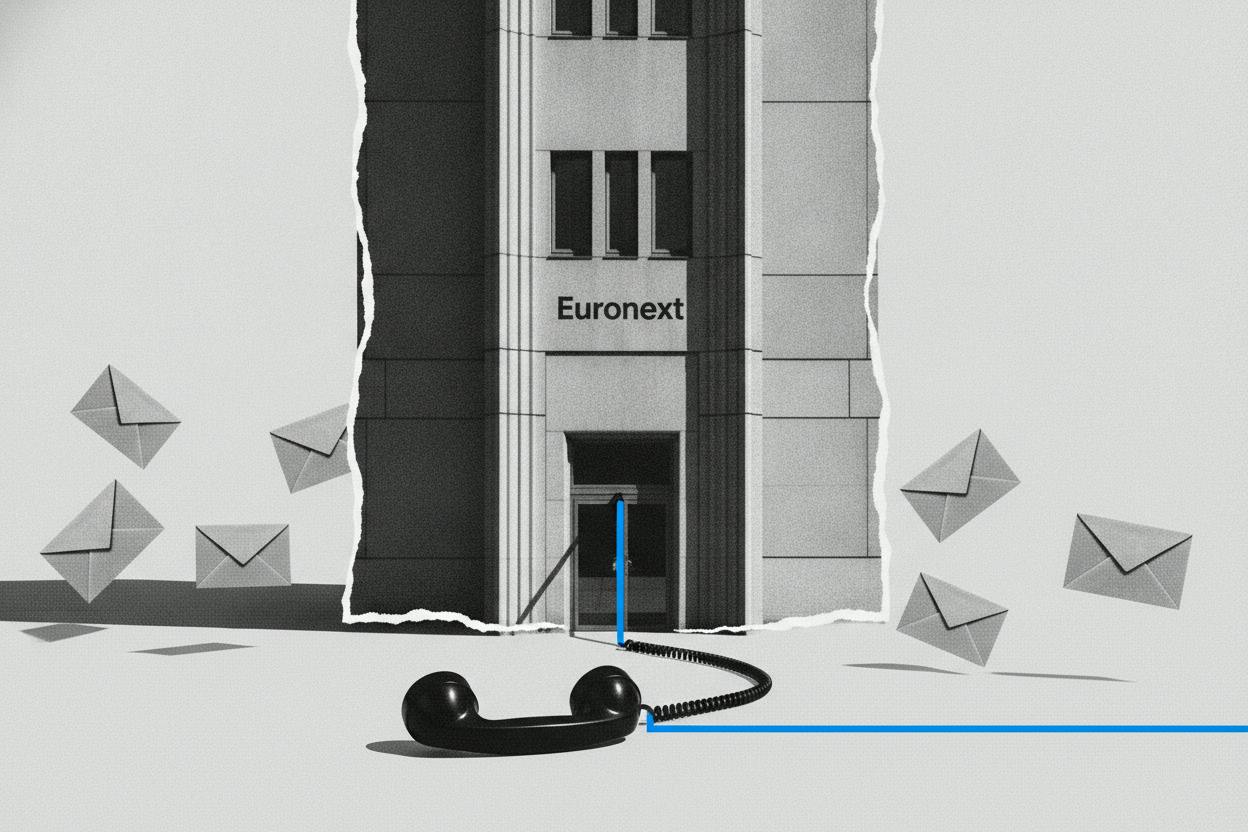
Euronext, the exchange operator behind markets in Paris, Amsterdam, Brussels, Milan and elsewhere, told listed companies on Friday morning to pick up the phone for urgent filings after a Microsoft Outlook disruption left its Corporate Actions and Listing teams unable to receive emails.
The company said the issue was part of broader Microsoft disruptions that also affected Teams and Copilot. With inboxes effectively closed, Euronext asked issuers and their agents to call the relevant exchange team for time-sensitive requests like trading suspensions, corporate-action processing, and other regulated notifications. It also pointed MyEuronext users toward mobile calls and two-factor authentication, and said it had enough staff to handle the extra manual workload.
Why email matters for market infrastructure
Corporate actions are the market's admin events – dividends, rights issues, tender offers – and they often come with tight deadlines and precise instructions. When an exchange can't receive emails, moving those steps to phone calls means more verification, more back-and-forth, and more chances for delays or miscommunication.
That tends to matter most for stocks with an imminent halt decision, deadline, or election window, where brokers and traders may hesitate until they're confident the paperwork is confirmed. The result is usually temporary: thinner liquidity and wider bid-ask spreads in the affected names until normal communications are restored.
This is not the first time a Microsoft outage has rippled through financial markets. In recent months, Microsoft 365 outages have disrupted Outlook, Teams, and AI tools, affecting businesses across sectors. For exchanges, the reliance on everyday tools like email is a reminder that even the most sophisticated market infrastructure depends on basic communication channels.
What it means for investors
For everyday investors, the practical impact of this outage is likely to be limited and short-lived. If you hold shares in a company listed on a Euronext exchange, you may not notice anything directly. However, if you were expecting a dividend payment or a corporate action notification, there could be a slight delay in processing.
More broadly, this episode underscores how market infrastructure can be vulnerable to disruptions in third-party services. While exchanges have contingency plans, the fallback to manual processes can introduce friction. Investors should be aware that on days when such outages occur, trading in affected stocks might see wider spreads or slower execution.
Euronext's response – asking for phone calls and confirming adequate staffing – is designed to minimize disruption. The exchange operator said it had enough staff to handle the extra manual workload, which should help keep the market functioning smoothly.
Broader context
This is not an isolated incident. Technology outages have become a recurring theme in financial markets, from cloud service disruptions to software glitches. For exchanges, the challenge is to maintain operational resilience while relying on external providers like Microsoft.
Investors who follow Microsoft's cloud deals or its AI partnerships may see this as a reminder that even the largest tech companies can face hiccups. But for the average investor, the key takeaway is that market infrastructure is built on layers of technology, and when one layer fails, the system adapts – often with a bit of extra time and effort.
As Euronext works through the disruption, investors should keep an eye on any announcements from the exchange or the affected companies. If you have questions about a specific corporate action, it may be worth checking the company's investor relations page or contacting your broker for the latest updates.



