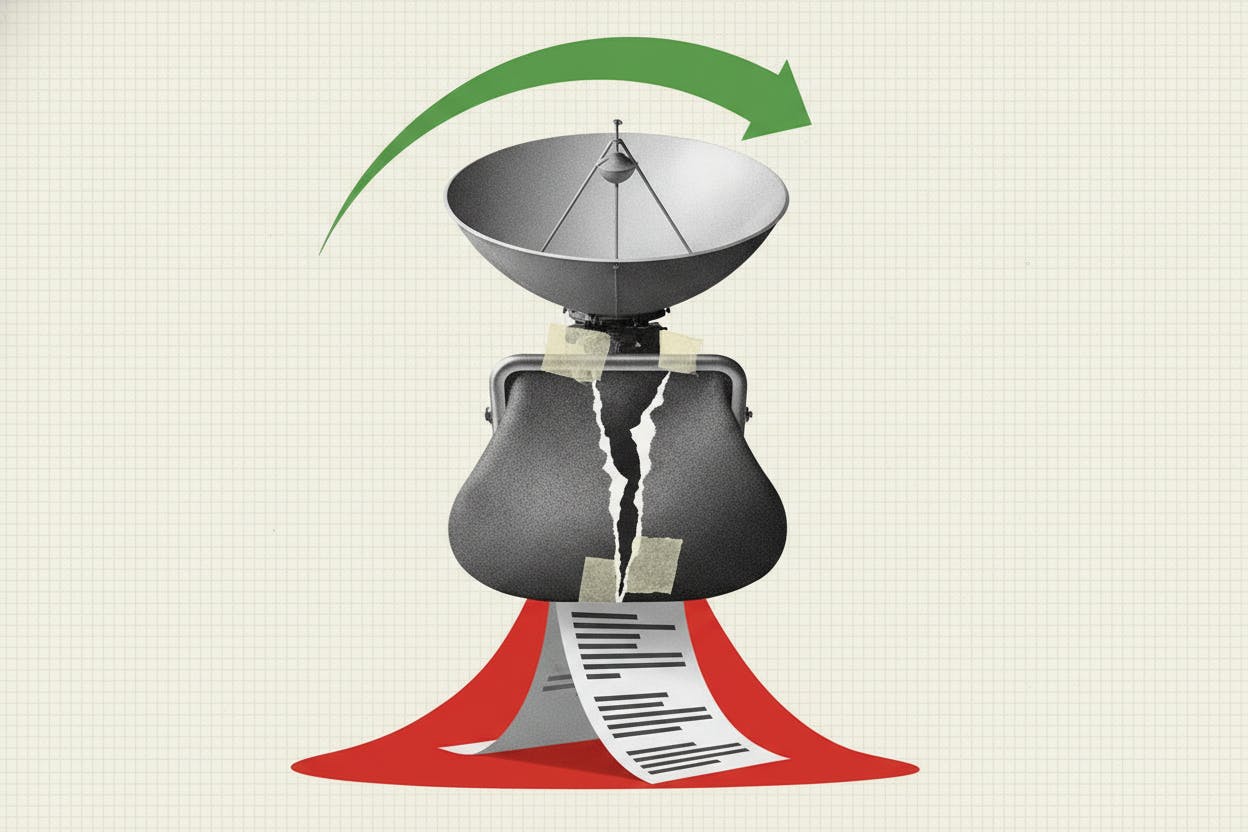
French satellite operator Eutelsat delivered better-than-expected revenue for its full fiscal year, but the company remains firmly in the red as it pours money into building out its next-generation low Earth orbit (LEO) constellation.
The company said full-year revenue came in above the €1.2 billion that analysts had been looking for. However, both operating income and group net result were negative, underscoring the heavy costs of transitioning from a traditional geostationary satellite business to a newer, faster LEO network.
What is Eutelsat and why does LEO matter?
Eutelsat is one of the world's largest satellite operators, providing connectivity for broadcasters, telecom companies, governments, and enterprises. Historically, its satellites have sat in geostationary orbit, about 36,000 kilometers above the equator, where they stay fixed over one spot on Earth. That setup is great for broadcasting TV signals but less ideal for low-latency internet, because the signal has to travel a long way up and back down.
LEO satellites, by contrast, orbit much closer to the planet—typically a few hundred kilometers up. That dramatically cuts the time it takes for data to travel, making LEO ideal for high-speed broadband, especially in rural or remote areas where fiber is impractical. The most famous LEO network is Starlink, operated by Elon Musk's SpaceX, but Eutelsat is among the companies racing to build its own constellation.
Eutelsat's push into LEO is a strategic bet that the future of satellite communications lies in low-latency, high-capacity networks. But building and launching hundreds of satellites is enormously expensive, which is why the company is still losing money even as revenue grows.
The numbers behind the story
The brief notes that full-year revenue exceeded €1.2 billion, which was the consensus estimate. That is a positive sign, suggesting demand for Eutelsat's services remains healthy. But the bottom line tells a different story: operating income was negative, and so was the group net result. In plain terms, the company is spending more than it earns, and that gap is being driven by the heavy investment in LEO.
Investors often focus on revenue growth and profitability, but for a company in the middle of a capital-intensive transformation, losses can be expected. The key question is whether the investment will pay off in the form of future revenue and profits.
Eutelsat itself is pointing to that future. The company said it expects more than 30% growth in its LEO business in fiscal year 2026-27. That is a strong projection, but it is still a couple of years away, and investors will be watching to see if the company can execute on that plan.
What it means for investors
For everyday investors, Eutelsat's results are a reminder that revenue growth and profitability don't always move in lockstep. A company can beat sales forecasts and still lose money, especially when it is investing heavily in future growth. That is not necessarily a red flag—many successful companies, from Amazon to Netflix, went through long periods of losses before turning profitable.
But it does mean investors need to look beyond the headline revenue number. The more important metric is whether the company's investments are generating the returns it expects. In Eutelsat's case, the LEO business is still in its early stages, and the 30% growth forecast for 2026-27 is a key target to watch.
Eutelsat is not alone in facing this kind of transition. Other companies in the satellite and telecom space are also spending heavily on new technologies, and the results can be volatile. For investors, the takeaway is to understand the business model and the timeline for profitability before jumping in.
In the broader market context, Eutelsat's results come as investors are paying close attention to companies that are investing for growth, especially in technology and communications. The Airbnb earnings beat and Gen Digital's raised outlook are examples of companies that managed to grow profits while also investing. Eutelsat, by contrast, is still in the investment phase.
For those watching the satellite sector, the next few quarters will be crucial. Eutelsat needs to show that its LEO expansion is on track and that the losses are narrowing as revenue grows. If the company can deliver on its 30% growth target, the current losses could be seen as a necessary step toward a more profitable future. If not, investors may start to question the strategy.
As always, it's important to remember that past performance is not a guarantee of future results, and investing in a company that is losing money carries additional risk. But for those willing to take a longer-term view, Eutelsat's story is one of transformation and potential.