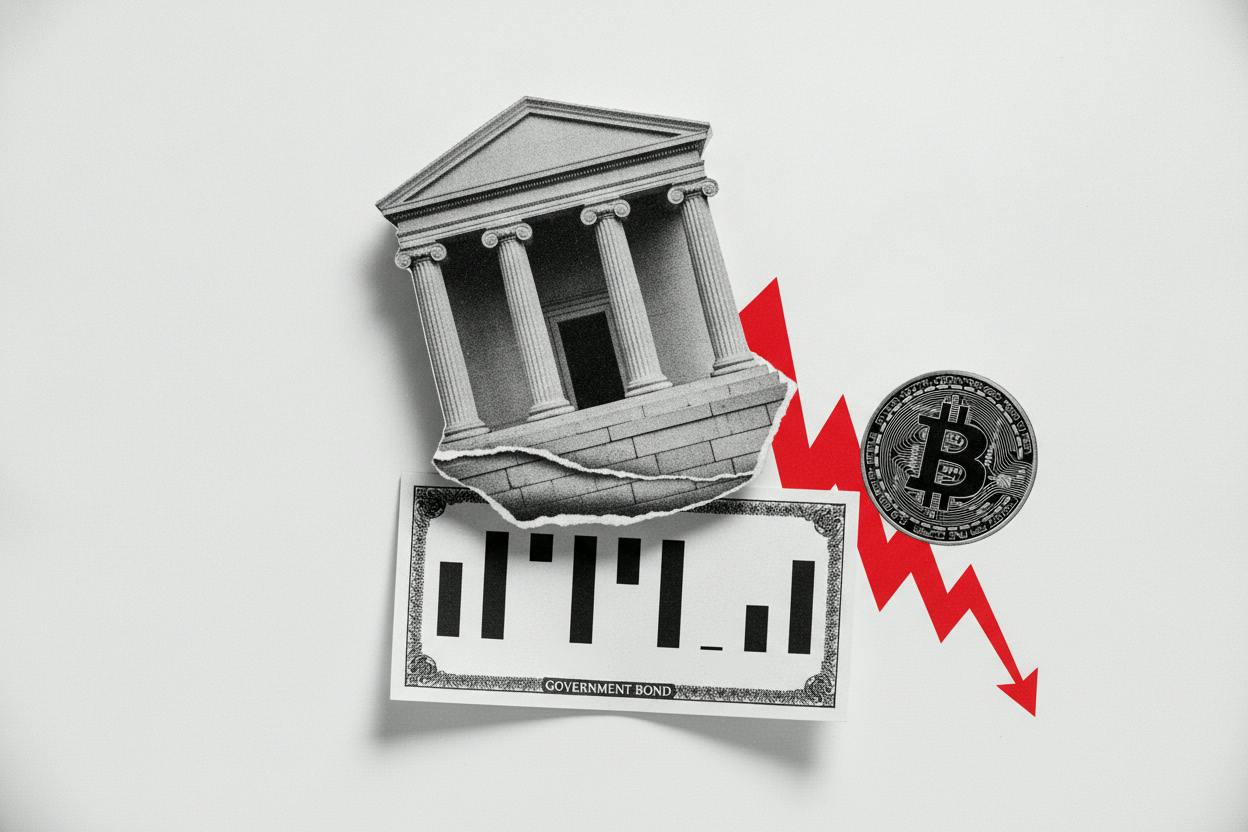
US financial stocks ended the week on a soft note Friday, weighed down by a dip in long-term Treasury yields and a sharp pullback in bitcoin. By late afternoon, the NYSE Financial Index was down 1.3%, and the Financial Select Sector SPDR Fund (XLF), the largest exchange-traded fund tracking the sector, had slipped 0.7%.
The moves came as the 10-year Treasury yield fell 0.06 percentage points to 4.929%, and bitcoin dropped 4.9% to $76,790. Even so, two names bucked the trend: Global Payments jumped more than 13% on deal chatter, and exchange operator Cboe gained nearly 7%.
Why lower yields weigh on banks and insurers
Banks and insurers earn much of their profit from the spread between what they collect on loans and investments and what they pay out to depositors and policyholders. When long-term rates fall, that gap can narrow, and the cash firms reinvest tends to earn less. The 10-year Treasury yield is a key benchmark for mortgages, corporate bonds and many other long-term loans, so its direction matters for the entire financial sector.
Friday's decline in the 10-year yield was modest, but it added to a recent run of softer rate moves. Investors have been parsing mixed economic data and shifting expectations for Federal Reserve policy, which has kept long-term yields volatile. For financial stocks, the path of rates is often as important as the headline earnings numbers.
The pullback in bitcoin added another layer of pressure. Crypto prices have become increasingly correlated with risk assets, and several financial firms now have exposure to digital assets through trading desks, custody services or crypto-related products. A 4.9% drop in bitcoin can ripple through those businesses and dent sentiment toward the broader financial sector.
Global Payments and Cboe stand out
Not every financial stock moved lower. Global Payments drew buyout interest, sending its shares up more than 13%. The payments processor has been a subject of speculation as the industry consolidates, and any potential deal would likely be scrutinized by investors for its valuation and strategic fit.
Cboe Global Markets, which runs options and futures exchanges, rose nearly 7%. Exchange operators can benefit from volatility because higher trading volumes tend to boost transaction fees. Cboe's gain suggests some investors were positioning for continued market swings, even as the broader financial sector weakened.
The divergence highlights an important theme: within financials, not all businesses respond to rates and crypto in the same way. Banks and insurers are more rate-sensitive, while exchanges and payment processors are driven by trading activity, deal flow and consumer spending.
What it means for investors
For everyday investors, Friday's action is a reminder that financial stocks are not a single, uniform bet. A broad fund like XLF holds banks, insurers, asset managers and exchanges, so its performance reflects a blend of rate expectations, deal news and market volatility. That diversification can smooth out some of the swings, but it also means the fund may lag when a specific subsector rallies.
Rates remain the biggest swing factor. If long-term yields keep drifting lower, bank and insurer margins could face continued pressure. If yields stabilize or rise, those same firms may see a relief rally. Investors will also watch whether the deal chatter around Global Payments develops into a formal offer, and whether crypto weakness persists or proves temporary.
It is also worth keeping an eye on the broader market backdrop. Recent sessions have seen weak tech forecasts drag US stocks lower, and AI spending fears have driven Treasury yields to their biggest monthly drop since 2023. Those crosscurrents can amplify moves in rate-sensitive sectors like financials.
For now, the sector's pullback looks modest rather than alarming. But with rates and crypto both in flux, financial stocks may stay choppy as investors weigh the outlook for profits, dealmaking and the economy.