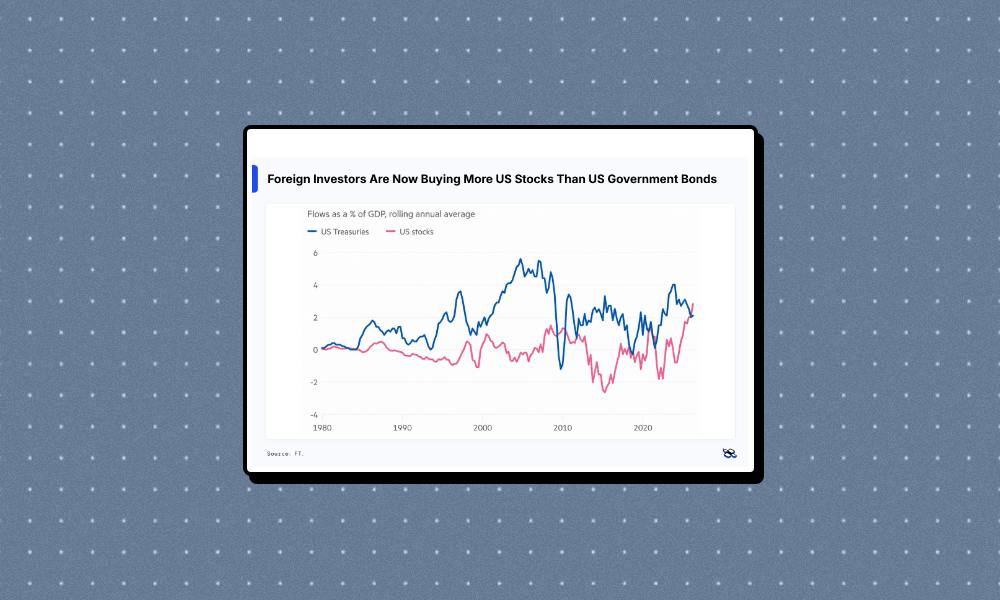
Foreign investors are increasingly choosing American stocks over US government bonds, a shift that could have lasting implications for the dollar and global markets. In the year through June, international flows into US equities averaged 2.8% of GDP, outpacing the 2% that went into Treasuries. Outside brief episodes around the financial crisis and the pandemic, that marks the first time this century that stocks have taken the lead.
Why the sudden love for US stocks?
The appeal is straightforward. The S&P 500 is on track for a fourth consecutive year of double-digit gains, fueled by heavy investment in artificial intelligence and robust corporate profits. For foreign investors, that kind of performance is hard to ignore, especially when compared with the modest yields on long-term government bonds.
At the same time, the case for Treasuries has grown less compelling. The US government's debt has ballooned to roughly $40 trillion, persistent deficits show no sign of shrinking, and inflation worries remain. Add in questions about the Federal Reserve's independence, and the once-unquestioned safety of "risk-free" bonds starts to look a little less bulletproof. Long-term Treasury yields have jumped as investors demand more compensation for holding them.
This isn't just a niche portfolio shift. It reflects a broader reassessment of what US assets offer. Stocks are seen as a bet on growth and innovation, while bonds are increasingly viewed as a source of income that carries its own set of risks, including the possibility that inflation erodes returns.
What this means for the dollar
For decades, foreign demand for Treasuries was a key pillar supporting the dollar. When global investors bought US debt, they needed dollars, which helped keep the currency strong. Now, with equity flows taking the lead, the dollar's fate may hinge more on stock market performance than on bond yields.
That could make the dollar more volatile. Stock markets are driven by sentiment, earnings, and risk appetite—factors that can shift quickly. If foreign investors start pulling back from US equities, the dollar could weaken just as fast as it strengthened during the buying spree. Conversely, as long as the AI boom and profit growth continue, the dollar might find support from equity inflows, even if bond demand cools.
This dynamic is already visible in currency markets. The dollar has been sensitive to shifts in risk appetite, and any sign of trouble in tech stocks or corporate earnings could ripple through the currency. For everyday investors, that means the dollar's strength is no longer a given—it's now tied to the fortunes of the stock market.
What investors should watch
For those with money in US stocks or bonds, this trend offers both opportunities and cautions. On the one hand, strong foreign demand for US equities can push prices higher, benefiting domestic shareholders. On the other hand, if foreign investors ever lose their appetite for US stocks, the selling pressure could be intense.
It's also worth keeping an eye on Treasury yields. If foreign demand for bonds continues to wane, the US government may have to offer higher yields to attract buyers, which could raise borrowing costs across the economy. That would affect mortgages, credit cards, and corporate loans, potentially slowing growth.
The shift also highlights a broader point: the US is no longer the only game in town, but it remains the most attractive for many investors. The AI-driven rally has made US equities a magnet for global capital, and as long as that continues, the dollar may find support from an unexpected source.
For context, similar dynamics have played out in other markets. For instance, European banks shifting risk shows how investors are increasingly willing to take on different types of exposure. And energy stocks riding the AI wave illustrate how technology is reshaping traditional sectors.
Ultimately, the shift from bonds to stocks is a bet on growth over safety. It's a bet that has paid off handsomely in recent years, but it carries risks. If the AI boom falters or inflation reignites, foreign investors could quickly retreat, and the dollar would feel the impact.
For now, the message is clear: the dollar's fate is increasingly tied to the stock market, not just the bond market. Investors should watch both, and understand that the old rules may no longer apply.